Leuthold
William Tell (P. G. Wodehouse Edition)Leuthold is a bodyguard whose duty to enforce a public gesture of submission makes him a conspicuous target of ridicule. Posted with Friesshardt at the cap on the pole, he helps defend the order when the crowd turns from mockery to violence; yet his vigilance also exposes the weakness of a command that can be evaded, laughed at, and finally challenged in front of its guards.
Identity and Assignment
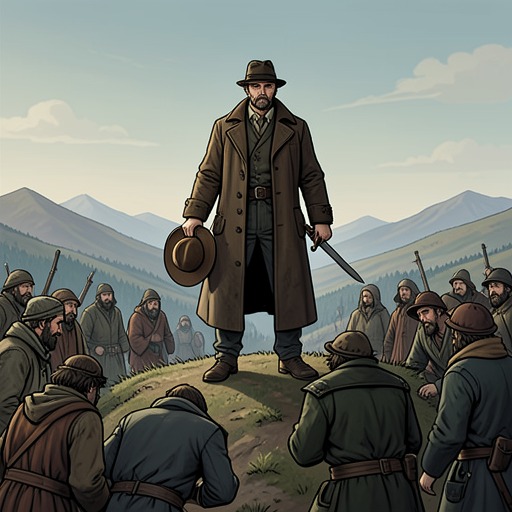
Hermann Gessler assigns Leuthold and Friesshardt to stand watch at the pole in the Meadow Outside the City Gates for the whole day. Their instruction is to ensure that nobody passes without kneeling before the pole and removing a hat. The order makes the soldiers guardians not of a person or a strategic position but of a visible emblem of enforced deference.
The Swiss people avoid the meadow rather than perform the required gesture. Taking the long way round, they leave the two guards with a lonely post and no passersby to compel. When people emerge from the council-house at noon, they do cross the meadow, but the priest stands before the pole and the sacristan rings the bell; the group kneels to pray, not to honor the cap. Leuthold and Friesshardt thus watch the expected act take place in a form that defeats its intended meaning.
Leuthold suspects that the people are laughing at the guards. A voice from behind a rock asks where the hat came from, reviving a joke that had already mocked the soldiers by asking who made it. The crowd turns the question into a recurring catchphrase, shouting it at the pair. Leuthold describes their position as that of rogues in a pillory and objects that a sword-bearing soldier has been reduced to keeping watch over an empty hat. His complaint identifies the central indignity of the assignment: the guards are made to embody an authority that the people can expose as foolish simply by refusing to respect its emblem.
From Mockery to Combat
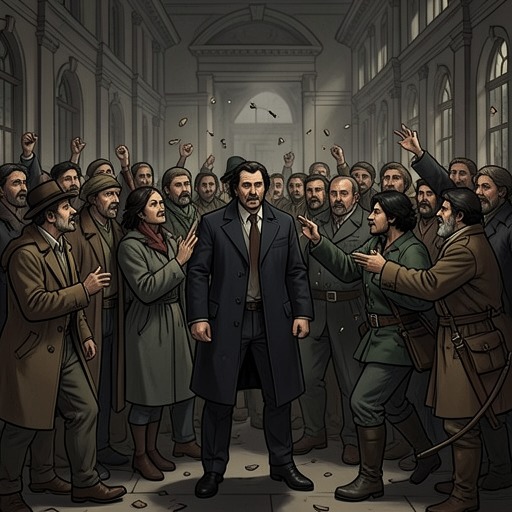
The taunts at the pole give way to a physical assault. An egg bursts over Leuthold’s shoulder, and the crowd, delighted by the escalation, soon fills the air with eggs, cabbages, cats, and other missiles. The two guards rave and shout but remain at their post. When the barrage suddenly stops, the crowd turns, jumps, and waves its hats; a deafening cheer follows. The rapid shift from derision to collective excitement leaves Leuthold and Friesshardt still exposed at the center of the gathering.
The fight begins after Friesshardt strikes William Tell, bringing the crowd to Tell’s assistance. People who had been reluctant to attack the soldiers without a leader rush across the meadow with sticks and cudgels. Leuthold and Friesshardt are taken by surprise, but they strike back. Their armor gives them an advantage against the unprotected crowd: the soldiers are difficult to hurt, while the townspeople discover how readily they themselves can be injured. Conrad Hunn, for example, is driven off when Friesshardt drops his pike on his toe. In the wider melee, Leuthold knocks Klaus von der Flue head over heels, while Friesshardt fells Seppi the cowboy. For a time, the guards have the better of the fight.
Leuthold’s alertness also protects his companion from a planned blow. Arnold of Sewa, advising the crowd that guile rather than brute force is needed against an armored opponent, creeps behind Friesshardt with his cudgel raised. Leuthold catches sight of him and drives his pike into Arnold’s side. Arnold is winded, rolls over, and, after being trampled in the confusion, limps home; he stays in bed for two days. The episode shows Leuthold responding quickly and forcefully amid the disorder, even as the narrative’s comic account makes the advice about cunning collapse into an unsuccessful ambush.
William Tell eventually ends the disturbance by aiming his crossbow at the cap. Friesshardt sees what he intends and rushes to stop him, but a blow from a spade knocks Friesshardt’s helmet over his eyes, leaving him unable to intervene before the arrow passes through the cap and pole. The narrative does not assign Leuthold a separate attempt to prevent the shot; it places him within the soldiers’ overwhelmed defense as the crowd’s violence and Tell’s decisive act converge.
After the arrow strikes, Leuthold and Friesshardt lie beside the pole, sore and bruised, and make no attempt to interfere with the celebration. Leuthold’s helmet has been battered by sticks until it sits over his eyes and is out of shape. With the crowd rejoicing around Tell, the guards choose to stay down rather than risk restarting the fight. Their post has been transformed: they began as enforcers of compulsory homage, but end the confrontation unable to protect either the cap or the authority it was meant to represent.
The Report to Gessler
When Friesshardt later recounts the disturbance to Hermann Gessler, Leuthold remains part of the story as his fellow guard: Friesshardt tells how the crowd put them on the ground, raised William Tell on its shoulders, and heard him begin a speech just as Hermann Gessler arrived. The report’s emphasis is telling. Friesshardt calls the arrow’s passage through the cap a waste of a good hat, presenting damage to the emblem as the most immediate loss even after the guards have been overwhelmed. Leuthold’s assignment has thus ended not in successful enforcement but in a scene that carries the ridicule of the empty-hat post into the governor’s presence.
Comic Characterization and Function
Leuthold’s role is drawn through the collision between a soldier’s claim to dignity and the absurdity of the duty imposed on him. He regards the watch as a disgrace for an armed man, yet his complaint itself becomes material for the crowd’s ridicule: the guards are not simply enforcing the cap’s authority but standing beside it as visible proof of how hollow that authority can look. Friesshardt’s joking answer, which compares bowing to the cap with bowing to an empty skull, sharpens the contrast between Leuthold’s indignation and the rough humor surrounding their post.
The narrative keeps Leuthold recognizable through this practical, exposed role rather than giving him a separate history or private objective. He can act decisively in the melee, and his quick notice of Arnold of Sewa protects Friesshardt, but neither courage nor vigilance can preserve the cap or restore the command attached to it. His battered helmet, like the pierced emblem he was ordered to guard, makes the failure visible: the scene turns the governor’s attempt to compel a gesture of respect into a spectacle of ridicule and physical defeat.