Swiss people
William Tell (P. G. Wodehouse Edition)The Swiss people are not presented as a single formal body with an established command, but as a community brought into political action by shared oppression and a growing capacity to act together. Their movement begins in everyday resistance and disagreement over how to confront Hermann Gessler; it culminates in a countrywide revolt, the destruction of his fortresses, and a deliberate transformation of his emblem of obedience into a memorial of liberty.
Collective Identity and Grievances
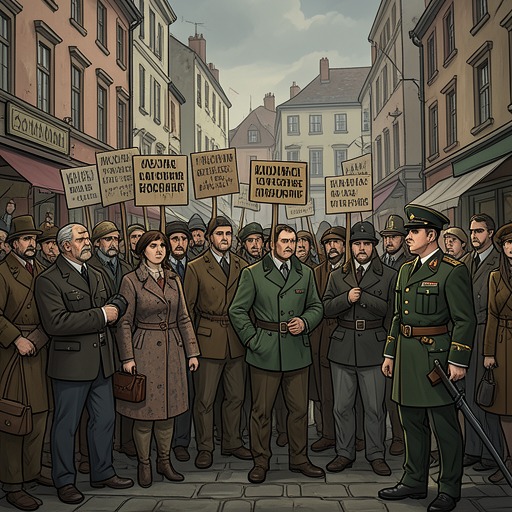
The people first appear as fellow citizens gathered outside the Palace while three spokesmen meet Hermann Gessler. They had accompanied the delegation and waited by listening at the front-door keyhole, though the Hall of Audience was separated from them by other doors, stairs, and a long passage. Their eagerness to question the spokesmen makes the distance between the governed and the Governor literal: the crowd can wait and ask, but it cannot hear the decisions that concern it directly. Its concerns include the taxes on jam and mixed biscuits, small, pointed examples of how oppressive taxation reaches into ordinary life.
When the spokesmen report that Hermann Gessler will not remove the taxes, the crowd’s disappointment becomes the immediate setting for Walter Furst’s call to rebel. The shift is collective but not automatic: the proposal first draws an astonished response, after which Walter Furst repeats it firmly. The scene presents revolt as a decision that must be spoken and then accepted in common, rather than as an already organized action.
Resistance and the Question of Leadership
The community’s resistance is not confined to speeches. After Hermann Gessler orders everyone to treat his cap on a pole as if it were him and threatens punishment for anyone who crosses the meadow without bowing, the people avoid the required gesture by taking the long way around. The tactic denies the Governor the submission he demands without forcing an immediate confrontation. His soldiers, Friesshardt and Leuthold, are left watching an empty meadow. When people later cross it, a priest stands before the pole and a sacristan rings the bell; the crowd kneels to pray, not to do obeisance to the cap. The episode shows the people finding room for collective refusal even under a command backed by soldiers.
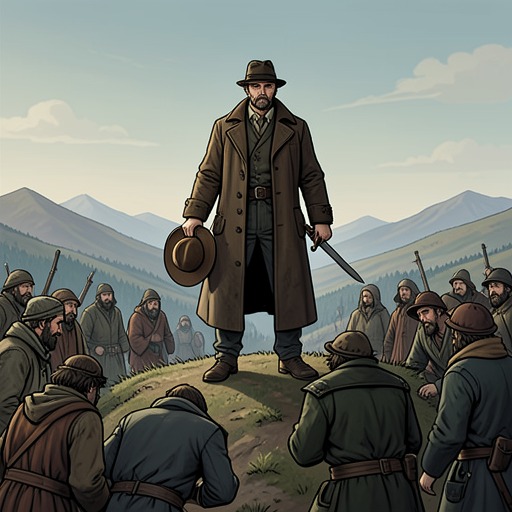
The need for a leader nevertheless exposes a strategic division. Walter Furst recounts that William Tell had argued that a Governor whose oppression did not provoke revolt might eventually tire of oppressing. Walter Furst rejects that expectation: in his view, Hermann Gessler will not simply stop, and the people need to hold together. William Tell answers with the contrasting maxim that the strong are strongest alone, but clarifies that he does not intend to desert the community. He sees himself as unsuited to plotting, counsel, or meetings, and useful instead when action is required. Werner Stauffacher names him for leadership; the crowd answers with a cheer and a communal song. The choice makes room for both forms of resistance: collective deliberation and the decisive deeds William Tell promises to undertake.
From Protest to Coordinated Revolt
The call to rebel leads directly to plans for plotting, with Jost Weiler urging the crowd to begin. Yet the people’s readiness has limits, and the narrative makes the danger visible. After William Tell’s apple shot, Arnold of Melchthal asks Werner Stauffacher whether they will permit the spectacle before their eyes and urges the people to rise and kill the tyrant. Werner Stauffacher considers the proposal but points out that they are unarmed while the soldiers are armed. Shared outrage, the scene suggests, does not erase the practical imbalance of force.
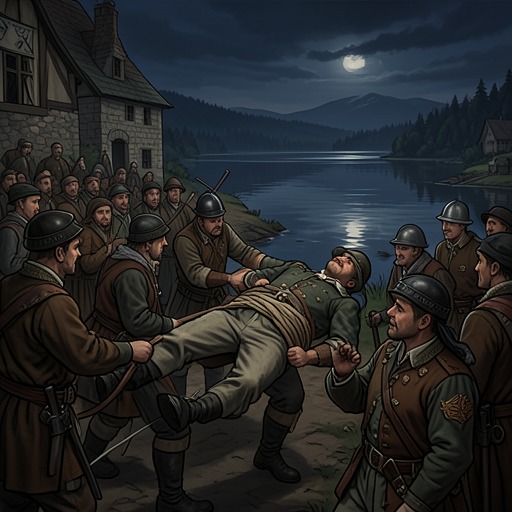
That balance changes after Hermann Gessler is killed. His death becomes the signal for the Swiss people to rise, although the revolt itself has been brewing for a long time. The account identifies a solemn oath to drive the enemy from the country as an existing bond, and says that nobles and peasants had united in preparations throughout Switzerland. News of the Governor’s death converts preparation into immediate action: meetings take place in every town, and the people resolve to begin the revolution without delay. All of Hermann Gessler’s fortresses are taken by assault on the same night. The sequence turns the crowd’s earlier shared grievance into coordinated action across the country, supported by a coalition that crosses the distinction between nobles and peasants.
Defeating the Fortresses and Reclaiming the Pole
The last fortress to fall had only recently been begun, and the people forced to help build it are among those who pull it down. Even the children join in, enjoying the freedom to break what they choose without being told not to. The action reverses the purpose of their compelled labor: the stones they had been made to set in place are now pulled down by the community. William Tell watches and predicts that the children will remember the night when they are old as vividly as they remember the following day. The revolt thus becomes not only a military event but an experience transmitted through the people who take part in it.
Some call for Hermann Gessler’s pole to be destroyed or burned, but William Tell stops them. The object that had been installed to enforce submission is to remain standing as a memorial of newly gained liberty, and the pole is to mark where the revolution finished. Its meaning is reversed without erasing its history: the Swiss people preserve the visible instrument of coercion so that it can testify to their escape from it.
Unity and the Unfinished Future
Arnold of Melchthal questions whether the revolution is truly finished, anticipating that the Emperor of Austria may seek revenge for Hermann Gessler’s death and the destruction of the fortresses. William Tell acknowledges that the Emperor will come, but answers with confidence in the country’s defenses and the people’s unity. Switzerland, he argues, can be approached through only a few mountain passes, which the people will block with their bodies; united, they need fear no enemy. The crowd’s cheer gives this confidence a collective voice, while the anticipated invasion makes clear that victory over the Governor has not removed every threat.
The Swiss people’s development therefore runs from separate frustrations and cautious workarounds toward a shared political undertaking. Their resistance uses evasion when direct defiance is dangerous, debate when strategy is unsettled, and force when the Governor’s death opens the way to revolt. The ending gives unity both practical and symbolic weight: it is a means of defending the mountain passes, and the principle that binds a community able to reclaim the objects and places through which it had been commanded to submit.