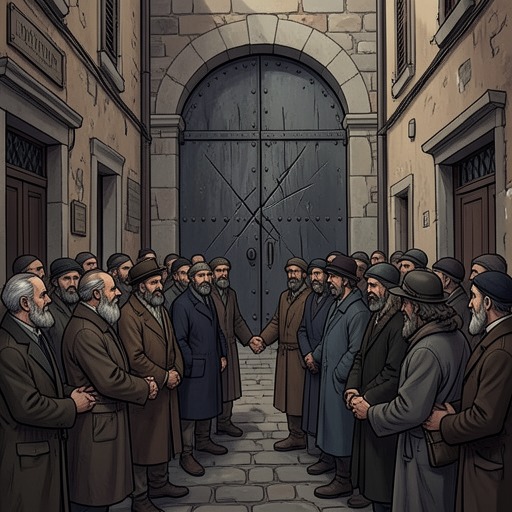
Swiss subjection under Austrian rule
William Tell (P. G. Wodehouse Edition)Swiss subjection under Austrian rule is depicted as both political dependence and intrusion into everyday life. The Emperor of Austria claims authority over Switzerland, appoints Hermann Gessler to govern it, and leaves the Swiss people to contend with a governor who turns taxation and prohibition into instruments of control. The narrative treats this oppression with comic exaggeration, but its details make clear how broadly power reaches: from the ownership of animals to food, entertainment, and daily habits.
Political Setting and Governorship
The account opens with a deliberately expansive sense of time: Switzerland belongs to the Emperor of Austria, who may do with it as he likes. Its comic prologue measures the distant past against the later arrival of hotels and English tourists photographing Mont Blanc, framing the political setting in a conversational, lightly absurd register rather than as solemn chronicle.
The Emperor sends Hermann Gessler, described as his friend, to govern the country. Gessler is characterized as unpopular, and the narrative quickly identifies taxation as the principal point of conflict between him and the Swiss people. Rule is therefore introduced not only as an external authority but through the local governor who makes that authority tangible in ordinary transactions.
Taxation and Material Burden
Gessler’s tax policy reaches across livelihoods and consumption. Anyone who owns a flock of sheep must pay him a sum; if a farmer sells the sheep and buys cows instead, the tax on the cows is higher than the earlier sheep tax. The example makes the policy seem less like a stable levy than a charge that follows people as their circumstances change.
The list then moves from livestock to food: Gessler taxes bread, biscuits, jam, buns, and lemonade, and the narration says he taxes everything he can think of. The Swiss people are characterized as simple and thrifty, objecting to taxes of any kind and wanting to spend their money on other things. The contrast between their wish to keep their money for themselves and Gessler’s appetite for taxing every available subject gives the conflict its plain material stakes.
Complaint and Collective Response
The Swiss people eventually determine to complain. They appoint Walter Furst, Werner Stauffacher, and Arnold of Melchthal to present their grievance. The narrative sketches them in comic shorthand: Walter Furst has red hair and looks fierce; Werner Stauffacher has gray hair and wonders how to pronounce his own name; Arnold of Melchthal has light-yellow hair and is supposed to know a great deal about the law.
Their visit gives the grievance a public form. They call on Hermann Gessler one lovely morning in April and are shown into the Hall of Audience, where he asks what is the matter. The polite setting and ordinary greeting sit beside the broad dispute over taxation: the people have to bring their complaint to the official whose policies have created it.
Prohibitions and Everyday Control
Taxation is only one expression of Hermann Gessler’s rule. When the narrative returns to his conduct, it describes his chief amusement as thinking up new ways to annoy the Swiss people. His preferred method is prohibition: he looks for what people enjoy and has a herald announce that it must stop. The account presents this not as incidental administration but as a deliberate pattern of interference.
The prohibitions encompass dancing, singing, and playing musical instruments, which Gessler claims make noise and disturb people who want to work. He also forbids every kind of food except bread and the simplest sorts of meat, alleging that other foods make people unwell and unfit for anything but sitting still and saying how ill they are. Games, too, are forbidden as a waste of time. The reasoning shifts from rule to rule, while the result is consistent: pleasure and leisure are recast as problems that government may eliminate.
Narrative Significance
The portrait of subjection grows through accumulation. The sheep tax leads to the higher cow tax; the list of taxed foods expands from bread to lemonade; the bans extend from music and dancing to food and games. Each new example makes the reach of authority feel more comprehensive, while the comic explanations expose the gap between Gessler’s stated justifications and the intrusive effect of his policies.
The Swiss people are not presented as silently accepting these burdens: they decide to complain and select representatives to speak to the governor. At the same time, the account’s humor keeps the abuses sharply visible. Gessler’s authority is serious in its consequences for ordinary life, but the narration makes its pettiness legible by showing a ruler who taxes nearly everything and, when he has forbidden all he can think of, is still eager to find something else to prohibit.