Tell Threatens Gessler with a Second Arrow and Is Arrested
William Tell (P. G. Wodehouse Edition)William Tell’s disclosure of the second arrow turns the aftermath of the apple shot into an open confrontation with Hermann Gessler: Tell makes explicit the threat he had kept concealed, and Gessler responds by ordering his arrest. The scene’s decisive distinction is between a life spared and a freedom taken. Gessler insists that he will keep the letter of his promise while using his authority to confine Tell, leaving the crowd to watch the man they hoped might lead them being taken away.
The question and the second arrow
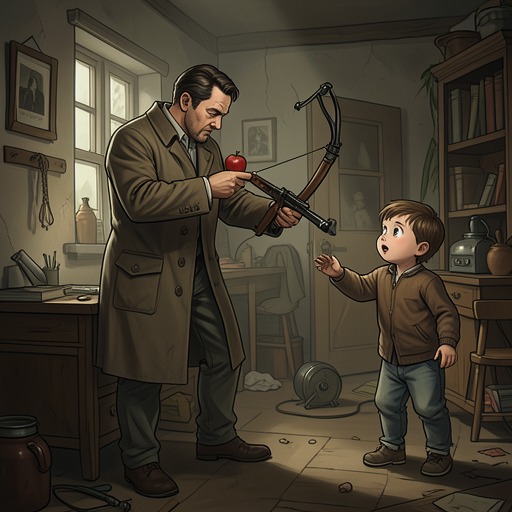
Gessler asks Tell to explain why he placed a second arrow in his belt while preparing to shoot at the apple. Tell first acts astonished that the Governor noticed it, then gives the practical explanation that archers customarily carry a spare. That answer does not satisfy Gessler. He says he believes there was another meaning, demands the truth, and promises that Tell’s life will be safe if he speaks.
The exchange makes the promise a condition of disclosure. Tell stops fidgeting with his bow, meets Gessler’s eyes, and agrees to answer because his life has been promised. He draws the arrow from his belt and holds it up while the crowd presses forward to hear. The physical object at the center of the question is thus also the evidence of a concealed intention: the second arrow was not merely a spare for another shot at the apple.
Tell’s conditional threat
Tell explains that if his first arrow had pierced his child instead of the apple, the second would have pierced Gessler. He adds that, had he missed the first shot, the second would have found its mark. The threat is explicitly conditional: Tell describes what he would have done if the apple shot had gone wrong, not an attack carried out in the scene. The second arrow makes the danger implicit in the earlier test newly plain to the Governor and the assembled people.
A murmur of approval rises from the crowd as Tell puts the arrow back in his quiver and faces Gessler with folded arms. Gessler turns white with fury and orders the soldiers to seize him. The exchange shifts the scene from a question about Tell’s conduct during the shooting to a contest over what he has now declared. Tell’s answer gives the crowd a reason to approve him, while giving Gessler grounds to describe him as dangerous and to act against him.
Promise, authority, and arrest
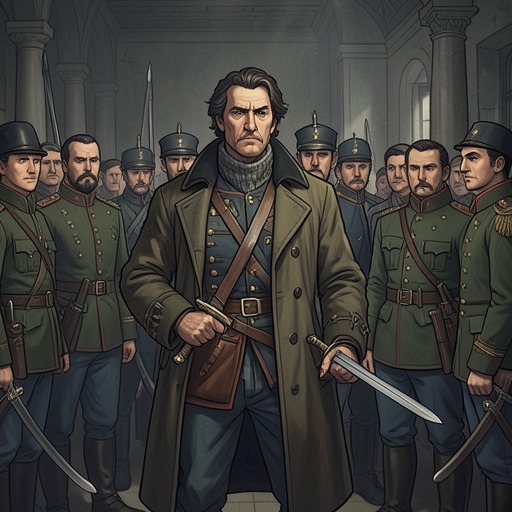
Rudolph der Harras reminds Gessler that he promised Tell his life and urges Tell to flee, but Tell does not move. Gessler repeats the command to seize and bind him, adding that the soldiers should cut him down if he resists. Tell says he will not resist. He condemns his trust in a tyrant’s word and argues that his death would at least show his countrymen what the Governor’s promises are worth.
Gessler answers by drawing a distinction between life and freedom. He maintains that he did promise to spare Tell’s life, but says he made no promise to leave him free. He calls Tell dangerous, refers to the purpose Tell has disclosed, and declares that he must guard against its fulfillment. His proposed safeguard is imprisonment: Tell is to be taken to the dungeons in Gessler’s castle at Kussnacht, where Gessler says no ray of sun or moon falls, and chained hand and foot. The promise is therefore kept in its narrowest stated sense while confinement supplies the punishment and prevents Tell from acting freely.
Removal and public consequence
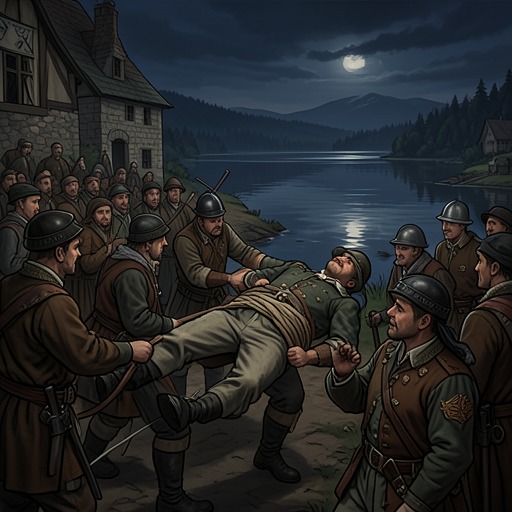
Gessler orders the soldiers to bind Tell and lead him to the ship, announcing that he will follow and conduct Tell to Kussnacht himself. The soldiers tie Tell’s hands; he offers no resistance. The crowd groans as he is led away to the lakeshore, where Gessler’s ship lies at anchor. The arrest ends not with a fight but with Tell’s stillness and the soldiers’ control of his movements.
The people interpret the departure as a loss extending beyond Tell’s immediate captivity. They tell one another that their last chance is gone and ask where they can look for a leader. Their response establishes the public stakes of the arrest: Tell is not only the man Gessler has ordered confined, but someone the people regard as a possible source of leadership. The scene closes with that uncertainty unresolved. Gessler has secured Tell’s person and stated his destination, while the watching people are left to confront the absence of the leader they hoped to find.