Tell’s crossbow
William Tell (P. G. Wodehouse Edition)Tell’s crossbow gives practical form to William Tell’s defining skill: it feeds his household, establishes his reputation as a marksman, and turns moments of political coercion into acts of resistance. Its uses move from hunting and public competitions to the shots that destroy Hermann Gessler’s authority over Tell: first the arrow through the Governor’s hat, and later the arrow that kills him.
Identity and Reputation
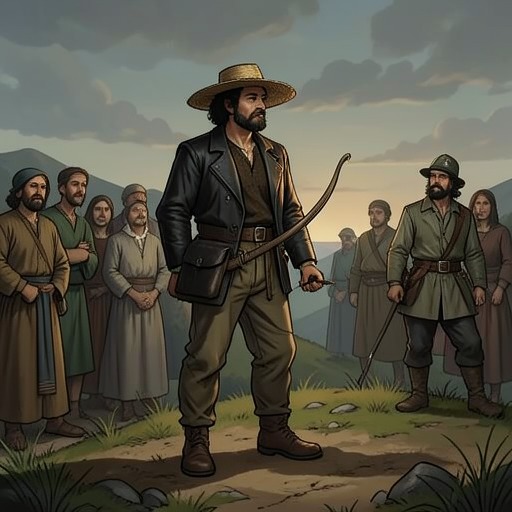
The crossbow belongs to a hunter whose abilities are introduced in emphatic terms. Tell is described as the best crossbow shot in all of Switzerland, a man capable of crossing ice fields and pursuing a chamois over crags. The weapon is not an occasional emblem of his prowess: it is central to the account of what he can do, and it accompanies him into both the mountain landscape and the public conflicts that follow.
His skill has a public record. Tell attends shooting competitions for miles around and wins first prize every time. His rivals acknowledge the consistency of his victories by calling him a pot-hunter, suggesting someone who enters every contest and takes every prize. Tell accepts the label and explains that he hunts to fill the family pot. That reply links the crossbow’s competitive use to its domestic purpose: the same marksmanship that wins prizes also provides food.
Hunting and Household Use
Tell does not return empty-handed from the chase. Sometimes he brings home a chamois, which the family eats roasted on the first day, cold over the next four, and minced on the sixth, served with sippets of toast around the dish. At other times his catch is only a bird. Hedwig worries that it will not go round, but it always does. These precise household details make the crossbow’s ordinary work consequential: its accuracy helps supply a family whose meals are carefully made to last.
The weapon therefore has an everyday value before it becomes a political one. Its association with Tell’s skill is inseparable from labor, provision, and the needs of Hedwig and the children. The account’s lightly comic attention to stretching a meal also counters any idea that his marksmanship matters only in grand public contests. The crossbow is useful because Tell can bring home what the household needs.
The Hat and Public Defiance
When Tell arrives in the meadow with Walter beside him, the crossbow is over his shoulder. He has not heard that Hermann Gessler’s hat has been placed on a pole, and he is surprised by the large crowd. After Walter points out the hat, Tell asks what it has to do with them and continues across the meadow with dignity. The weapon is visibly with him, but at first he does not treat the hat as a challenge requiring a shot.
The crowd’s confrontation with the soldiers changes the situation. Tell watches as violence spreads; while the quarrel is between himself and Friesshardt, he is willing to fight, but he judges it unfair when the crowd joins in against one man. He then draws an arrow, sets it in the crossbow, and aims at the hat. Friesshardt tries to stop him, but a blow from a spade knocks the soldier’s helmet over his eyes. Before Friesshardt can see again, Tell’s arrow has passed through the cap, through the pole, and out the other side. The crowd celebrates, while Tell stands beside Friesshardt twirling his moustache.
The crossbow’s shot turns a prohibited object into a visible act of refusal. Its target is the hat on the pole, not a person: the arrow passes through the sign of the Governor’s authority and the support holding it in place. In this scene the weapon serves both Tell’s precision and his judgment about when to intervene. The act is a deliberate public answer to the imposed display, rather than a general attack on everyone in the meadow.
The Apple Test and the Second Arrow
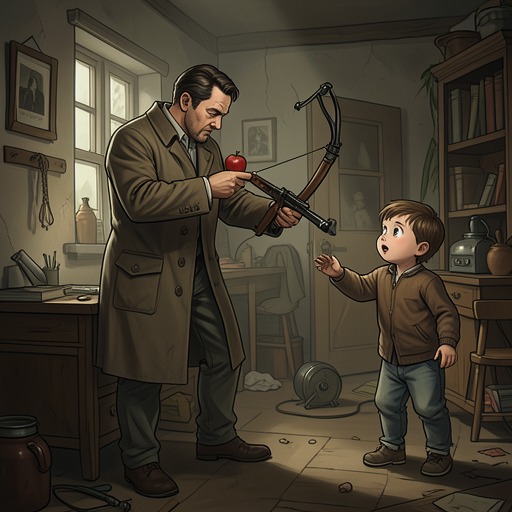
At the later confrontation, Hermann Gessler points to Tell’s bow, which is in his hand, and orders him to shoot an apple placed on his son’s head. Walter is to stand a hundred yards away; if Tell misses the apple with his first shot, his life will pay the forfeit. The crossbow is thus made part of a coercive test: Tell’s celebrated accuracy is invoked by the Governor, but success is demanded under threat to both father and son.
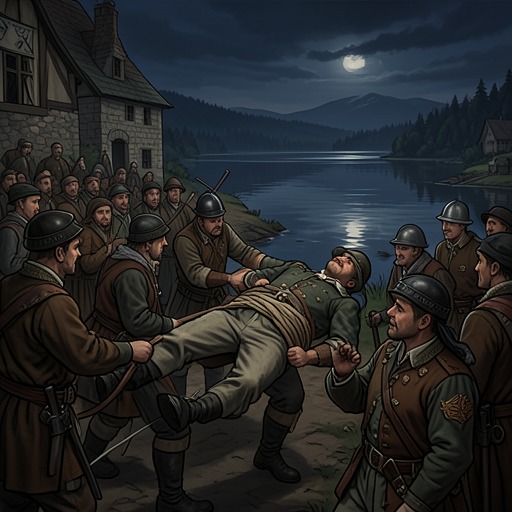
The weapon’s role continues when Tell is taken aboard Gessler’s ship. As soldiers approach with ropes, Tell sees a lofty rock of the kind he has climbed while hunting chamois. He snatches up the bow and quiver lying on deck, springs onto the bulwark, and leaps onto the rock, putting himself beyond reach. The crossbow is again a practical instrument, now used in the rapid escape that prevents his capture.
The final shot changes its function once more. The bowmen are ordered to shoot, but they are too late: Tell is ready before them, and his arrow pierces Hermann Gessler through the heart. The account identifies it as Tell’s second arrow and notes that, like the first, it finds its mark. The crossbow’s course through the story therefore culminates in a lethal reversal: the Governor who had used Tell’s skill to impose a deadly test is himself killed by Tell’s shot.
Narrative Significance
Across these episodes, the crossbow links domestic provision, celebrated expertise, defiance, escape, and vengeance. Its meaning depends on what Tell aims at and why: game for the household, the hat and pole in the meadow, and finally Hermann Gessler. The weapon remains materially consistent, but the stakes of its use change sharply, from sustaining family life to confronting the Governor’s power and ending his pursuit.
The repeated emphasis on accuracy also gives the episodes a clear structure. Tell wins competition after competition, sends an arrow through the hat and pole, and later kills Gessler with a second arrow that finds the heart. Yet the story does not present skill alone as the whole explanation for these moments. Tell’s restraint while the crowd fights, his quick judgment aboard the ship, and his choice of target shape what the crossbow accomplishes. It is the instrument of his marksmanship, but its consequences arise from the occasions on which he chooses to use it.