The Swiss people and Austrian rule
William Tell (P. G. Wodehouse Edition)The relationship between the Swiss people and Austrian rule is a progression from externally imposed authority to collective resistance and freedom. Austria’s rule begins as a power exercised at the Emperor’s discretion, becomes tangible in Hermann Gessler’s taxes and public commands, and is challenged first through quiet evasion and then through revolt. The account links political independence not to a single act alone but to the Swiss people’s capacity to act together, preserve the meaning of their resistance, and withstand the possibility of renewed attack.
Subjection and the Everyday Burden
The narrative establishes the imbalance at the outset: Switzerland belongs to the Emperor of Austria, who may do with it as he pleases. This description makes subjection a condition of political ownership rather than a negotiated relationship between governing power and governed people. The Emperor appoints his friend Hermann Gessler to rule the country, placing authority in the hands of a governor whose policies soon make that distant sovereignty part of daily life.
Taxation is the most persistent point of conflict. The Swiss people are described as thrifty and unwilling to pay taxes, while Gessler seeks to tax whatever he can. His demands reach ordinary goods and livelihoods: a farmer pays for keeping sheep, and owes more if he sells them and replaces them with cows. Bread, biscuits, jam, buns, and lemonade are also taxed. The range of these levies makes rule feel pervasive, extending beyond a single exceptional payment into food, trade, and household choices. The people’s complaint therefore arises from the cumulative reach of government into everyday economic life.
The Swiss people respond through representatives rather than beginning with immediate armed action. Walter Furst, Werner Stauffacher, and Arnold of Melchthal are appointed to present their complaint to Gessler. Their delegation gives the grievance a public and collective form: the dispute is not simply between a governor and an individual taxpayer, but between the governing authority and people seeking to address the burdens imposed on them. Yet the later revolt shows the limits of petition when the governor’s power remains unchecked.
Evasion, Defiance, and Disagreement
Gessler’s order concerning the cap extends his authority from taxation into public conduct. He places a cap on a pole in the meadow outside the city gates, declares that it is to be treated as though it were himself, and requires everyone crossing the meadow to bow. His announcement makes obedience visible: people are not merely to submit to government in private but to perform reverence in a public space. The threat of arrest for anyone who refuses makes the demand an instrument of political discipline as well as a personal display of authority.
The townspeople find a practical way to refuse without crossing the meadow. Rather than bowing to the cap or confronting the guards there, they take the longer route around. Their conduct frustrates the order’s purpose: the empty meadow and the soldiers’ unoccupied watch show that a command can be formally enforced yet denied its intended public acknowledgment. When some people later pass the pole while kneeling in prayer, the distinction between religious observance and obeisance to Gessler further exposes the gap between outward action and the meaning the governor seeks to impose on it.
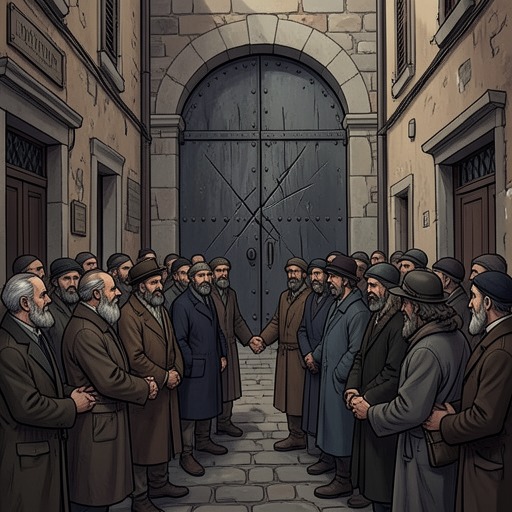
The story also gives the Swiss people no single, uncontested account of how resistance should proceed. Walter Furst argues that the people could accomplish much if they held fast together and treats union as the condition of effective action. William Tell, by contrast, maintains that the strong are strongest when standing alone. Furst’s response turns that disagreement toward the country’s predicament: if Switzerland is driven into self-defence, can it count on Tell? The exchange sets individual independence against political solidarity, a tension that acquires greater weight when the later uprising depends on united action.
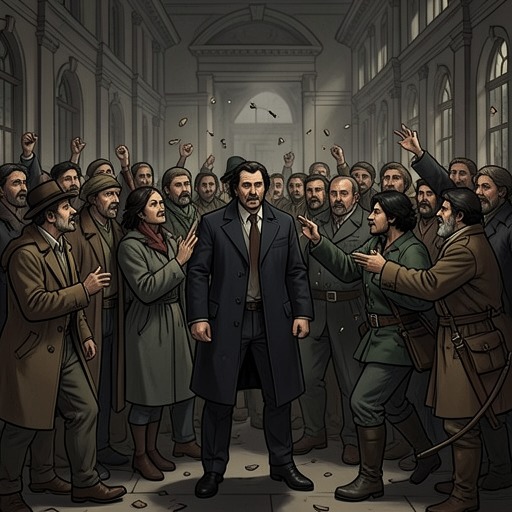
At the moment when William Tell has completed the apple test and Walter walks away carrying the apple, Arnold of Melchthal asks whether the assembled people will allow the scene before them to pass without acting. He recalls their oath to rebel and urges them to rise against the tyrant. Werner Stauffacher answers cautiously: the crowd is unarmed while the soldiers have weapons, and an attack could bring immediate defeat. Their exchange presents resistance as a choice made under unequal conditions. Anger and the prior oath call for action, but the risk of acting without adequate strength makes collective timing and preparation central to the people’s struggle.
From Resistance to Revolution
Gessler’s death changes the political situation. The account identifies fear of the governor as the main reason a rising had not already taken place, though opposition had been developing for a long time. The Swiss people had sworn to drive the enemy from the country, and preparations for revolution were proceeding across Switzerland. Nobles and peasants had united, joining people of different social positions in a common effort against Austrian rule.
Once news arrives that Gessler has been slain, meetings take place in every town and the people resolve to begin the revolution without delay. The change is from prolonged preparation to coordinated action. In a single night, they take by assault the fortresses Gessler had built during his years of rule. The last fortress to fall had only recently been begun, and people who had been compelled to help build it take pleasure in pulling down the stones they had laboured to put in place. Even children participate. The reversal is concrete: work once directed toward strengthening the governor’s control is turned into the dismantling of his structures.
That participation also makes the revolution a shared public experience rather than a change carried out solely by armed leaders. William Tell observes that the children, when old, will remember the night as freshly as the following day. His observation connects the immediate destruction of the fortresses with a lasting communal memory. The revolution acts on the built symbols of rule and gives those who had lived under it a common event through which to remember its end.
Liberty, Memory, and the Outcome
After the fortresses fall, people bring forward the pole from the meadow, with Gessler’s cap still nailed to it by William Tell’s arrow. Some call for the emblem to be destroyed. William Tell instead proposes preserving it as a memorial of the liberty newly gained, and as a marker for the place where the revolution finished. The object’s meaning has changed with the balance of power: what Gessler installed to demand submission is retained by the Swiss people as a record of resistance. In that transformation, public memory becomes part of the new political order.
Arnold of Melchthal questions whether the revolution is truly finished. Gessler’s death and the fall of the fortresses have removed the local governor and his defenses, but the Emperor of Austria may come to seek revenge. William Tell acknowledges that possibility rather than treating victory as secure. He points to Switzerland’s difficult approaches and few mountain passes, where the Swiss can stand against an invading force, and emphasizes their unity as a strength. The answer shifts the measure of independence from a completed uprising to the people’s continuing readiness to defend their country together.
The Emperor’s death removes the prospect of an immediate attack. As he rides from Stein to Baden, the lords of Eschenbach and Tegerfelden fall upon him with their spears; his bodyguard, separated from him by a stream he has just crossed, cannot assist him, and he dies instantly. The account then states that his death allows the revolution in Switzerland to proceed without check. His successor is occupied with defending himself against his father’s killers, and by the time he can turn his attention to the Swiss, they have become too strong to attack. The Swiss people consequently become free. The ending makes independence both a product of their revolt and an outcome enabled by events within the ruling dynasty; the account does not present their freedom as secured by resistance alone, but as consolidated when the anticipated imperial retaliation fails to arrive.