The apple
William Tell (P. G. Wodehouse Edition)The apple is the ordinary piece of fruit Hermann Gessler transforms into the target of a life-or-death test. Set on Walter’s head while William Tell is ordered to shoot from a hundred yards away, it concentrates the danger of the scene into one small, visible object. Once William Tell pierces it through the center, the apple becomes proof of his skill, a focus for the crowd’s rejoicing, and, in Walter’s hands, a piece of fruit whose ownership matters again.
Selection and Imposed Test
The apple is brought forward at Hermann Gessler’s command. Friesshardt picks one up from several lying about, after apples had been thrown at him and Leuthold earlier that day. This one is bruised, and Friesshardt explains that it hit his helmet. The fruit therefore enters the scene already marked by the day’s disorder; Hermann Gessler, however, dismisses that damage as irrelevant because he does not need it for eating.
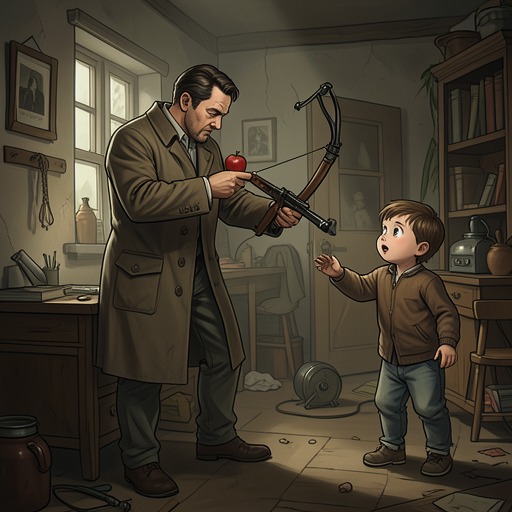
Hermann Gessler presents the apple as simple and not over-ripe, then makes it the measure of a feat William Tell’s son has praised: shooting an apple from a hundred yards. He orders that it be placed on Walter’s head and sets the consequence of a miss as William Tell’s death. The apple’s ordinary scale is part of the test’s force. It is small enough to demand exceptional precision, yet the command makes a child’s safety depend on striking it rather than him. The fruit is not merely a target chosen for the display of marksmanship; it is the point at which Hermann Gessler’s imposed danger becomes immediate and visible.
Walter asks where he must stand and says he is not afraid, trusting that his father can hit a bird in flight. When Hermann Gessler orders his soldiers to take Walter to a lime tree and bind him there, Walter refuses to be bound and insists he can stand still. The episode thus places the apple within a coercive arrangement: the governor dictates the test and its lethal stakes, while William Tell must aim at the fruit with his son beneath it. Walter’s confidence does not remove the danger; it sharpens the contrast between the child’s trust and the punishment Hermann Gessler has attached to a failed shot.
The Shot and Its Public Proof
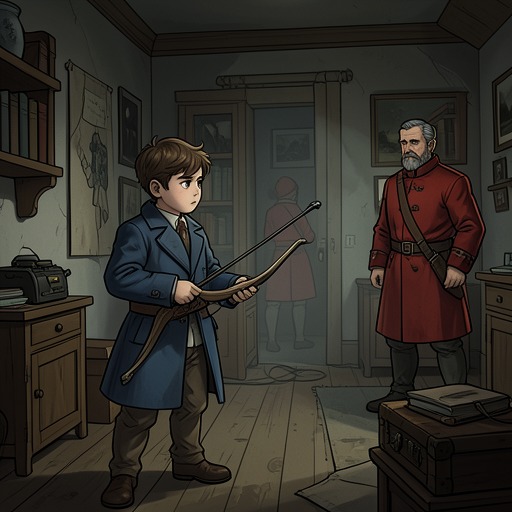
Before shooting, William Tell takes a second arrow from his quiver and places it in his belt. He then regains his calm, raises his bow, and takes a steady aim. The crowd cranes forward; people in the front ranks tell those behind that pushing will gain them nothing. Hermann Gessler leans over his horse’s neck to peer toward Walter. The apple is the focus of this held moment: the spectators can do nothing but watch the distance between the archer, the boy, and the target.
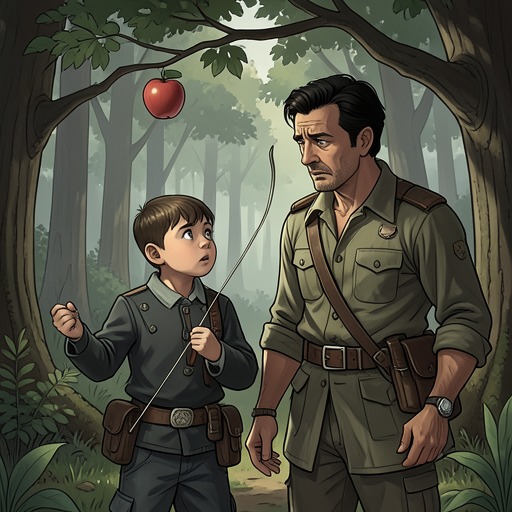
William Tell releases the string. After a moment of suspense, the crowd erupts in a cheer: the apple has leaped from Walter’s head, pierced through its center. Its condition records the exact outcome of the test. The target is struck cleanly, and Walter is unharmed. The apple’s puncture is visible confirmation of what the crowd has just witnessed, turning an act of extraordinary precision into something they can look at and pass among themselves.
The reaction quickly makes the result public. The spectators cheer repeatedly, shake hands, and throw their caps into the air; they are delighted both because they are fond of William Tell and Walter and because Hermann Gessler has been disappointed. Walter picks up the pierced apple and shows it proudly to his friends. He says he had known his father would not hurt him and calls him the best shot in Switzerland. The apple thus carries the achievement out of the instant of the shot: it can be displayed as tangible evidence that William Tell succeeded where a miss would have cost him his life.
Recovery, Display, and Ownership
After the shot, William Tell drops his crossbow and stands motionless, still gazing in the direction the arrow went. Hermann Gessler sits moodily without answering. The apple has been struck, but the scene does not end with the crowd’s recognition of the feat; its handling continues to change the emotional temperature. Rudolph der Harras breaks the awkward silence and supposes that it is all over. Walter is still holding the apple when Rudolph bites a large piece from it.
Until then, Walter has shown no sign of dismay despite the peril he faced. Seeing someone eat the apple provokes a piercing scream: Walter regards it as his own property. Rudolph apologizes and hands it back, and Walter begins to munch it contentedly. This small reversal returns the apple from public trophy to a child’s possession. A moment earlier, its importance lay in the precise shot and the danger attached to it; now Walter’s protest is about the bite taken from what he considers his. His calm eating closes the object’s passage through the scene without erasing what it has witnessed.
Meaning and Narrative Function
The apple’s function changes through a sequence of concrete uses. It is first one of several apples lying about, bruised from an earlier blow to Friesshardt’s helmet. Hermann Gessler selects it for a test that gives its position on Walter’s head fatal significance. The arrow through its center then makes it proof of William Tell’s accuracy; Walter’s display turns that proof into a shared celebration, before Rudolph’s bite brings the object back to ordinary appetite and personal ownership.
That movement between the exceptional and the everyday gives the apple much of its force. It remains a small, edible object even while Hermann Gessler makes it the target on which life and death depend. The clean central puncture registers the success of William Tell’s shot, but the fruit does not remain frozen as a monument: Walter takes it up, shows it to his friends, objects when Rudolph eats from it, and finally eats it himself. Its changing uses make the scene’s reversal tangible. The governor has arranged the apple as an instrument of danger and a test of control; by the end, Walter is holding and eating it on his own terms.