Werner Stauffacher
William Tell (P. G. Wodehouse Edition)Werner Stauffacher is a Swiss spokesman who helps turn a complaint about Hermann Gessler’s taxes into an organized call for rebellion. He is neither a simple coward nor a forceful revolutionary: he urges the people to unite, proposes bringing their established spokesmen to William Tell, and later admits that he himself advised delaying action. His mixture of prudence, political purpose, and comic evasiveness makes him a distinctive voice in the story’s account of resistance.
Identity and Public Role
The narration introduces Werner Stauffacher as one of three men appointed to carry the people’s complaint to Gessler. His fellow delegates are Walter Furst, described as red-haired and fierce-looking, and Arnold of Melchthal, whose light-yellow hair and supposed knowledge of the law are also noted. Stauffacher, by contrast, has gray hair and is said always to be wondering how he ought to pronounce his own name. That joke sets a lightly comic register for a character who will repeatedly approach grave political questions through hesitation, qualification, and careful phrasing.
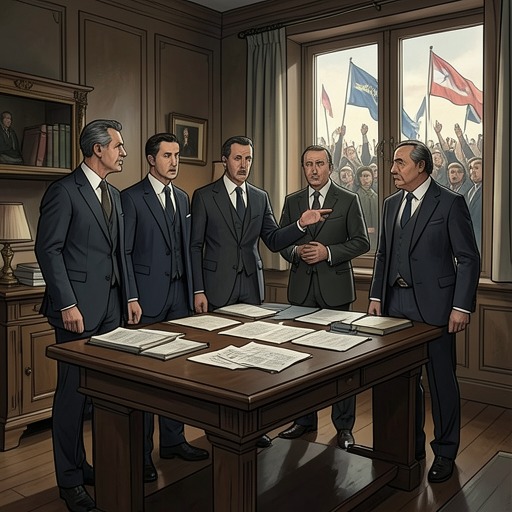
His public position is practical rather than solitary. He joins a delegation, speaks with other citizens about what to do next, and participates in decisions about leadership and timing. The narrative gives him a recognizable political manner: he can speak for collective action, but he is also attentive to the dangers and complications that may follow from it.
The Petition and Its Failure
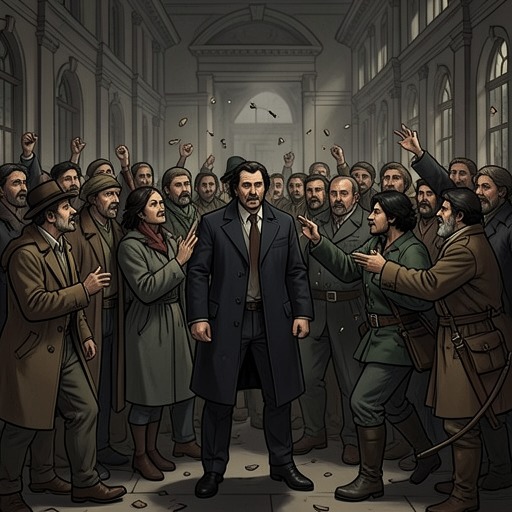
The delegation’s mission arises from Gessler’s taxation of nearly everything he can think of. The people appoint Stauffacher and the other two spokesmen to complain, and they visit the Governor on an April morning. When they return, the crowd asks what Gessler said. Stauffacher answers that the Governor did not actually say much; the important thing, as he puts it, was what Gessler did. Walter Furst describes Gessler as a man with arguments at his fingertips, and Arnold of Melchthal responds with a sharp howl when he hears the phrase. The account of the audience thus arrives not as a clear record of negotiation but as a comic, indirect report of intimidation and frustrated speech.
The failure is made plain when the crowd asks whether Gessler will release them from the taxes and receives a no. Walter Furst then draws a deep breath and declares that they must rebel. Stauffacher does not originate this decisive announcement, but he helps create the setting in which it becomes a collective declaration: the complaint has failed, the refusal is explicit, and the crowd answers with enthusiasm. After the initial outcry against the taxes, Stauffacher identifies the next practical need: they want a leader. His intervention moves the discussion from grievance toward organization, and he names William Tell as the man for the role.
Organizing Around William Tell
When the citizens later meet at the Glass and Glacier to decide how to approach Tell, Stauffacher argues for continuity. Rather than appointing a new set of envoys, he proposes sending the same three men who had gone to Gessler. Arnold of Sewa objects that the delegation already failed with the Governor. Arnold of Melchthal snaps back that Arnold of Sewa did not succeed either. The exchange exposes the awkwardness of choosing representatives by their record: their first mission has not secured relief, but the group still needs people who can carry its request to a potential leader.
Stauffacher’s preference for keeping the three spokesmen is a modest, procedural answer to that problem. It does not erase the failure; it treats continuity as preferable to changing representatives simply because the first attempt was unsuccessful. This is characteristic of his role in the narrative. He tends to manage the movement through discussion and collective arrangements rather than presenting himself as its commanding figure.
Unity, Tell, and Political Difference
In recounting his conversation with Tell, Stauffacher sets out the disagreement between their approaches to oppression. Tell had argued that peaceable people might be left in peace and that Gessler could tire of oppression if it did not provoke revolt. Stauffacher rejects that confidence: he says Tell does not understand the Governor if he believes Gessler will grow tired of oppressing people. Stauffacher’s alternative is collective resistance, expressed in the principle that unity is strength.
Tell answers with a contrary principle, that the strong are strongest when standing alone. Stauffacher presses the disagreement by asking whether their country can then count on Tell when it must defend itself. Tell does not wholly withdraw: he says he does not want to desert them, but explains that he is no use as a plotter or counsellor. He will not join meetings or be made to speak; his strength lies in deeds, and he promises not to hang back if they ask him to do something. Stauffacher’s account therefore reveals both a political difference and a limited understanding between the men. Stauffacher wants cohesion and counsel; Tell declines that role but offers practical help when action is required.
The contrast matters because Stauffacher is among those who build a movement by talking, planning, and recruiting, while Tell defines his usefulness through deeds. Stauffacher does not dismiss Tell’s refusal as outright desertion. He reports the qualifications as well as the promise, and the citizens take Tell’s answer as encouraging enough to proceed with plotting.
Prudence, Delay, and the Crisis
Stauffacher’s caution becomes most consequential during the apple test imposed on Tell. As Walter walks away carrying the apple, the crowd falls silent and then begins whispering. Arnold of Melchthal asks whether they can allow this to happen after swearing to rebel and urges them to rise and kill the tyrant. Stauffacher scratches his chin and answers that they are unarmed while Gessler’s soldiers are armed. He says he would enjoy killing the tyrant, but expects that the tyrant would kill them. His reasoning is not a denial of the injustice before them; it is a calculation of the immediate imbalance of force.
Arnold then reproaches the group for not rising earlier and asks who advised delay. Stauffacher says that he cannot quite remember, but that the minutes of their last meeting would show the motion had been carried by a majority of two votes. The joke lands because the text immediately identifies Stauffacher himself as the person who had advised delay. As Gessler grows impatient on his horse and orders Tell to begin, Stauffacher’s evasive answer sits beside the danger he had been trying to avert. His prudence may be politically intelligible, but at this moment it also exposes the cost of postponement: the crowd has sworn to resist and yet finds itself unarmed while a public ordeal proceeds before it.