William Tell
William Tell (P. G. Wodehouse Edition)William Tell is a celebrated Swiss crossbowman, devoted family provider, and forceful opponent of Hermann Gessler. His defining distinction is the union of exceptional practical skill with an aversion to political plotting: he will not claim to be a counsellor, but promises not to hang back when deeds are needed. The apple placed on his son Walter’s head turns that character into a public ordeal, and the second arrow he reserves for Gessler carries his resistance from a threat into action.
Identity and Mountain Life
William Tell lives with his wife Hedwig and their sons Walter and William in a chalet high in the mountains, surrounded by snow and edelweiss. The narrator introduces him in extravagant terms: he is the best crossbow shot in Switzerland, courageous, agile, sure-footed, and conspicuously bearded. The description is comic in its accumulation of talents, but it also establishes the practical world that has formed him. Tell can cross ice-fields, leap from crag to crag after a chamois, and bring home food; his abilities are not ornaments detached from daily life.
His hunting sustains the household. Tell says that he hunts to fill the family pot, and he returns from the chase with game rather than empty-handed. A chamois can provide several meals: roasted on the first day, cold for the next four, and minced on the sixth with toast around the dish. When he brings home only a bird, Hedwig worries that it will not go round, but the family manages. These details place his celebrated marksmanship within domestic responsibility. The crossbow is at once the instrument of his reputation and a means of feeding those who depend on him.
Skill, Temper, and Deeds
Tell’s skill is repeatedly tested in public. He attends shooting competitions for miles around and wins first prize each time; even his rivals acknowledge his ability. They call him a pot-hunter because he enters every contest and takes its prize. He accepts the label by making its practical meaning plain: the prizes, like the game, serve the household. His prowess is therefore neither merely boast nor spectacle. It has a use, and the story will later make that same accuracy carry a much higher cost.
His directness is as conspicuous as his aim. In the ravine of Schachenthal, a rocky wall rises on one side and a river roars below, leaving no way past when Tell meets Gessler face to face. Gessler grows pale, his knees totter, and he sits down feeling unwell. Tell rebukes him for taxing bread and sheep and predicts that he will come to a bad end. He leaves with scorn rather than caution. Gessler thereafter bears a grudge and waits for a chance to pay him back.
That frankness is balanced by action on behalf of others. When Gessler’s soldiers pursue Tell’s friend Baumgarten, the only escape is across a lake in a fierce storm. The ferryman refuses to risk his boat, even for twice the usual fare, while the soldiers ride down to seize their quarry. Tell gets into the boat and rows with all his might, bringing Baumgarten safely across after a choppy passage. The rescue further angers Gessler. Tell’s opposition is thus visible not only in insults but in the practical protection he gives someone pursued by the Governor’s men.
A Man of Action, Not a Plotter
When the Swiss discuss resistance, Tell distinguishes between deliberation and action. He says that the strong man is strongest standing alone, prompting the challenge that his country cannot rely on him when it must defend itself. He answers that he does not mean to desert them; rather, he is no use as a plotter or counsellor and does not want to be summoned to meetings to speak. His strength lies in deeds. If the others need him to do something, they need only write—even a postcard will do—and he will not hang back.
The exchange defines his place among the resistance without making him its strategist. Tell offers no plan and claims no command over the others’ deliberations. Instead, he makes himself available for a specific kind of service. His confidence in acting alone might sound like withdrawal, but his clarification makes the distinction: he refuses a role unsuited to him while affirming his willingness to serve when action is required. The promise becomes newly consequential when Gessler forces him to act under the eyes of a crowd.
The Apple Ordeal
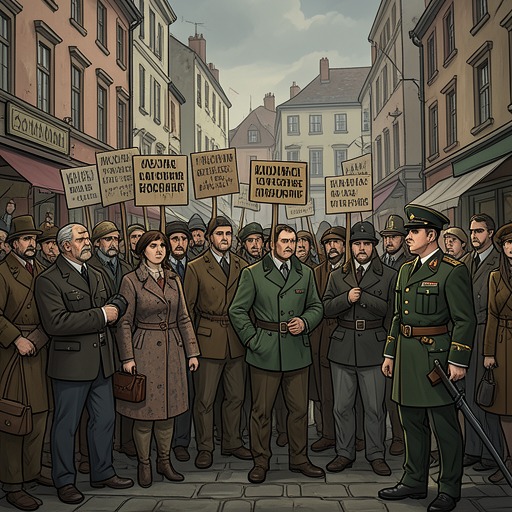
Tell arrives in the meadow with Walter beside him and his crossbow over his shoulder, unaware that Gessler’s hat has been placed on a pole. He bows politely to the gathered crowd, receives its cheers, and bows again. Walter points out the hat; Tell treats it as irrelevant and continues across the meadow with dignity, his son trying to imitate his manner. The scene sets Tell’s ordinary composure against the public display of authority surrounding the pole.
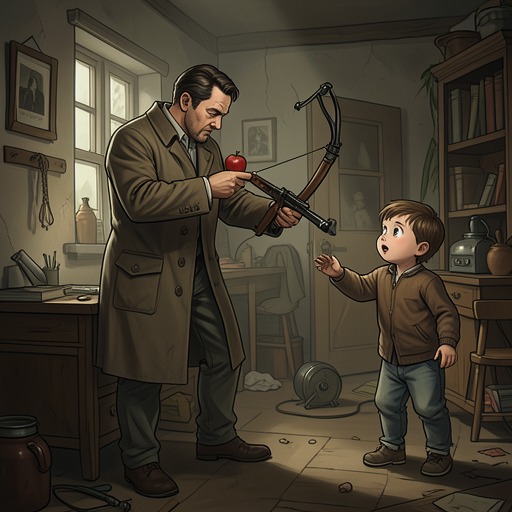
Gessler turns that encounter into a test with Walter’s life at stake. He selects an apple, says it is not over-ripe, and orders Tell to prepare his crossbow. Walter is to stand a hundred yards away with the apple on his head; if Tell fails to hit it with his first shot, his own life will pay the forfeit. The threat makes Tell’s skill inseparable from paternal responsibility. He is not shooting for a prize or for food, but under a condition in which a single error could kill his child.
Tell first stands in silence, trembling hands and fixed eyes shifting between Gessler and the sky. He takes a second arrow from his quiver and places it in his belt. Walter calls to him not to be afraid, and Tell regains his calm, raises the bow, and takes a steady aim. The crowd strains forward; Gessler bends over his horse’s neck to watch Walter. After the shot, suspense gives way to a tremendous cheer. Tell has hit the apple rather than his son, but the accuracy does not erase the coercion that made the shot necessary.
The Second Arrow and Its Consequence
Tell explains what the second arrow was for. Had the first pierced Walter instead of the apple, he says, the second would have pierced Gessler; even if he had simply missed the first shot, the second would have found its mark. The crowd murmurs approval as Tell returns the arrow to his quiver and faces the Governor with folded arms and burning eyes. Gessler turns white with fury and orders him seized. Tell’s reserve arrow makes explicit the threat concealed within the ordeal: he had accepted the shot required to save his son, but had also prepared to answer the Governor’s violence.
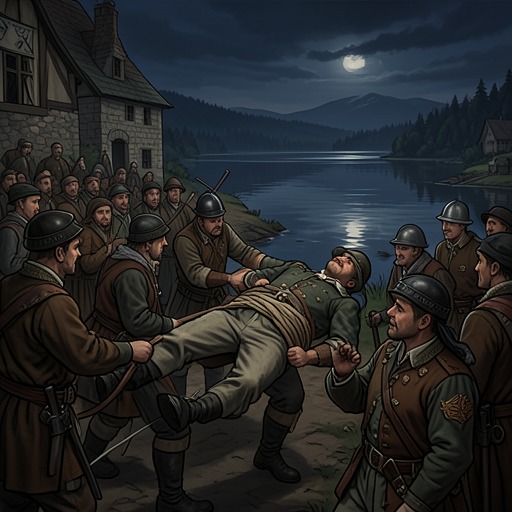
Later, on the deck of Gessler’s ship, the Governor cries for his bowmen to shoot. They fit arrows to their strings too late. Tell is ready first; his shaft rushes through the air and pierces Gessler through the heart. The Governor falls dead, and Tell’s second arrow has found its mark. The ending fulfills the warning he gave after the apple shot, while completing the portrait of a man whose principal contribution is not political counsel but decisive action.