William Tell and Hedwig’s marriage
William Tell (P. G. Wodehouse Edition)William Tell and Hedwig’s marriage is portrayed as a contented partnership tested by Tell’s appetite for danger and his commitment to Switzerland’s resistance. Hedwig’s forebodings repeatedly collide with his confidence: she warns him about the Governor, the mountains, and political plotting, while he chooses to hunt and to act for his country. Their domestic disagreements do not displace the narrative’s concluding image of a lasting family life; after the revolution, Tell returns home and lives happily with Hedwig and their two sons.
Identity and Household
Hedwig is William Tell’s wife, and the story introduces the couple within a family of four: their sons are Walter and William. They live in a small chalet high in the mountains, amid snow and edelweiss. The setting establishes the household’s distance from the town and its closeness to the hazardous landscape that shapes Tell’s pursuits. It also gives the marriage a concrete domestic center: the couple’s disputes unfold not in isolation but alongside the work and routines of raising their children.
The narrator describes Tell and his family as living happily and contentedly despite the Governor’s taxes. That domestic happiness is important because the couple’s arguments are not presented as evidence that the marriage has failed. Instead, affection and disagreement occupy the same home. The family faces political oppression, but the account also gives space to ordinary household concerns, especially Hedwig’s wish that her sons help her with the work and Tell’s willingness to encourage their military play.
Warnings and Their Different Temperaments
Hedwig’s caution is established early through the story of Tell’s encounter with Hermann Gessler in the ravine of Schachenthal. After Tell describes how he insulted the Governor over taxes on bread and sheep, Hedwig predicts that Gessler will never forgive him. Tell answers that he will avoid the Governor and assumes that Gessler will not seek him out. Her warning identifies a danger he would prefer to treat as avoidable; his confidence does not persuade her, and she tells him to be careful.
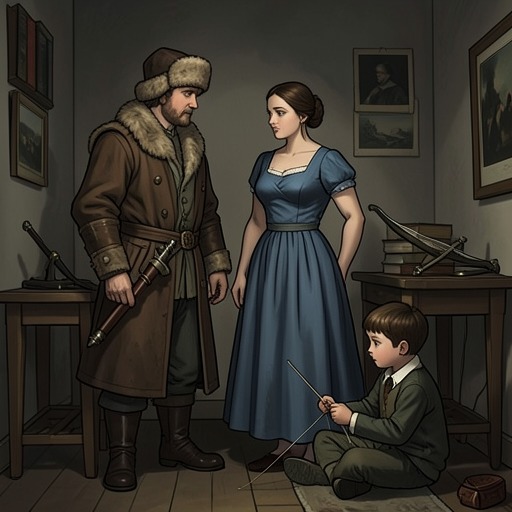
Their disagreement also concerns Tell’s love of adventure. When Hedwig finds him mending an axe at the door of their home, she is washing up and the boys are playing with a little crossbow nearby. She objects to the boys’ eagerness to shoot and says they ought to stay home and help their mother. Tell responds that he is not made to stay at home or work as a herdsman: hunting, he says, is his particular line. Hedwig’s complaint is both practical and personal. She wants help with domestic work, but she also fears what Tell’s preferred occupation may do to him.
She names the hazards with specific force: Tell might fall down a precipice, be caught by an avalanche, or break through the ice while crossing it. Her list turns the beautiful mountain world of their home into a catalogue of possible injuries. Tell counters with self-assurance, claiming that a man with ready wit and a quick eye need not fear the mountain, and describing himself as a child of it. Hedwig snaps back that he is certainly a child, an answer that makes their difference in judgment comic without making her anxiety disappear.
Family Life and Political Conflict
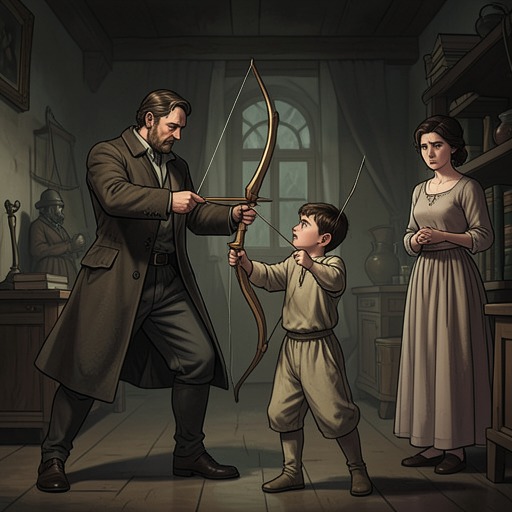
The boys’ play makes the couple’s disagreement recur beyond the question of Tell’s own safety. Tell believes the Swiss will one day rise against the Governor’s tyranny, and he drills his sons so they will be prepared. Their marching, tin-can drumming, and shouting delight the boys but irritate Hedwig, who wants them to dust chairs and scrub the kitchen floor. She regards the growing militarism of children as a bad sign; Tell treats preparation to bear arms as necessary for anyone who hopes to fight through life. The same family scene therefore holds two competing ideas of care: Hedwig emphasizes household contribution and protection from harm, while Tell emphasizes readiness for a political future he expects to come.
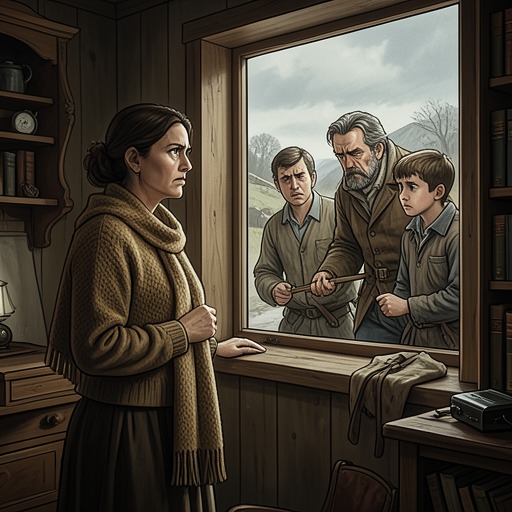
Hedwig’s unease extends from Tell’s adventuring to his involvement in resistance. She has noticed that her father, Walter Furst, brought Werner Stauffacher and another man to the house, and that Tell would not let her listen. From these circumstances she concludes that a plot against the Governor is underway and that Tell is involved. Tell laughs off her suspicion at first, but acknowledges the principle behind his choice by saying that a man must help his country. Hedwig understands that this patriotic obligation may place him in danger; she urges him not to go and even proposes that he send a note declining the invitation to plot.
Her concern becomes immediate when she tells him that Hermann Gessler is in town. Tell nonetheless sets off for the town with Walter. Hedwig’s prediction that something bad may happen is thus another instance in which her apprehension accompanies, rather than prevents, Tell’s decision to act. The episode makes their disagreement more than a difference in temperament: his public duty repeatedly draws him away from the security she tries to preserve at home.
Separation and Ending
The account does not describe the couple’s courtship or wedding, and it gives no particular scene of reconciliation between them. Its emphasis falls instead on the household they share, the arguments that arise from Tell’s pursuits, and Hedwig’s repeated attempts to make him recognize danger. Those limits matter: the marriage is characterized through its ordinary and political pressures rather than through a separate romantic plot.
After the revolution, Tell retires to his home and lives happily ever afterward with Hedwig and their two sons. The ending returns the narrative to the family life that had been placed at risk by his encounters with the Governor and his participation in resistance. The sons, by then, become nearly as skilled with the crossbow as their father. That detail brings the earlier dispute over their training to a quiet close: the martial preparation Hedwig had resisted has become part of the family’s legacy, while the final emphasis remains on the family’s continued happiness together.