Gessler's Hat: A Symbol of Tyranny
William Tell (P. G. Wodehouse Edition)Gessler's Hat: A Symbol of Tyranny is an ordinary, deliberately shabby cap made into a public test of submission. Hermann Gessler orders it raised above the Meadow Outside the City Gates and commands the Swiss people to bow to it as if it were the Governor himself. William Tell refuses, then shoots through the cap and its pole; after the revolution, the same object is kept as a memorial of liberty. Its meaning changes with the power exercised around it: first a demand for obedience, then a target of resistance, and finally a marker of the people’s victory.
The Cap and the Command
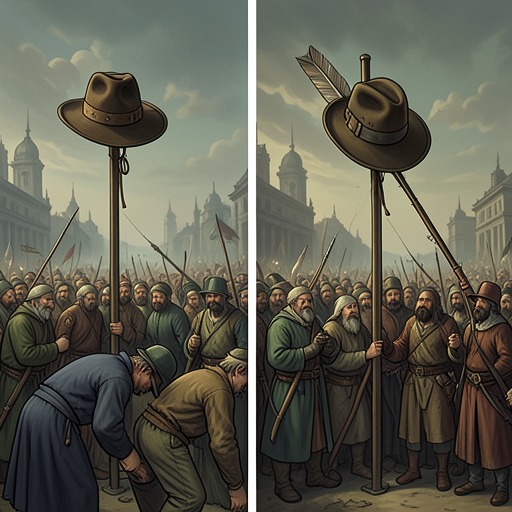
Hermann Gessler’s choice of headwear is practical and revealing. He tells his servants to cut a long pole, then asks for one of his hats—not the best, worn on Sundays and State occasions, nor the second-best, used every day, nor the hunting hat, which he still needs. He chooses the oldest. The servants put it on the pole and set it in the middle of the meadow just outside the town gates. A discarded possession is thus given a conspicuous place and made to stand for its owner.
The order is announced as a public ceremony. Hermann Gessler summons people from north, south, east, and west to hear something supposedly important and special, and they gather in tens, fifties, and hundreds: men, women, and children. At eleven o’clock, after breakfast, he addresses them from the Palace steps. The crowd does not respond as he expects. When he claims that they respect and love him, they remain silent; when he says they would like to visit his Palace and do reverence, a voice answers, “No, no!” Another speaker compares the cap unfavorably with Hermann Gessler himself.
His explanation turns the hat into a substitute for the access and reverence he says the crowd desires. Since the people are too numerous to visit the Palace, they may bow to the cap instead; in fact, they must. He declares that everybody is to look on it as if it were him. Anyone crossing the meadow without bowing is to be arrested by his soldiers and subjected to a grotesque punishment involving infuriated blackbirds. Threats of wild elephants, pink scorpions, and trained bluebottles answer the crowd’s interruptions. The extravagant punishments and the gap between his demand for love and the people’s silence give the decree a comic edge, but its consequence is coercive: the cap makes a gesture of submission compulsory in public space.
Tell’s Refusal and the Arrow
The day after the decree, William Tell arrives in town with Walter at his side and Tell’s crossbow over his shoulder. He knows nothing about the hat on the pole and is surprised by the crowd in the meadow. After greeting them, he sees the cap when Walter points it out. Tell answers, “What is the hat to us?” and walks across the meadow with dignity; Walter walks beside him, trying to look like his father. The soldiers stop them because neither has bowed.
The hat’s prescribed meaning is therefore challenged by a visible action rather than a counter-decree. Tell does not acknowledge the cap as a legitimate stand-in for the Governor. When the confrontation around him develops into a disturbance, he initially keeps apart: while the quarrel is between himself and Friesshardt, he is willing to fight, but he does not think it fair to join a crowd attacking one man. He then sees that the disturbance must be ended. Drawing an arrow from his quiver, he places it in his crossbow and aims at the cap.
Friesshardt recognizes what Tell intends and rushes to stop him, but someone in the crowd strikes Friesshardt with a spade, knocking his helmet over his eyes. Before he can see again, Tell has shot. The arrow passes through the cap, through the pole, and out the other side. The object that was meant to command a bow is pierced instead. The crowd dances, shouts, and throws its own caps into the air; Tell stands beside Friesshardt, twirling his moustache. The shot physically damages neither the Governor nor his authority in that moment, but it makes the cap’s imposed claim to reverence impossible to mistake for consent.
A Relic Reassigned
After news arrives that Hermann Gessler has been slain, meetings are held in towns across Switzerland, and the people resolve to begin the revolution without delay. They take by assault the fortresses Hermann Gessler built during his rule. At the last fortress to fall, even the people forced to help build it take pleasure in pulling down the stones they had labored to put in place; children join them. The old cap returns amid this wider dismantling of the Governor’s power.
A group brings the pole from the meadow. The cap is still at its top, nailed to the wood by Tell’s arrow. Ruodi identifies it as the hat to which the people had been ordered to bow, and voices in the crowd propose destroying or burning it as an emblem of tyranny. Tell stops them. He argues that the object should be preserved: Hermann Gessler had set it up to enslave the country, but the people can now set it up as a memorial of their newly gained liberty. He proposes that the pole mark the spot where the revolution finished. The physical arrangement is unchanged—the cap remains fixed to the pole by the arrow—but its public meaning has been deliberately reversed.
Symbol and Political Reversal
The cap’s power depends not on its material value but on the command attached to it. Hermann Gessler’s old hat is not a crown or a special insignia; it is an everyday object elevated by decree and backed by soldiers. The demand that people treat it as the Governor himself exposes the absurdity of rule that insists upon love while threatening punishment for disobedience. Its position in the meadow makes submission a visible, repeated choice for anyone crossing that space.
Tell’s arrow supplies the counter-image. It does not merely remove the cap or carry it away: it passes through both hat and pole, leaving the instrument of the decree visibly marked by the act that defied it. Later, the arrow remains embedded there as part of the relic. The crowd’s wish to burn the cap would erase the object associated with coercion; Tell instead gives it a new public use, preserving evidence of what was demanded and of the resistance that followed. The pole becomes a marker of the revolution’s claimed completion, while Arnold of Melchthal’s question about whether the struggle is truly finished keeps that claim in view as a political hope rather than an unquestioned fact. The cap’s passage from imposed object of reverence to memorial of liberty condenses the story’s larger reversal: a symbol created to make obedience visible is retained to make resistance, and the people’s unity, visible instead.