Hermann Gessler
William Tell (P. G. Wodehouse Edition)Hermann Gessler is the Austrian-appointed governor of Switzerland whose rule turns everyday life into a stage for taxation, arbitrary commands, and punishment. Presented with comic exaggeration but consequential power, he provokes resistance through both routine fiscal demands and public humiliations. His personal grudge against William Tell culminates in the apple-shooting test, Tell’s arrest, and Gessler’s death aboard his ship. The contrast between the governor’s grand claims and the ridicule directed at him makes him the story’s central portrait of authority without popular legitimacy.
Identity and Government
Gessler is sent to govern Switzerland by the Emperor of Austria, described as the Emperor’s friend. His office gives him the power to impose the policies that quickly alienate the Swiss people. The narration calls him an unpleasant man and presents the disagreement over taxes as a defining conflict of his administration: the Swiss object to paying them, while Gessler wants to tax everything he can think of.
The levies reach across ordinary sources of income and daily consumption. A farmer who owns sheep must pay; one who sells them and buys cows owes still more. Bread, biscuits, jam, buns, and lemonade are also taxed. The escalating list turns the policy into a comic inventory, but its implications are serious: Gessler’s authority reaches into both work and household provisions. The Swiss eventually decide to complain and send Walter Furst, Werner Stauffacher, and Arnold of Melchthal to make their case. When the delegates say they will no longer tolerate the situation, Gessler summons the Lord High Executioner rather than answer their grievance, making the threat of punishment part of his response to protest.
Grudge Against William Tell
Gessler’s conflict with Tell begins before the public confrontation over the hat. In the Schachenthal ravine, the two meet on a narrow route bordered by a steep rock wall and a river below. Tell openly condemns Gessler’s taxes on bread and sheep and predicts that the governor will come to a bad end. Gessler, who is visibly shaken by the encounter, is left to think over the insult; afterward, he bears a grudge and waits for an opportunity to retaliate.
Hedwig warns Tell that Gessler will not forgive him. Tell says he will avoid the governor and assumes Gessler will not seek him out. That confidence proves mistaken. The later punishment of Tell is not simply an impersonal enforcement of a rule: it follows an existing antagonism, and Gessler uses his office to turn a personal grievance into a public ordeal.
The Hat and Public Authority
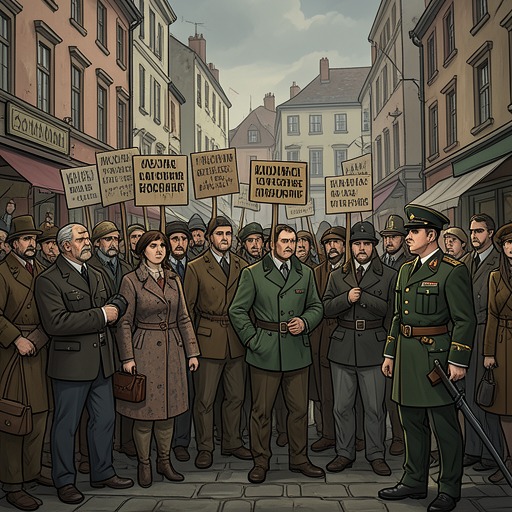
When Gessler cannot think of another prohibition with which to annoy the Swiss people, he devises a conspicuous substitute for appearing before them. He orders a very long pole, selects his oldest hat rather than the hats he wears on Sundays, on state occasions, every day, or hunting, and has it placed on top. The pole is erected in the middle of the meadow just outside the city gates. Heralds summon people from every direction to hear an announcement presented as important and special.
At eleven o’clock, after breakfast, Gessler tells the assembled crowd that the hat is to receive the reverence they would otherwise show him at his palace. He asserts that the people love and respect him, although they remain silent when he pauses for their approval. Voices from the crowd contradict his claim and mock the cap. Gessler answers dissent with extravagant threats and orders his soldiers to move the gathering along. His speech therefore exposes the gap between the obedience he demands and the respect he claims to possess. The hat is more than an arbitrary object: by requiring passers-by to bow to it as though it were himself, he makes submission visible in a public space.
Confrontation and Apple Test
The next day, Tell and his son Walter come to town, unaware that events have changed. At the meadow, the encounter with the hat brings Tell into direct conflict with Gessler’s soldiers. A crowd gathers, and Tell shoots an arrow through the cap. When Gessler arrives, he finds the hat damaged, two soldiers on the ground, and Tell still standing by the pole. Friesshardt’s account explains the sequence: he had ordered Tell to bow, struck him with a pike when he refused, and was then attacked by Tell and the crowd. During the fighting, Tell shot through the hat. Gessler hears that the crowd lifted Tell onto their shoulders and that he began to speak before the governor arrived.
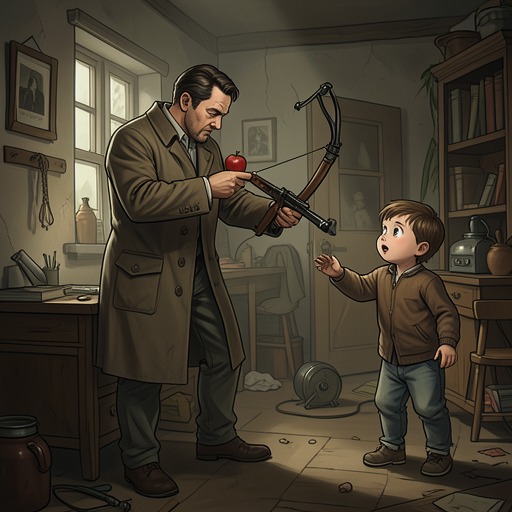
Gessler redirects the confrontation into a test that exploits Tell’s reputation as a skilled archer. He takes an apple that had been thrown earlier and orders Tell to shoot it from Walter’s head at a distance of one hundred yards. He makes the first shot a condition of Tell’s survival, and threatens the boy’s life as well if Tell refuses. Tell protests that a father should not be made to take such a risk with his son. Gessler rejects the appeal and insists that the command is his will. The test thus converts Tell’s skill into an instrument of state power: refusal and failure are both made dangerous, while the governor controls the terms of the spectacle.
Arrest, Death, and Political Meaning
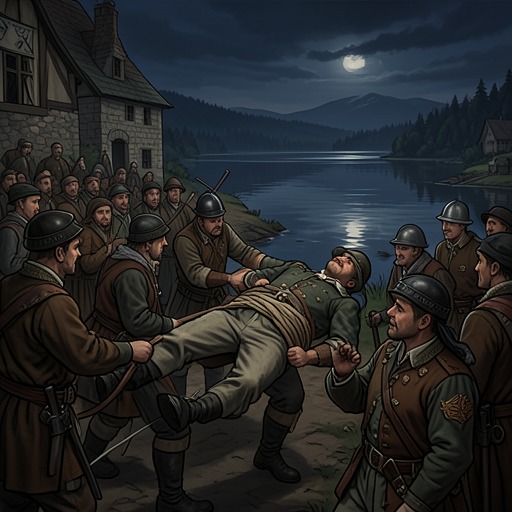
After Tell succeeds in shooting the apple, he reveals that he had kept a second arrow for Gessler in case the first had killed his son. Gessler orders his arrest. When Rudolph der Harras reminds the governor that he promised Tell his life, Gessler distinguishes survival from freedom: he says he will honor the promise by imprisoning Tell in a dungeon at Kussnacht, where Tell will be unable to carry out the threat. He orders the soldiers to bind Tell and take him to his ship, saying that he will conduct the prisoner to Kussnacht himself. Tell does not resist, and the crowd groans as he is led to the lakeshore.
Aboard the ship, Gessler calls for his bowmen to shoot, but Tell acts first. His second arrow kills the governor on deck. The ending completes the pattern established by Gessler’s earlier acts: he uses commands to constrain others, but cannot secure the obedience or safety he demands. His death also belongs to a larger political change. The epilogue says the Emperor’s death later allows the Swiss revolution to proceed without interference and that Switzerland becomes free; it does not attribute that outcome to Gessler’s death alone. Instead, the story closes its portrait of the governor with a deliberately smaller irony: although the governor is demolished, the epilogue adds that taxes are not abolished. The joke punctures any simple claim that defeating one tyrant ends the burdens of government.