Rudolph der Harras
William Tell (P. G. Wodehouse Edition)Rudolph der Harras emerges in the meadow scene as an intermediary between Hermann Gessler’s authority and the people endangered by it. His brief interventions follow the crisis from Walter’s peril, through the proof of William Tell’s skill, to Gessler’s attempt to seize Tell; each time, he speaks or acts at a moment when the Governor’s power is being tested.
At Walter’s Peril
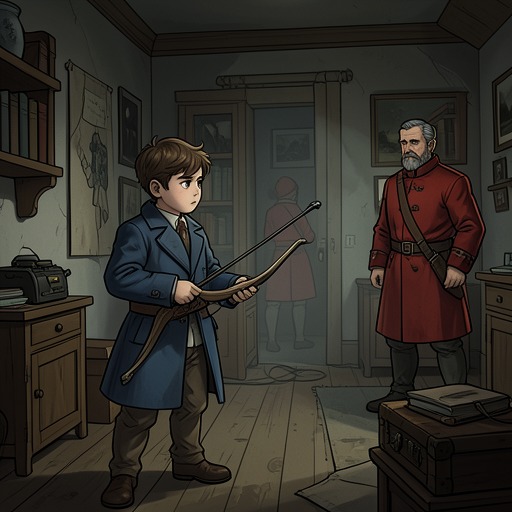
When Hermann Gessler makes Walter’s life depend on William Tell shooting the apple on his head, Rudolph whispers advice to the boy: “Down on your knees, boy,” he urges, telling Walter to beg “his Excellency for your life.” The counsel offers submission as a possible way out of the Governor’s threat. Walter refuses: “I won't!” Rudolph’s appeal therefore marks the child’s resolve without changing the danger confronting him.
The Shot and Its Proof
After William Tell’s arrow strikes the apple, Rudolph takes it from Walter and shows it to Hermann Gessler, who remains transfixed on his horse. Rudolph points out the arrow’s passage through its center and calls the feat “a master shot.” His action makes him the bearer of visible evidence: rather than leaving the result as a claim, he presents the pierced apple before the Governor. Rosselmann’s severe remark that it was nearly a “'Master Walter shot,'” however, shifts attention from Tell’s accuracy to the danger the boy himself faced.
The Arrest and the Broken Promise
When Hermann Gessler orders Tell seized, Rudolph first reminds him of the promise he made: “My lord, bethink you,” he whispers, “you promised him his life.” He then calls out, “Tell, fly!” Tell does not move. Gessler repeats the order, now directing that Tell be bound and cut down if he resists. Rudolph’s intervention makes the conflict between the Governor’s stated promise and his renewed command explicit, but it cannot prevent the arrest order from proceeding.