Swiss uprising against Austrian rule
William Tell (P. G. Wodehouse Edition)The Swiss uprising against Austrian rule transforms resistance to Hermann Gessler’s government into a countrywide revolution. Its decisive turn is not simply the fall of Gessler: the revolt draws on a long-prepared oath and cooperation between nobles and peasants, then converts the symbols and structures of rule into signs of collective freedom. A further change in imperial power prevents the expected retaliation and allows Switzerland to become free.
Causes and Preparation
The uprising has a long prehistory. Before Gessler’s death, fear of the Governor had chiefly prevented the people from rising, but the revolt had been “brewing for a long time.” The Swiss people had sworn solemnly to drive the enemy from the country, and preparations were already under way throughout Switzerland. Nobles and peasants had united, making the resistance broader than a single grievance or a single community.
An earlier exchange gives the immediate political pressure a specific form: the people ask whether Gessler will release them from the taxes, and the answer is no. Walter Furst draws a deep breath and concludes that they must rebel. The people’s response—first repeating the word as a question, then echoing it after Furst repeats it firmly—marks a decision taking shape in public. The later account connects that decision to a much wider movement: the denial of tax relief sharpens the crisis, while the oath, preparations, and alliance across social ranks show that rebellion was not made from nothing in that moment.
Gessler’s death supplies the signal that fear had previously withheld. The account distinguishes the trigger from the underlying cause: the uprising follows the Governor’s killing, but the conditions for it had accumulated beforehand. Once news of his death arrives, the people no longer defer action.
The Revolt and the Fall of the Fortresses
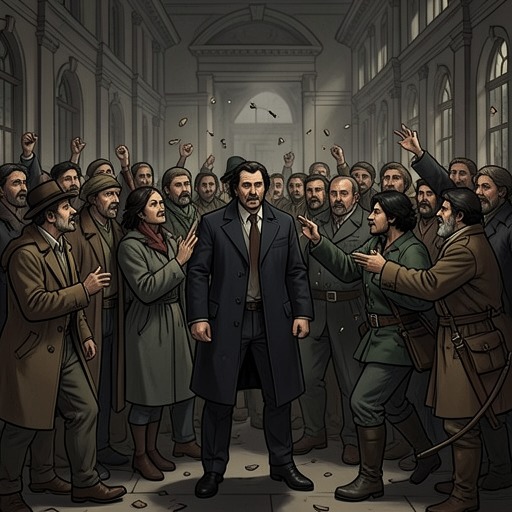
Meetings are held in every town in Switzerland as soon as news reaches the people, and they resolve to begin the revolution without delay. That decision is followed by a coordinated assault: all the fortresses Gessler built during his years of rule are taken on the same night. The account presents the fall of these strongholds as both a practical defeat of his rule and a public reversal of the labour his system had imposed.
The last fortress to fall had only recently been started. People forced to help build it spend an hour pulling down the stones they had laboured to put in place, and children join them. Their pleasure in breaking what they choose, without being told not to, makes the destruction more than a change of military control: the scene reverses the experience of compelled construction and prohibition. William Tell watches the children and observes that, when they are old, they will remember this night as clearly as the next day. His remark gives the victory a future as well as a present; the event is imagined as a memory carried by those who witnessed it.
The Pole and the Meaning of Victory
In the aftermath, people bring forward the pole Gessler’s soldiers had erected in the meadow. The hat remains nailed to its top by Tell’s arrow, an object that joins the Governor’s command to the act of defiance that pierced it. Some call for the emblem to be destroyed or burned. Tell stops them and proposes instead that the pole be preserved as a memorial of the liberty newly gained, and that it mark the place where the revolution finished.
That proposal changes the object’s public meaning without erasing its history. The pole had been set up to help enslave the country; preserved, it is to recall the oath to drive the tyrants out. The people’s debate over whether to destroy it or keep it also shows that victory requires an account of what has happened, not only the removal of the regime’s fortresses. Tell’s answer makes memory part of the settlement: the instrument associated with submission is retained as evidence of the freedom won against it.
The claim that the revolution is finished is immediately tested. Arnold of Melchthal asks whether the Emperor of Austria will seek revenge for Gessler’s death and the destruction of the fortresses. Tell expects that he will, but answers that the Swiss will meet the danger. He points to the few mountain passes through which an enemy can approach and says they will be defended, identifying unity as the people’s great strength. The speech does not suggest that the threat has disappeared; it frames the revolution’s achievement as a capacity to face a new one together.
Imperial Crisis and the Outcome
The expected imperial response is overtaken by events beyond the uprising. A messenger reports that the Emperor has been killed while riding from Stein to Baden: the lords of Eschenbach and Tegerfelden attack him with spears, and his bodyguard, separated from him by a stream he has just crossed, cannot assist him. He dies instantly. The account presents this death not as an action of the Swiss revolt but as the circumstance that allows the revolution to proceed without check.
The Emperor’s successor must defend himself against those who killed his father and therefore cannot turn his attention to attacking the Swiss. By the time he is free to do so, the Swiss have become too strong to attack. The movement’s final success thus comes through both its own consolidation and a change in the imperial situation: the fortresses have fallen, the people are united, and the successor’s attention is elsewhere until the balance has shifted. The narrative concludes that the Swiss became free.
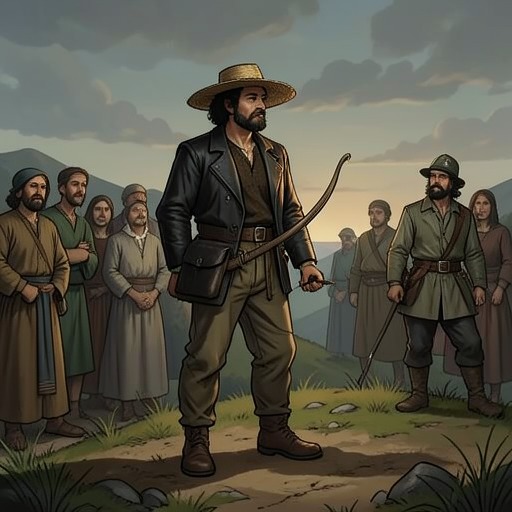
For William Tell, the political change is followed by a return to private life: he goes home and lives with Hedwig and their two sons. That closing domestic outcome stands beside, rather than in place of, the collective one. The uprising begins in resistance to rule and ends with freedom secured, while the preserved pole and the children’s anticipated memory give the victory a visible marker and a generational horizon.