Tell’s escape from Gessler’s ship and killing of Gessler
William Tell (P. G. Wodehouse Edition)William Tell’s escape from Gessler’s ship and killing of Gessler is the turning point that converts a threatened prisoner into a fugitive who has killed the governor pursuing him. A storm drives the ship toward a hazardous shore passage; William Tell is forced to take the helm, saves the vessel, then uses the moment after the danger has passed to escape and strike at Hermann Gessler. The sequence makes skill first a means of survival under threat, then the means of breaking free.
Storm and immediate danger
At first the ship travels through calm water, while William Tell lies below and listens to the sailors moving about on deck. He has given up hope of seeing his home and friends again. The change comes when he notices the vessel rolling and pitching harder: a sudden storm has arisen on a lake where conditions can shift from smooth to perilous during a crossing. The account stresses that the danger is not incidental. Spray obscures the entrance to the bay, and the rocks along the coast make a mistaken approach liable to wreck the ship.
Hermann Gessler stands beside the helmsman, watching the rocky entrance to the bay near Castle Kussnacht. It is the only safe landing place for miles; the coast on either side is lined with rocks. The helmsman cannot be sure of finding the passage through the spray, and a mistake would mean shipwreck. William Tell, who is below deck, therefore becomes essential not because he has any authority aboard but because the crew needs the ability he possesses.
The storm also changes the stakes for William Tell. He welcomes the danger because he sees years of imprisonment in the dark dungeon of Castle Kussnacht as worse than drowning. His response gives the peril a double meaning: for the people aboard, it threatens immediate destruction, while for him it offers a possible end to captivity. This does not make the storm a chosen escape plan; the opening of the opportunity comes from the ship’s crisis and the crew’s need for a capable helmsman.
The forced passage into the bay
Rudolph der Harras asks what the ship is to do. The helmsman hesitates, then tells Hermann Gessler that William Tell could steer them through if the governor would give him the helm. Gessler reacts with startled repetition of Tell’s name before summoning him. When William Tell does not answer at once, Gessler gives him a direct order: take the helm and steer through the rocks into the bay, or face instant death.
William Tell complies without speaking. He peers into the obscured passage and turns the vessel first to one side, then the other, before steering back into the spray. The ship is now among the rocks, yet it does not strike them. It pitches and shudders through the passage until the spray is behind it and the calm water of the bay lies ahead. The successful crossing is a precise reversal: Gessler has compelled the very man he holds captive to save the ship, and William Tell’s skill has preserved the lives of those aboard, including the governor who ordered him to act.
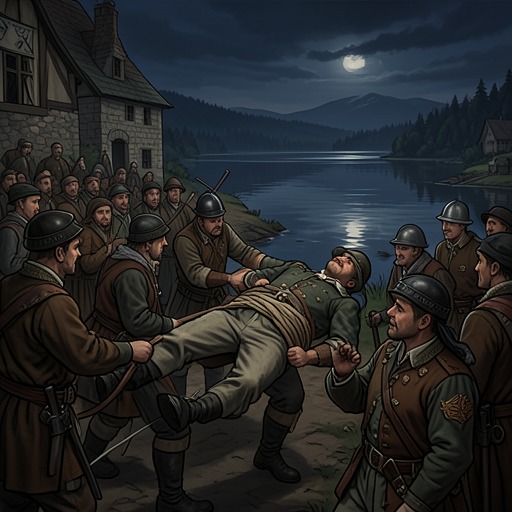
Once the ship is safe, Gessler beckons the helmsman to take back the helm and orders the soldiers to bind William Tell. The soldiers advance slowly, reluctant to bind the man who has just saved them from destruction, but they still carry out the governor’s command. The change from dependence to renewed restraint is immediate. William Tell’s service has not earned his freedom; the order to bind him shows that Gessler intends to resume control as soon as the danger has passed.
Escape and the second arrow
As the soldiers approach with ropes, William Tell moves back. The ship is gliding past a lofty rock, one of the rocks he has often climbed while hunting Chamois. He acts with a hunter’s quickness: he takes the bow and quiver lying on deck, springs onto the vessel’s bulwark, and leaps to the rock. In a moment he is out of reach. The escape depends on a fleeting conjunction of place, equipment, and opportunity: the ship passes close enough to a climbable rock, his bow and quiver are on deck, and he moves before the soldiers can bind him.
Hermann Gessler responds by shouting to his bowmen to shoot. They fit their arrows too late. William Tell is ready first, and his arrow strikes Gessler, who falls dead on the deck. The account identifies this as William Tell’s second arrow finding its mark, as the first had done. The parallel makes the shot an answer to an earlier successful act of archery, while its consequence is radically different: the second arrow ends Gessler’s life and the immediate power he has exercised over his captive.
Consequences and narrative significance
The escape and killing follow directly from the shipboard sequence rather than from a planned confrontation on the rock. Gessler’s command first forces William Tell into a role that saves the ship; the order to bind him then makes clear that the rescue will not change his captive status. His leap breaks the soldiers’ immediate control, and Gessler’s order to shoot begins the final exchange. The governor’s authority proves unable to secure the prisoner once the ship’s danger, and then the guards’ hesitation, have opened a narrow chance to act.
The event also reverses the distribution of power aboard the vessel. At the start, William Tell lies below deck believing he will never return home, while Gessler directs the voyage and commands the soldiers. During the storm, Gessler must depend on William Tell’s competence; in the bay, he attempts to restore his authority by ordering him bound. The leap to the rock defeats that restoration, and the second arrow turns flight into the killing of the governor. The storm that William Tell had welcomed as an alternative to imprisonment thus becomes the circumstance in which he escapes and kills Hermann Gessler.