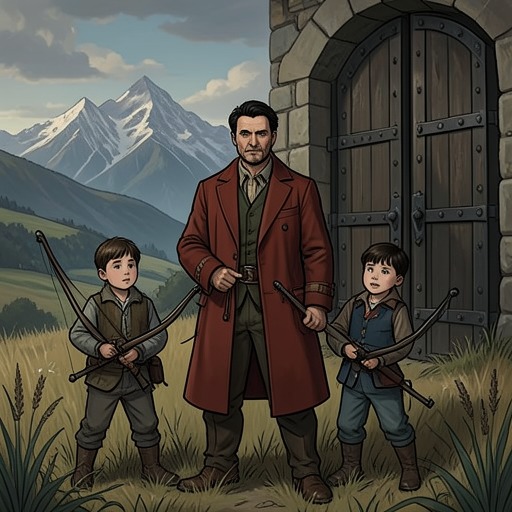
William Tell and Hermann Gessler’s antagonism
William Tell (P. G. Wodehouse Edition)William Tell and Hermann Gessler’s antagonism grows from a private grievance into an open contest over the Governor’s authority. Gessler bears a grudge after Tell condemns his taxes and predicts his downfall; later, he turns a public test of loyalty into a perilous demand involving Tell’s son. Tell’s concealed second arrow then exposes the danger beneath his obedience, and Gessler’s attempt to imprison him ends with Tell’s escape and the Governor’s death.
Origin of the Grudge
The conflict begins in the ravine of Schachenthal, where the two men meet in a place with no easy way past one another. Tell is travelling with his crossbow when he encounters Gessler. The Governor reacts with visible apprehension, but Tell does not retreat or soften his judgment. He condemns Gessler’s taxes on bread and sheep and warns that the Governor will come to a bad end. The rebuke is brief, but it establishes the terms of their relationship: Tell speaks to Gessler as a man answerable for his conduct, while Gessler regards such direct criticism as an insult to be repaid.
Tell leaves the encounter scornfully, but Gessler does not let it pass. He keeps the grievance alive and waits for an opportunity to retaliate. The asymmetry between them is already clear: Tell can speak bluntly and continue on his way, while Gessler possesses the power to turn resentment into punishment. Their antagonism is therefore personal without being merely private. Tell’s criticism concerns the burdens imposed by the Governor’s rule; Gessler’s response makes dissent itself a target.
Hedwig understands the danger more clearly than Tell does. After hearing what happened in the ravine, she predicts that Gessler will not forgive him. Later, when Gessler is in town, she urges Tell to wait until the Governor has gone and to stay away because Gessler bears him malice. Tell answers that he does what is right and need not fear an enemy. Hedwig counters that Gessler hates those who do right most of all, and reminds Tell that he has never forgiven the earlier encounter. Their exchange makes the coming collision foreseeable: Tell trusts his own integrity to protect him, while Hedwig recognizes that integrity will not restrain a ruler who can punish at will.
A Public Test of Authority
The old grievance returns amid a public confrontation over Gessler’s hat, which has been placed on a pole as a test of the people’s loyalty. When Gessler rides into the meadow, the crowd disperses rather than risk being caught in a gathering that might look like rebellion. Tell remains by the pole. The scene presents him alone, with two of Gessler’s soldiers subdued nearby and an arrow through the Governor’s cap. Tell does not flee, though he recognizes that the situation is dangerous.
Gessler’s questioning brings the earlier encounter directly into the present. He recognizes Tell and reminds him of their meeting in Schachenthal, treating the former rebuke as a remembered offense. Tell confirms where they met. Gessler then joins that old grievance to the immediate incident: he accuses Tell of mistreating his soldiers and of defying his authority by refusing to bow to the hat. He explains the hat as proof of the people’s loyalty, transforming a refusal to perform an act of homage into an accusation of disloyalty. The conflict has moved from a private exchange in a ravine to a public judgment of what obedience to Gessler means.
Gessler’s response makes that judgment coercive. He orders Tell to shoot an apple from his son’s head, placing the boy a hundred yards away, and threatens Tell’s life if he fails to hit it with his first shot. Tell protests that a father cannot be asked to take such a risk with his child. Gessler refuses to withdraw the command and insists that it is his will. The demand is not simply a test of Tell’s skill: Gessler deliberately makes compliance carry a terrible personal stake, while presenting the danger as an opportunity suited to a celebrated marksman. Tell’s objection underscores the gulf between the Governor’s power to command and the human cost of obeying him.
The Second Arrow and the Arrest
Tell complies with the shooting demand, but he has placed a second arrow in his belt while preparing to shoot. Gessler notices it and demands to know why he carried it. Tell first pretends surprise, but the Governor is not deceived. Once pressed, Tell explains that if his first arrow had struck his child rather than the apple, the second would have been aimed at Gessler. The disclosure changes the meaning of the earlier test: Tell had submitted to the imposed ordeal, but had also prepared to answer the possible death of his son by killing the man who ordered it.
The crowd responds with approval, and Gessler turns furious. He orders Tell seized. Tell does not resist, but scornfully says that he should not have trusted a tyrant to keep his word and that his death will show his countrymen what the Governor’s promises are worth. Gessler rejects that charge on a narrow distinction. He says he promised Tell his life and will not take it, but claims he never promised him freedom. Because Tell has revealed an intention to kill him if the first shot failed, Gessler says he must guard against that danger. He orders Tell bound and taken by ship to the dungeons at Kussnacht, where he intends to confine him beyond the reach of his arrows.
This exchange lays bare the political structure of their antagonism. Gessler treats his promise as technically intact while using his power to remove Tell’s liberty and prevent the threat from being carried out. Tell, by contrast, interprets the arrest as proof that a ruler’s formal word cannot be trusted when the ruler controls its meaning. The crowd’s groans as Tell is led to the lake register that the conflict has consequences beyond the two men: the arrest is witnessed as an act against someone who has become a public opponent of the Governor.
Escape and Final Reversal
Aboard Gessler’s ship, the balance of power shifts when the vessel passes a lofty rock that Tell knows from hunting. As soldiers approach with ropes, Tell steps back, takes up his bow and quiver from the deck, leaps onto the bulwark, and gains the rock. His escape depends on the same physical skill that had made Gessler’s earlier shooting challenge seem plausible, but now that skill serves freedom rather than compliance. The Governor’s plan to carry Tell to Kussnacht is interrupted before the intended imprisonment can begin.
Gessler orders his bowmen to shoot, but they are too late. Tell gets ready first and shoots the Governor, killing him on the deck. The second arrow has now found its mark, not as the contingency Tell hoped would never be needed, but as the decisive end of their conflict. The sequence reverses Gessler’s attempt to control Tell through command, threat, and confinement: the Governor who set the terms of the apple test and ordered the arrest is himself brought within reach of Tell’s weapon.
Significance of the Antagonism
The conflict’s recurring objects carry its development. The hat begins as Gessler’s instrument for demanding visible obedience; Tell’s refusal and the arrow through it expose the coercion beneath that demand. The apple then makes Gessler’s authority intimate, forcing Tell to risk his son’s life. Finally, the second arrow converts an unspoken possibility into an explicit threat and, after Tell’s capture, into the means by which he kills Gessler.
Their opposition thus moves through distinct stages: Tell’s spoken criticism of oppressive taxation, Gessler’s delayed personal resentment, the public accusation of disloyalty, the imposed ordeal, and the attempt to confine Tell after he reveals his intention. Gessler repeatedly interprets resistance as a challenge to his authority; Tell refuses to treat that authority as beyond moral judgment. The final reversal does not erase the coercion that produced the confrontation. It completes a relationship in which Gessler’s effort to silence and contain Tell ultimately places the Governor within the reach of the very second arrow he had demanded Tell explain.