
The Moral Boundary Between Resistance and Revenge
William TellThis flow follows the play’s effort to distinguish defense of the vulnerable from violence pursued for private vengeance or ambition.
increasing Bearing strength in each event
 decreasing
Bearing strength in each eventdecreasingBaumgarten’s Defense

Baumgarten’s Defense
Violence as immediate protection
Conrad Baumgarten explains that he killed the seneschal while defending his wife from sexual assault. The fisherman and herdsman initially recoil at the blood on his clothes, then recognize the desperation of his situation.
A contested justification
The play places the act beside the question of whether any free person should endure such an attack. Baumgarten claims a household right to defend its honor, while the flight itself shows how dangerous that choice has become.
The incident introduces violence as morally complicated rather than automatically heroic. Its urgency lies in protecting another person from an immediate wrong.
The Assembly Rejects Private Revenge

The Assembly Rejects Private Revenge
Arnold’s anger
Arnold of Melchthal wants to attack Landenberg after learning that his father has been blinded. His grief is understandable, but the elders warn that a lone assault would fail against the governor’s fortified power.
A collective alternative
Werner Stauffacher insists that the meeting is meant to prevent future wrongs, not simply repay the past. Arnold joins the broader undertaking, where a common plan can protect more people.
The shift does not require him to forget his father’s suffering. It asks him to place justice inside a shared political purpose rather than allow pain to dictate the form of punishment.
Tell’s Vow Under Duress
Tell’s Vow Under Duress
A father forced to aim
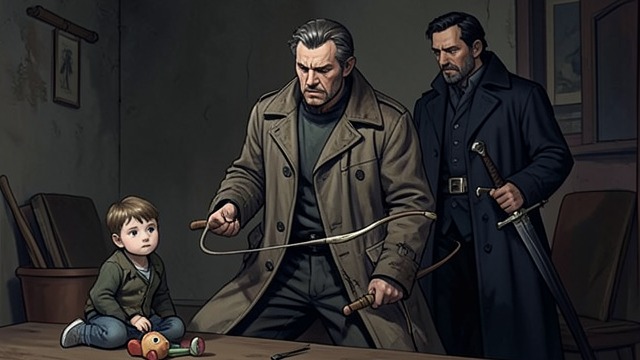
Tell is made to risk Walter’s life at Gessler’s command. His successful shot prevents the threatened harm, but his second arrow reveals what he would have done if the governor had killed his child.
A morally charged response
Tell’s stated intention is directed at the person who has created the danger. The ordeal places his possible violence within the immediate defense of family, not the pursuit of rank or conquest.
The distinction does not remove the danger of his choice. It asks the audience to judge an act shaped by coercion and by the need to prevent further violence.
The Ambush in the Pass
The Ambush in the Pass
A promised act of retaliation
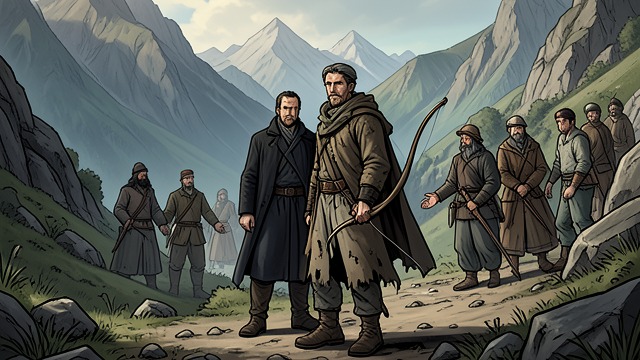
Tell waits for Gessler after escaping imprisonment and recalls his vow to shoot the governor. He also explains that Gessler’s threat endangered his wife and children.
A public consequence
The arrow kills Gessler, and the people declare that their country is free of its enemy. The act is both personal retaliation and a turning point in a wider political crisis.
The play does not make the killing indistinguishable from every later act of violence. It places Tell’s deed against an established pattern of coercion and the immediate danger to his household.
Duke John’s Plea

Duke John’s Plea
A different motive for killing
Duke John arrives disguised as a monk after killing Albert I. He argues that the emperor withheld his patrimony, but Tell rejects the comparison between ambition-driven regicide and a father’s defense of his child.
Compassion without approval
Tell condemns the murder yet refuses to treat Duke John as beyond human concern. He directs him toward confession and penitence rather than offering shelter for his crime.
The encounter clarifies the moral boundary of the play’s resistance. A grievance may be real without making murder just, and compassion can coexist with a refusal to excuse violence.
Opening scene, during Baumgarten’s flight
During the Rütli meeting
During the apple ordeal at Altdorf
Near the ending, on the way to Küssnacht
At the ending, at Tell’s cottage
