
The Fishermen and the Storm
William TellThis flow uses the lake and the people who navigate it to show how danger tests practical courage and mutual responsibility.
increasing Bearing strength in each event
 decreasing
Bearing strength in each eventdecreasingStorm Signs
Storm Signs
Nature gives warning
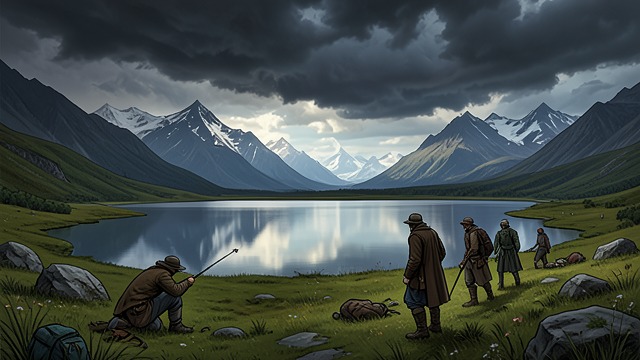
The fisherman, herdsman, and huntsman read the behavior of animals, wind, and water as signs of an approaching storm. Their practical knowledge comes from living closely with the mountains and lake.
A landscape of risk
The play opens with the lake, meadows, and distant glaciers presented as both beautiful and dangerous. The storm is not merely scenery; it shapes the choices people can safely make.
The natural world establishes an order no governor controls. That contrast becomes especially sharp when political authority assumes that everyone and everything must obey.
Ruodi Weighs the Crossing
Ruodi Weighs the Crossing
A real danger
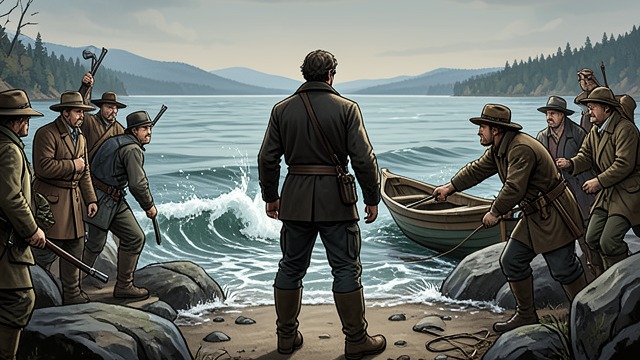
Ruodi refuses to take the boat out because the storm is rising. He knows that the lake can overwhelm an experienced boatman and has a family of his own to protect.
Pressure from compassion
Kuoni and Werni remind him that Baumgarten’s life is at stake. Their appeal does not erase the danger but makes clear that refusing also has consequences.
The scene treats courage as a choice made amid competing responsibilities. It does not assume that a person who hesitates is indifferent to another’s suffering.
Tell’s Dangerous Passage
Tell’s Dangerous Passage
Action where talk ends
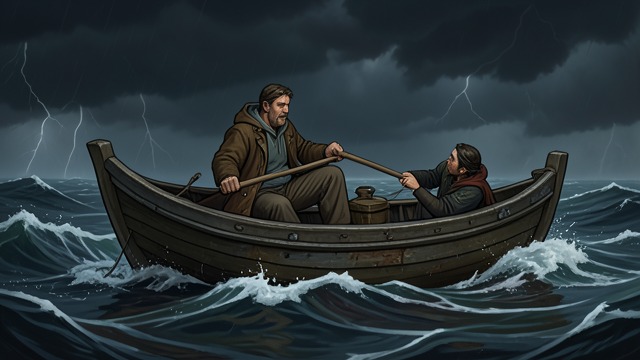
Tell decides that Baumgarten cannot wait and takes the boat into the storm. He accepts the possibility that he may not return, asking the herdsman to comfort his wife if disaster follows.
Skill joined to compassion
He uses his knowledge of the lake to carry the fugitive across. The rescue depends on both physical competence and a decision to place another person’s need ahead of his own safety.
The act becomes an early measure of Tell’s character. His later political choices will carry greater consequences, but this rescue shows that his instinct for aid predates the uprising.
The Governor at Sea
The Governor at Sea
Authority meets its limits
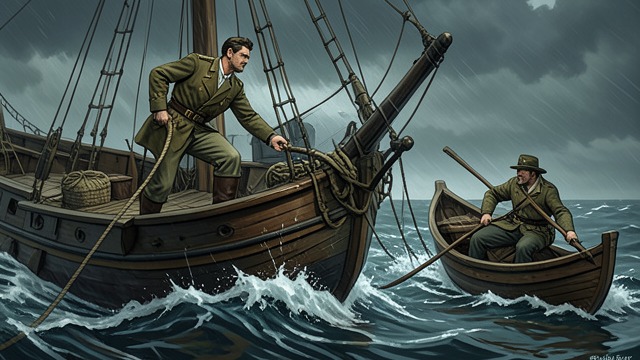
Gessler’s ship is caught in a storm that cannot be quieted by commands or symbols of office. The boatmen struggle, and the governor must rely on the prisoner he has bound.
A practical dependence
Tell agrees to steer the ship through danger and uses the chance to escape. His knowledge of the water proves more decisive than Gessler’s armed authority.
The episode reverses their apparent positions without making nature a simple ally. The storm threatens everyone, but it creates an opening that the capable and alert can use.
The Lake as Witness
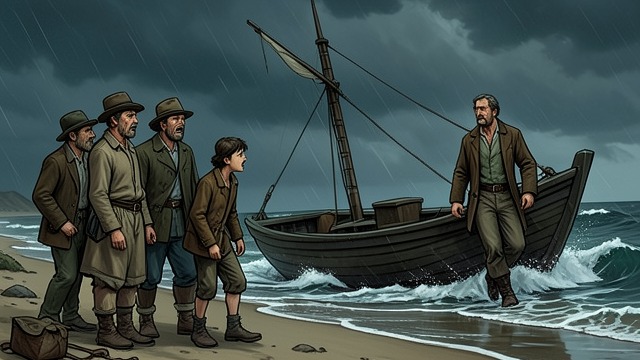
The Lake as Witness
Rumor on the shore
A fisherman and boy watch the governor’s vessel struggle through the storm and fear that Tell remains aboard. The storm intensifies their sense that the people are powerless before forces they cannot control.
A changed report
Tell appears on shore and recounts his escape. The lake that had seemed to carry him toward imprisonment has instead delivered him to freedom and back into the landscape he knows.
The sequence turns a natural hazard into a witness to political reversal. Yet its power remains morally neutral: survival depends on human judgment, not on nature dispensing justice by itself.
Opening scene, before Baumgarten arrives
Opening scene, as Baumgarten begs for passage
Opening scene, during the storm crossing
Near the ending, during the storm after Tell’s arrest
Near the ending, after Tell’s escape
