Assassination of Albert I
William TellAssassination of Albert I is an offstage killing recounted as news to the Swiss leaders: the emperor is slain by his nephew Duke John and other attackers while traveling near the Reuss. The report transforms a private act of dynastic violence into a political turning point. For those fearing imperial power, Albert’s death removes a dreaded adversary; yet the promised change in the crown is only reported, not settled.
The News and Its Stakes
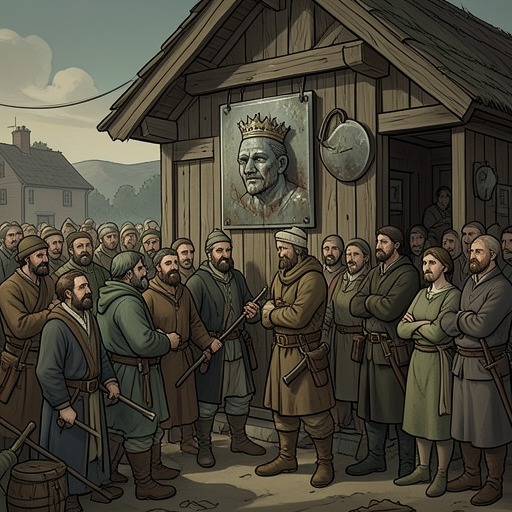
The event reaches the assembled characters through a sequence of announcement, disbelief, and confirmation. Rosselmann states that the emperor has been murdered; Walter Furst reacts with alarm, and Melchthal asks how the news could be known. Werner Stauffacher confirms it, presenting the information as reliable rather than rumor: John Mueller, from Schaffhausen, brought the report. The exchange makes the murder consequential before its circumstances are fully described. Its first force is the shock of learning that the highest ruler has fallen.
The news also alters the emotional and political atmosphere. Before the murder is recounted, a speaker declares that the group has been released from one great cause of dread. Stauffacher later explains that the most formidable enemy of liberty has fallen. Their response is not simple celebration: the death is a “bloody deed,” and the language of relief exists beside recognition of its horror. The play holds these judgments together, showing how the removal of a feared ruler can ease one danger without making the means or consequences uncomplicated.
The Journey and the Separation
Stauffacher places the killing during Albert’s journey from Stein to Baden, as the emperor traveled onward to join the court at Rheinfeld. He was accompanied by high-born gentlemen and by the young princes John and Leopold. This itinerary matters to the account because the emperor is not described as isolated from the start. The attackers create that isolation: at the ferry of the Reuss, they force their way into the boat in order to separate him from his suite.
The crossing establishes the physical division on which the episode turns. Once Albert has landed and rides on, those who had been with him are left across the stream. The report thus makes the river more than a place-name: it separates the emperor from his attendants at the moment when their presence might have mattered. The people on the opposite bank see what follows but cannot intervene, and their response is reduced to an ineffectual cry of lament. The scene’s helplessness arises from the stated geography and separation, not from any lack of witness.
The Attack and Its Participants
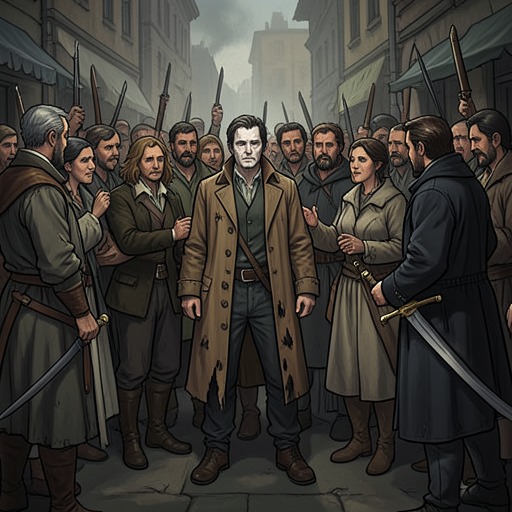
With the ancient towers associated with the House of Habsburg in sight, Duke John attacks Albert. Stauffacher identifies the assailant as the emperor’s nephew, his own brother’s child, and says that Palm and Eschenbach also take part in the killing. The account therefore presents the act as both a coordinated assault and a betrayal within the imperial family. Albert dies on his own soil, killed by kinsmen; the familial relation intensifies the political crime rather than excusing or obscuring it.
The report names several participants but does not give a detailed account of their planning or establish what each expected to gain. Nor does the question of motive receive an immediate answer when Melchthal asks what drove Duke John to the deed. Later, when Wilhelm Tell recognizes Duke John and names him as the killer of his uncle and liege lord, John gives a concise explanation: Albert had deprived him of his patrimony. That later statement supplies the duke’s stated grievance, but the play does not make it a full account of the plot or a justification of the killing.
Witnesses and the Report’s Human Scale
The killing is narrated not only through princes, attendants, and political consequences but through two sharply contrasted groups of witnesses. The emperor’s suite is divided from him by the stream, and those on the far bank can only lament. A poor woman sitting beside the way, by contrast, reaches him after the attack. She raises him and holds him as he dies. The account offers no further biography or explanation of her actions; her brief appearance is significant precisely because it places an ordinary person at the emperor’s final moment where the formal retinue cannot reach him.
This contrast gives the report a carefully bounded human focus. The witnesses across the river possess sight but not the means to prevent the event; the woman beside the road offers care after the attack, but cannot reverse its outcome. The emperor’s status does not protect him from death, and the scene’s final care comes not from the assembled nobles but from an unnamed woman. Stauffacher’s account thereby moves from dynastic identity and public violence to an encounter whose significance rests on a simple action of assistance.
Political Consequences and Dramatic Significance
For the Swiss characters, Albert’s death removes a major source of fear, but it does not itself establish their freedom or settle who will rule. Stauffacher says that the crown is reported to be passing from the House of Habsburg to another line. The qualification matters: the change is presented as a report about the succession, not as a completed political settlement. The characters can recognize an opening while remaining without certainty about what will follow.
The episode’s dramatic force comes in part from this distance between the event and its telling. Albert is killed away from the assembled Swiss leaders; they encounter the death through a messenger’s news as Stauffacher reconstructs the journey, separation, attack, and aftermath. That structure lets the audience hear both the immediate reaction and the later particulars, while keeping the murder itself outside the present gathering. The account is therefore at once an announcement, a witness narrative, and a political calculation.
The murder also creates a telling contrast with the resistance of the Swiss characters. They regard the emperor’s fall as relief from a powerful enemy of liberty, but the report attributes the killing to a nephew acting against his uncle and liege lord, with accomplices. The play does not collapse those circumstances into a single moral category. Instead, it lets the news sharpen the difference between a tyrannical power feared by the community and a dynastic killing driven, as Duke John later claims, by a grievance over inheritance. The death changes the balance of fear, while leaving its violence and the uncertain succession in view.