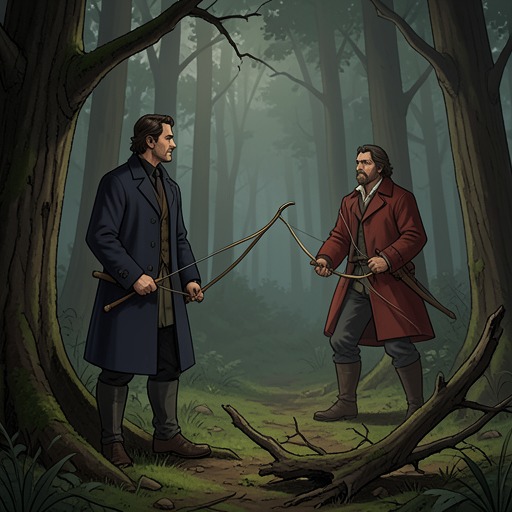
Assassination of Gessler
William TellWilhelm Tell’s assassination of Hermann Gessler turns a carefully chosen mountain pass into the scene of a political rupture. Tell waits above the narrow route to Küssnacht with his crossbow, shoots the governor as he passes, and lets Gessler know who has struck him. The act is personal vengeance, but its consequences are voiced collectively: Gessler’s fall is followed by a declaration that the country’s people are free and will brook no further violence. The play then gives Gessler’s cap a second life, transforming an emblem of enforced submission into a public sign of liberation.
The ambush at the defile
Tell enters carrying his crossbow and identifies the deep defile as the place where Gessler must pass. He notes that no other road leads to Küssnacht. The constricted route matters to his plan: it brings the target within reach of his arrow and, Tell says, makes pursuit difficult. The setting is not incidental scenery but the condition that allows the attack to be made and escape from immediate pursuit to seem possible.
Tell’s words establish that he has come prepared to kill. He calls on Gessler to answer for his actions before Heaven and declares that the governor’s time on earth is over. At the same time, he describes himself as having led a peaceful, inoffensive life. The contrast places the violence against the life Tell says he had previously chosen; it does not make the killing accidental. His crossbow, the selected passage, and his explicit address to Gessler all make the act deliberate.
The shot and recognition
The stage direction makes the decisive action abrupt: an arrow pierces Gessler, who puts a hand to his heart and begins to sink. His first response is a plea for divine mercy. Tell, appearing above on the rocks, tells him to address himself to God because he is dying. The elevated position that gave Tell his opportunity now makes the archer visible to the wounded governor and to the audience.
Gessler identifies the shot as Tell’s. Tell confirms that recognition, telling Gessler not to seek another hand. The exchange makes responsibility explicit: the killing is neither mistaken nor attributed to an unknown attacker. Tell also links his action to a wider claim, saying that their cottages are free and invoking innocence. The surviving lines do not complete that statement, but they clearly place the shot beside the freedom of ordinary homes rather than presenting it as a private contest alone.
From a fallen governor to a public claim
After Gessler falls, the scene’s language shifts from the single archer to the community. A voice insists that the country’s foe has fallen, rejects further violence, and declares, “We are free men.” The response does not erase the violence of the assassination; it gives the act an immediate public meaning. Tell has killed the governor, while the collective declaration names the political condition the speakers claim has changed.
This public significance is reinforced by the play’s recurring treatment of Gessler’s cap. Earlier, a crier announces in the emperor’s name that the cap will be set on a lofty pole in Altdorf’s market-place. Its display makes submission a public performance: the cap is placed where people must see it, and the command is issued before a crowd. The assassination reverses the force of that emblem. What had stood for authority imposed from above can now be handled and reinterpreted by the people.
The cap’s changed meaning
The play places other collective gestures alongside this reversal. Rosselmann calls for a ring to be formed and for the swords of power to be planted in the ground. Elsewhere, people involuntarily remove their caps and contemplate the breaking day in silence. These staged acts make political change visible through bodies and objects: a circle forms, swords are grounded, and a crowd stands bareheaded before the light. They are distinct scenes, but together they frame freedom as something publicly enacted and witnessed, not merely asserted by Tell’s shot.
Later, girls bring the cap in on a pole before a stage filled with people. When one voice proposes letting it burn, Furst refuses: it should instead be preserved, because the former instrument of despots can become a lasting symbol of freedom. The cap therefore does not simply disappear with Gessler’s death. Its meaning changes through public handling and decision. The object once used to stage obedience is retained as evidence of the power that has been overturned, while the assassination remains the sharpest point of that reversal.