Canton of Schwyz
William TellThe Canton of Schwyz is a political home under Hermann Gessler’s oppressive rule and a community whose claimed freedom coexists with obligations to the Holy Roman Empire. The play defines the canton chiefly through that tension: its people resent arbitrary domination, yet distinguish it from the freely accepted protection and duties they associate with imperial authority.
Local Setting and Political Pressure
Gertrude identifies Schwyz as the place where worthy men groan under Hermann Gessler’s grasping tyranny. The reference makes the canton more than a point on the map: it is a local community experiencing the pressure of the governor’s rule. The language locates the grievance among its people, rather than presenting resistance as an abstract dispute over sovereignty.
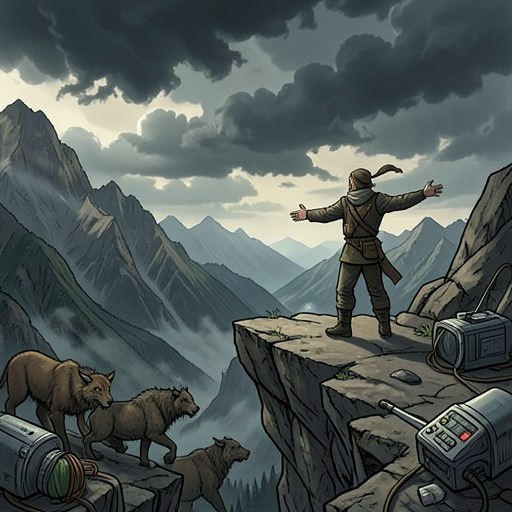
The dramatic world surrounding the canton is mountainous and exposed to sudden natural change. A rumbling, cracking sound and moving cloud shadows alter the landscape; elsewhere, thunder and wind accompany a rising lake. These images establish a volatile Alpine setting, but the play does not specifically identify those particular scenes as taking place in Schwyz.
Imperial Ties and Local Rights
The political argument distinguishes imperial protection from submission to a prince. The cantons’ representatives maintain that they have never bowed the knee to princes and sought the Empire’s protection freely; Rosselmann points to Emperor Frederick’s charter as confirmation that this protection was freely granted. Their account presents the relationship as a chosen compact, not as an admission that a local governor may rule without limit.
Stauffacher complicates any simple claim of independence by observing that even the freest people have a feudal lord and need a supreme authority to hear appeals in disputes. He also describes the freeman’s duty to aid the Empire in war and protect the power that in turn protects him. The argument gives Schwyz’s political identity two sides: resistance to arbitrary local domination and acceptance of obligations within a broader imperial order.
Stauffacher’s inherited lands provide a personal instance of that feudal relationship. He holds the lands left by his fathers in fief from the emperor, a fact invoked while explaining Gessler’s envy of his prosperous, free life. This detail concerns Stauffacher’s own inheritance; it does not establish that every holding in the canton had the same tenure.
Resistance and Intercantonal Cooperation
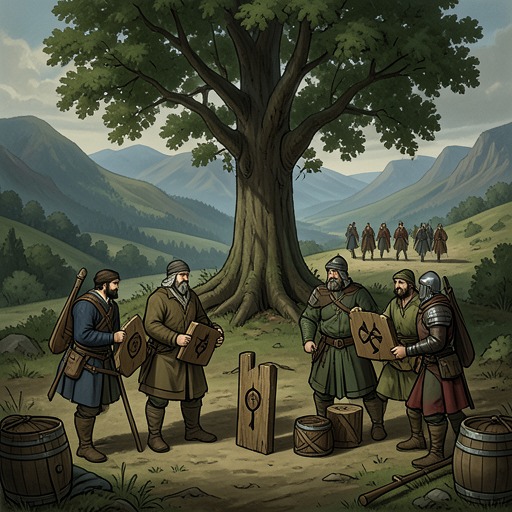
As resistance moves from grievance toward action, the speakers frame their purpose as casting off a hated thraldom and preserving ancient rights. Furst’s proposed limit is significant: they will do what necessity requires, drive out the tyrants and their followers, and raze their strongholds. The plan is expressed as a defense of established rights against oppressive rule, rather than a rejection of every superior authority.
The discussion also reveals cooperation among the cantons. Stauffacher says the sword should go to the Canton of Uri because its banner takes precedence in battle. The gesture places military coordination within a shared political undertaking and recognizes an established order among the allies. Schwyz’s role is therefore part of a collective resistance, not a solitary campaign.
Landscape and Dramatic Geography
The play gives more concrete form to its wider setting through scenes of water, weather, and difficult routes. During a storm-bound boat journey, Wilhelm Tell notes that his bow and quiver lie astern beside the helm and urges the rowers toward a shelving crag, where he believes the danger will pass. Near Küssnacht, the stage directions describe a descending pass with rocks on either side and travellers first visible on the heights; a traveller later reports that heavy rains have flooded the streams and swept away the bridges.
These scenes make terrain and weather consequential in the drama: they shape routes, obstruct travel, and frame moments of danger. The play does not, however, provide a comparable physical portrait of Schwyz itself. Its clearest definition remains political—the community named as suffering Gessler’s tyranny, while its rights, imperial ties, and cooperation with the other cantons are argued in public.