Gessler’s apple-shot ordeal
William TellHermann Gessler’s apple-shot ordeal makes Wilhelm Tell’s skill serve a coercive test: he must shoot an apple from Walter Tell’s head or face death himself. The shot succeeds, but the scene’s decisive revelation comes afterward. Wilhelm Tell discloses that he had reserved a second arrow for Hermann Gessler if the first had struck his child, transforming an apparent demonstration of obedience into an act shadowed by the possibility of resistance.
The Command and Its Stakes
Hermann Gessler frames the demand as proof of marksmanship. Since Wilhelm Tell can supposedly hit an apple from a hundred yards, Gessler orders him to take up his bow and shoot an apple from the boy’s head. The language of a test cannot conceal its violence: the target is placed on a child, and the governor dictates that a miss will cost Wilhelm Tell his life. Skill is being demanded under a threat that makes failure fatal to both father and son.
The immediate exchange establishes the personal stakes before the shot. Wilhelm Tell has said that both boys are equally dear to him. Gessler’s order therefore forces him to act against the very attachment he has just expressed: he must aim carefully at an object resting on his child, with no allowance for a second attempt. The command reduces a father’s love to the condition of the test, while making the governor the person who sets both its terms and its penalty.
The crowd’s horrified response registers that this is not an ordinary feat of archery. Gessler presents the order as an opportunity for Wilhelm Tell to approve his skill before him, but the threatened consequence exposes the unequal power behind that framing. Wilhelm Tell is not freely demonstrating his ability; he is compelled to do so, and the cost of a mistake has been explicitly named.
The Shot
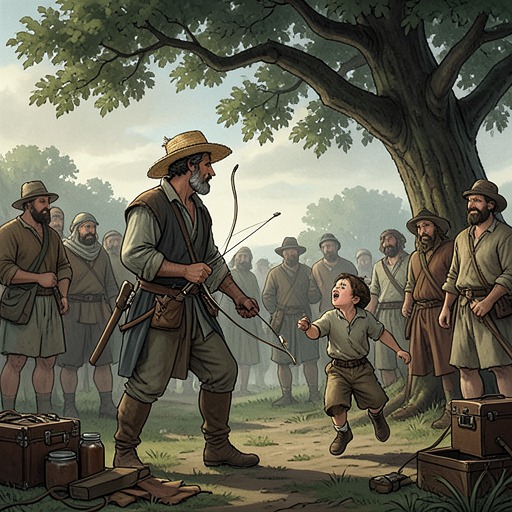
After further instructions from Hermann Gessler, Wilhelm Tell bends his bow and fixes the arrow. The stage direction brings the physical mechanics of the ordeal into view: the weapon is in hand, the aim must be made, and the apple on the boy’s head is the mark. Before the shot, Wilhelm Tell calls for a clear lane. The preparation concentrates the scene on the narrow gap between practiced skill and irreversible harm.
The shot takes place while attention has turned elsewhere. Bertha of Bruneck has thrown herself between Ulrich von Rudenz and Hermann Gessler, and the crowd’s attention is directed toward them. In that moment, Wilhelm Tell shoots. The staging makes the success occur alongside a separate confrontation rather than presenting the shot as a prolonged public display. The audience learns the result through the response: Werner Stauffacher exclaims that the apple is down, and Rosselmann confirms that the boy is alive.
Walter Tell then runs in carrying the apple. His arrival supplies visible confirmation of the outcome and gives the endangered child his own response: he says he knew his father would not harm him. The apple has been struck and the boy has survived. That resolution settles the immediate physical test, but it does not settle what Wilhelm Tell intended or what the threat has cost him. The successful shot resolves the danger as staged while leaving a more dangerous truth to be spoken.
The Second Arrow
The ordeal’s meaning changes when Hermann Gessler promises not to take Wilhelm Tell’s life and Wilhelm Tell agrees to declare the truth without reserve. He draws another arrow from his belt and fixes his eyes sternly on the governor. The gesture gives the disclosure a concrete object: the second arrow is not an abstract threat but a weapon Wilhelm Tell has kept with him through the test.
Wilhelm Tell explains the condition attached to it. Had his hand struck his child, he would have aimed the second arrow at Hermann Gessler, and he says he would not then have missed. The first shot therefore carried two different possibilities: the publicly imposed aim at the apple and a concealed intention directed at the governor if that aim ended in Walter Tell’s death. The scene reveals that Wilhelm Tell’s compliance was bounded; he obeyed the demanded shot, but had prepared to answer its worst consequence with violence.
The promise of safety immediately precedes this admission. Hermann Gessler’s assurance allows Wilhelm Tell to speak, but the fact disclosed makes the assurance tense rather than reassuring: the governor learns that the threatened father had held a second arrow for him. The exchange shifts the balance of the scene from the display of authority to a direct statement of what Wilhelm Tell was prepared to do. His words distinguish the successful shot from the contingency that would have followed a failure, without pretending that the danger had been harmless.
Consequence and Dramatic Significance
The apple-shot ordeal resolves on two levels. In public, Wilhelm Tell meets the imposed challenge: the apple falls, Walter Tell is alive, and the threatened penalty for a miss is not incurred. In the private intention disclosed afterward, however, the shot has never been merely a test of accuracy. The second arrow makes visible the limit of the governor’s control: Hermann Gessler could compel the first act, but could not make Wilhelm Tell accept the killing of his child without resistance.
The scene builds its force through the contrast between a small target and immense stakes. An apple rests on a boy’s head; a single arrow is meant to prove skill; a missed shot would cost a life, and the father’s next arrow would have been aimed at the governor. The recovered apple confirms precision, while the arrow drawn from Wilhelm Tell’s belt reveals the danger that precision had contained. Success ends the immediate ordeal, but the disclosure ensures that the encounter cannot be read as a simple victory for Hermann Gessler’s authority.