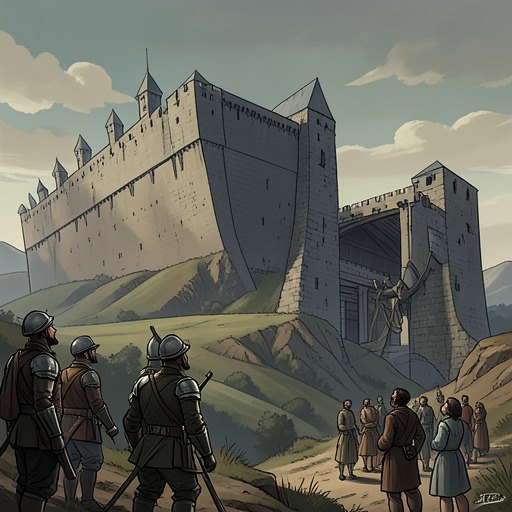
Gessler’s hat-salute decree
William TellGessler’s hat-salute decree is Hermann Gessler’s public order requiring the people of Uri to honor his cap as they would honor him. Raised on a pole in Altdorf’s marketplace, the cap makes submission visible and enforceable: people must bow on bended knee and uncover their heads, while refusal risks the loss of life and property. The order’s political force lies not only in what it commands, but in the public performance it demands—and in the later reversal by which the same cap becomes a symbol of freedom.
The Order and Its Public Setting
The decree is proclaimed in the emperor’s name. A crier calls the people of Uri to attention and announces that the cap will stand on a lofty pole in the marketplace at Altdorf. The governor’s stated wish is that the cap receive honor equal to his own. Every passerby must show reverence with a bowed knee and uncovered head; the king, the announcement says, will thereby know who among the people are his true and loyal subjects.
This arrangement turns a simple object into a public test. The cap is made conspicuous, and the required gesture is equally visible: obedience cannot remain private or ambiguous when people are expected to perform it before the pole. The decree thus makes loyalty legible to authority through an imposed ritual. Its threat gives that ritual material force: anyone who refuses forfeits life and goods to the crown. The order couples a bodily gesture of submission with the possibility of total punishment.
The people’s immediate laughter punctures the solemnity the proclamation tries to impose. That response does not, by itself, cancel the decree; the cap remains an object of surveillance, and guards stand watch over it. But the laughter introduces a gap between the obedience the order demands and the consent it cannot command. The public display is intended to demonstrate the governor’s power, yet it also gathers the people around a shared spectacle of that power’s absurdity and threat.
Enforcement and Resistance
The decree becomes an active danger when Wilhelm Tell tries to pass without saluting the cap. As Tell turns to leave, Friesshardt bars his way with a pike and orders him to stop in the emperor’s name. Reporting to Hermann Gessler, Friesshardt identifies himself as a soldier of the governor’s guard, stationed as sentinel beside the cap. He says he arrested Tell for passing without the required obeisance and adds that the people tried to rescue him.
The arrest demonstrates how the decree operates beyond its announcement: the pole is not merely a sign of authority but a guarded checkpoint at which conduct is judged and punished. Tell’s refusal makes the rule’s demand concrete, while the people’s attempted intervention shows that its enforcement can draw resistance from those gathered around it. The order claims to identify loyal subjects; its application instead exposes a conflict over whether the governor may compel public reverence.
After Friesshardt’s report, Hermann Gessler pauses, then challenges Tell over whether he holds the king and the governor, who acts as the king’s vicegerent there, lightly. The exchange places the cap’s required salute within a larger claim of delegated royal authority. The object is the immediate focus of the arrest, but the justification reaches from the governor to the crown: refusal to honor the cap is treated as an affront to the political hierarchy it represents.
From Instrument of Rule to Symbol of Freedom
The cap returns in a later public celebration, again carried on a pole, but its meaning has changed. Girls bring it into a scene filled with people. Walter Furst rejects the suggestion that it should be destroyed: the cap, once an instrument of despots, should instead be preserved as a lasting symbol of freedom. The object that had made compelled obedience visible is thus kept in public view as a reminder of its defeat.
That reversal does not erase the decree’s earlier coercion. It changes the meaning attached to the same visible object and display. Under Hermann Gessler’s order, the pole demanded a bow and uncovered head; in the later scene, preserving the pole-borne cap allows the community to mark a different political condition. The decree’s legacy is therefore carried not only in the memory of its threat and enforcement, but in the transformation of its emblem: what was meant to certify loyalty to authority becomes an enduring sign of freedom from despotic rule.