Holy Roman Empire
William TellThe Holy Roman Empire appears in the drama as a source of protection and a limited framework of authority, not as a synonym for the governors’ coercive rule. The communities of Uri, Schwyz, and Unterwalden describe their relationship with the Empire as freely chosen: they accept an imperial superior and duties of defense while preserving their own laws and customs. That distinction shapes the political logic of their resistance. They seek to end the governors’ tyranny without renouncing the older imperial relationship they regard as legitimate.
Imperial Protection and Local Freedom
Werner Stauffacher recalls the communities as a free people who had never bowed the knee to princes, but had freely sought the Empire’s protection. Rosselmann answers that protection was freely granted and recorded in Emperor Frederick’s charter. Their account gives the imperial bond a consensual basis: it is not represented as a conquest imposed on the communities, but as an arrangement they sought and received.
That protection does not erase local autonomy. At home, the communities govern themselves in peace under their own laws and ancient usages. The Empire occupies a higher place in the political order, but the play does not depict it as administering ordinary local life. Stauffacher’s formulation that even the freest people have a feudal lord places the Empire within a hierarchy, while leaving room for substantial self-rule below it.
Rights, Duties, and Limits of Authority
The relationship includes reciprocal obligations. The communities owe the emperor military assistance, as other free people of his realm do, and Stauffacher treats this as the freeman’s duty: to defend the Empire that protects him. The obligation is specific rather than unlimited. In his account, the Empire is their feudal lord, but that does not make every demand by a local ruler an imperial right.
Judicial authority is also described as bounded. The emperor’s stated right is to adjudge the penalty of death; for that purpose, he names a powerful noble as his delegate. Yet the communities continue to rule themselves through local laws and usages. The arrangement therefore combines imperial supremacy in a grave matter of judgment with customary local jurisdiction. The play presents the governors’ abuses against this background of divided authority, making the question not simply whether rule exists, but whether a particular exercise of power belongs to the order the communities accepted.
Resistance Without Renouncing the Empire
The distinction becomes explicit when a speaker urges Werner Stauffacher not to swear allegiance to Austria if he can avoid it, but to hold firmly to the Empire as before. The two affiliations are not treated as interchangeable. The advice preserves the older imperial connection while rejecting submission to Austria as the governors’ immediate political demand.
When the communities decide that no other course remains, Walter Furst frames their aim as shaking off a hated thraldom and keeping their ancient rights inviolate. He then draws a limit around the proposed action: they will do what necessity requires, but nothing beyond it; they will drive out the tyrants and their agents and raze their strongholds. The stated target is the coercive local regime, not the Empire as such. This is why the resistance can be presented as the recovery of established rights rather than a rejection of every superior authority.
Public Symbols and Collective Authority
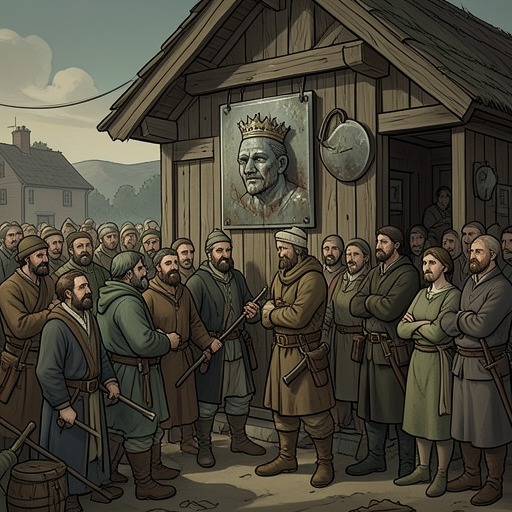
The Empire’s name also appears in a public performance of power. A crier speaks in the emperor’s name and directs the men of Uri to attend to a cap that is to be set on a lofty pole in Altdorf’s marketplace. The scene makes authority visible through an object and a required public response. Later, the cap is brought back on a pole before a crowd. Furst refuses to let it be destroyed: once an instrument of despots, it can be preserved as a lasting symbol of freedom. The object’s meaning has changed, even though the play does not identify the cap itself as an imperial institution; its public presentation had invoked the emperor’s name.
Other staged gestures give the communities’ political claims a collective form. Rosselmann calls for a ring to be formed and for the swords of power to be planted in the ground. At daybreak, those present involuntarily remove their caps and contemplate the light in silence. These actions place shared authority and public witness beside the older language of imperial allegiance. The opening of the Bond identifies the men of Uri, the community of Schwyz, and the people of the mountains of Unterwalden, marking a further level of association among the communities without making their common bond identical to the imperial hierarchy.
Significance in the Political Conflict
The Empire’s importance lies in the distinction it allows the communities to draw between legitimate, bounded authority and arbitrary domination. Protection, military service, appeal, and delegated judgment belong to the inherited relationship as the speakers describe it; the governors’ coercion does not acquire legitimacy merely by operating under a larger political order. Stauffacher’s appeal to the Empire and Furst’s determination to expel the tyrants can therefore coexist. The drama’s political argument is not that freedom requires the absence of every superior authority, but that authority must remain within the terms that make protection and self-government compatible.