Imperial Ban
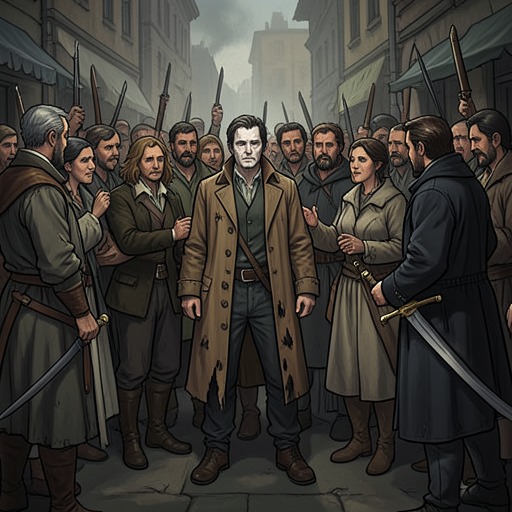
William TellThe Imperial Ban turns imperial authority into a sentence of exclusion. When Wilhelm Tell tells Duke John that the ban has been issued, its force is described not merely as punishment but as the severing of ordinary protection: Duke John is interdicted from his friends and delivered as a victim to his enemies. The rule’s consequence is visible at once in his isolation. He avoids public thoroughfares and will not knock at any door, taking instead to the mountains, where he becomes a terror to himself.
Imperial Authority and Local Law
The ban appears within a political order in which imperial power coexists with local self-government. Werner Stauffacher and Rosselmann recall that the communities freely sought the empire’s protection and that this protection was freely granted. Their account invokes Emperor Frederick’s charter as the record of that arrangement. Werner Stauffacher also observes that even the freest people still have a feudal lord and a supreme judge to whom disputes may be appealed. Imperial authority is therefore presented as part of a recognized hierarchy, not simply as a foreign force imposed from outside.
That hierarchy nevertheless has limits and is carefully defined in the speakers’ account. The communities continue to govern themselves in peace according to their own laws and ancient usages; the emperor’s stated right is to adjudge the penalty of death, exercised through a powerful noble appointed as his delegate. This distinction makes the Imperial Ban significant as an assertion of a higher jurisdiction over an individual, while the surrounding discussion insists that imperial supremacy does not erase local legal practice. The play places the ban within a layered order of authority rather than treating law as a single, uniform command.
The Ban’s Effect on Duke John
The exchange between Wilhelm Tell and Duke John makes the ban’s practical meaning concrete. Wilhelm Tell identifies Duke John as barred from his friends and exposed to his enemies. The terms describe more than loss of welcome: they leave him without the ordinary social shelter that might make travel or seeking help possible. Duke John confirms the consequence through his conduct. He keeps away from public routes, does not risk knocking at a door, and turns toward the wilds and the mountains.
The ban thus reshapes Duke John’s movement through the world. Roads and houses, ordinarily means of passage and refuge, become places he avoids; the mountains become his route because he says he has no safe public course. His isolation is not presented as a chosen retreat from society. He describes it as the result of the imperial sentence, which makes contact dangerous and leaves him wandering. The rule operates through this forced withdrawal as much as through its formal declaration.
Exclusion and Self-Alienation
Duke John’s account carries the ban inward. He says that he has become a terror to himself and shrinks in horror from his own self; even the chance of seeing his form reflected in a brook is something he dreads. The image of the possible reflection gives the punishment a private reach: although the sentence is imposed by imperial authority, its consequences extend into the outlaw’s own apprehension of himself. The play does not need to show an official pursuing him in order to make the sanction felt. His avoidance of people and his fear of his own image convey how completely the ban has narrowed his life.
This inward consequence should be distinguished from the ban’s stated legal effect. The dialogue explicitly establishes his exclusion from friends and exposure to enemies, then shows his retreat and self-horror; it does not detail a procedure for issuing the ban or specify every legal consequence attached to it. The force of the passage lies instead in the connection between public status and lived vulnerability: once declared outside the protection of friends, Duke John cannot treat ordinary places or encounters as safe.
The Ban in the Play’s Contested Order
The surrounding debate over resistance gives this imperial sanction a wider political context without making it identical to the communities’ dispute with their rulers. Walter Furst says that they must seek to shake off a hated thraldom while preserving their ancient rights; he also sets a limit on resistance, insisting that they will do what necessity requires and no more. The proposed expulsion of tyrants and their agents, and the destruction of their strongholds, is framed as a defense of inherited rights. Against this collective claim, the ban appears as an imperial power directed at one exposed individual. The two situations are not equated, but together they show that the play’s political world contains both competing claims to lawful authority and the threat of punishment for those placed beyond protection.
The appearance of the Bond, naming the men of Uri, the community of Schwytz, and the men of the mountains of Unterwald, further places political belonging in a communal frame. Beside that collective record, Duke John’s ban marks the opposite condition: not a community affirming its members, but an individual cut off from friends and left to move through the wilderness. The contrast clarifies the rule’s dramatic significance. The Imperial Ban makes imperial authority legible through the vulnerability it creates, while the play’s discussion of charters, local usages, and communal bonds keeps open the question of how far that authority may reach.