Küssnacht
William TellKüssnacht matters as more than a destination: the pass near it becomes a natural chokepoint where Wilhelm Tell can intercept Hermann Gessler. The play connects the governor’s plan to imprison Tell there with the defile’s defining feature—there is no other road to Küssnacht—so the landscape helps shape the encounter.
Setting and Route
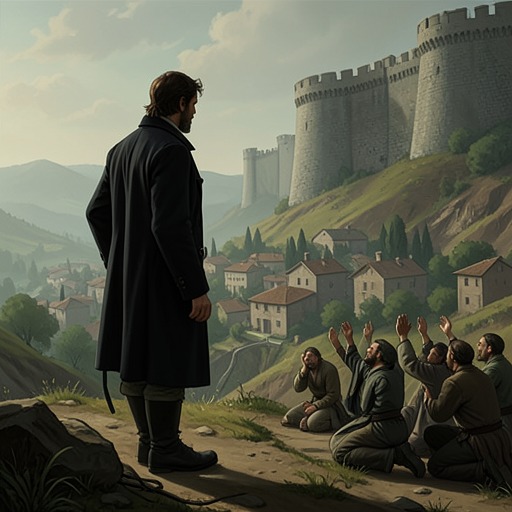
The stage direction places the pass near Küssnacht on a slope, with rocks on either side and brushwood growing over the surrounding rock. Travellers can be seen on the heights before they appear onstage, giving the approach a visible but not yet immediate presence. The scene’s steep, enclosed terrain narrows movement toward the road below.
Tell identifies the pass as the only way to Küssnacht. That restriction makes the place tactically important: rather than pursuing Gessler across open country, Tell can wait where the route itself requires the governor to pass. The setting thus supplies the conditions for an interception without requiring Tell to control a wider area.
Intended Destination
After ordering Tell taken aboard his ship, Gessler says that he will personally see him lodged at Küssnacht. Tell later recalls hearing Gessler state that he meant to disembark at Brunnen. These details place Küssnacht within the governor’s plan for Tell’s custody, while also showing that the journey by water involved an intended landing elsewhere before the planned confinement.
During the stormy passage, Tell’s bow and quiver lie astern beside the helm. He urges the men to row with all their strength until they reach a shelving crag, where he says the danger will be past. The episode makes the route toward Gessler’s intended destination contingent on the lake and its hazards; Tell’s escape interrupts the governor’s plan to bring him to Küssnacht.
The Pass and the Interception
Tell enters the pass with his crossbow and chooses it as the place to act. Because there is no alternative road to Küssnacht, he regards the opportunity as favorable. The travellers are first visible high above the stage, while Tell waits in the brushwood-covered rocky defile below: the staging turns the approach into a suspenseful interval before the expected passage reaches him.
The governor’s arrival is also subject to weather and damaged infrastructure. A traveller warns that Gessler will not come that day: heavy rains have flooded the streams and swept away all the bridges. This report disrupts the expectation that the governor will pass as scheduled, showing how water and broken crossings can delay movement toward Küssnacht. Together, the pass and the flooded routes make access to the place a practical constraint—and, for Tell, the basis of an opportunity.