Liberation of the Swiss Cantons
William TellThe Liberation of the Swiss Cantons is the play’s passage from resistance to a publicly affirmed free community. Its decisive change is not only the removal of oppressive authority: the people also define the limits of their obligations, reclaim a symbol once used to command obedience, and offer protection and membership to someone seeking refuge. The final celebrations credit Wilhelm Tell with helping secure the country’s liberty, while Bertha’s reception gives that freedom a civic form.
Causes and Political Principles
The uprising is presented as a defense of inherited rights, not as a rejection of every higher authority. In the gathering that precedes the revolt, the people recall that they freely sought the empire’s protection and that it was freely granted. Rosselmann invokes Emperor Frederick’s charter as evidence of that compact. Werner Stauffacher acknowledges that even the freest people may have a feudal lord and a supreme judge to whom disputes can be appealed. Their account makes a distinction between legitimate protection and the conduct of the tyrants: imperial obligations do not, in their view, license arbitrary domination.
The same distinction shapes the proposed resistance. Walter Furst says they will do what necessity requires, but no more: they intend to drive out the tyrants and their followers and bring down their strongholds. Werner Stauffacher’s account of the people’s duty to aid the empire in war likewise frames military service as reciprocal. The freeman guards an empire that guards him. Against that standard, revolt is represented as a response to a broken political relationship, aimed at restoring ancient rights rather than claiming unlimited power for the rebels.
Collective Resistance and Public Signs
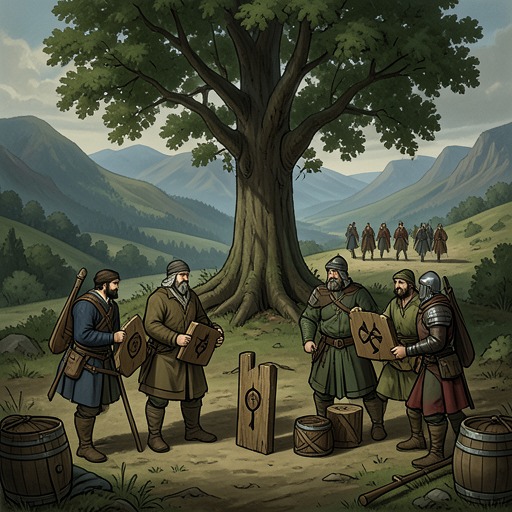
The play gives this political change a visible, communal shape. Rosselmann calls for a ring to be formed and for the swords of power to be planted in the ground. The gesture gathers the participants around a shared purpose: resistance is no longer only a private grievance but a collective undertaking. At daybreak, those assembled remove their caps and contemplate the light in silence. The pause marks a threshold between the earlier deliberation and the public action that follows.
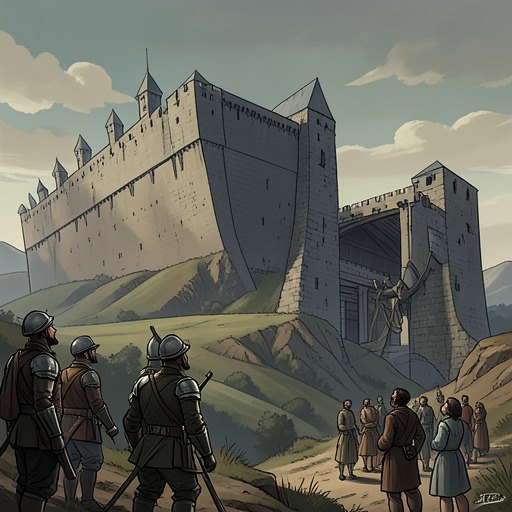
The cap in Altdorf provides a second, more contested public sign. A crier announces, in the emperor’s name, that it is to be set upon a lofty pole in the market-place; the workmen’s cry for silence makes the order a public performance of authority. Later, during the uprising, the people fall upon the building from every side, and Walter Furst recognizes that the floodgate has burst and the crowd cannot be restrained. After the stronghold’s seizure, girls bring the cap back on its pole before a stage filled with people. When others propose burning it, Furst argues that it should instead be preserved: once an instrument of despots, it can now remain as a lasting emblem of freedom. The object’s meaning changes with the balance of power, from a sign imposed on the people to one they can keep and reinterpret together.
Freedom Acclaimed and Shared
The return of Wilhelm Tell makes the consequences of liberation personal as well as political. Hedwig welcomes him as alive and free, and declares that she and the others are free too; she credits the country’s liberty to him. Walter adds that he also bore a part in the struggle. Their exchange locates the victory between an individual act of courage and the work of a larger community: Tell is honored, but the son’s claim prevents the celebration from reducing the people’s freedom to one man’s achievement.
Tell’s own response is framed as a public declaration. He raises his hand freely before Heaven and says it has shielded those present and set his country free. The gesture answers the earlier coercive display of the cap with a hand raised voluntarily. The play thus links freedom not only to the removal of the oppressor but also to the ability to act and speak without compulsion. Tell’s claim is forceful, while the surrounding recognition by Hedwig and Walter supplies a communal account of what his action has meant.
Bertha’s appeal shows the new community extending protection beyond the immediate victors. Addressing the peasants as Confederates, she asks to be received into their league and identifies herself as the first to find protection in the land of freedom. When she asks whether they will protect her as a citizen, they promise to do so with both life and fortune. Her welcome makes liberty more than the expulsion of rulers: it is also membership in a community prepared to defend its people. The subsequent personal pledge she makes to the youth present follows that acceptance, joining the scene’s political reconciliation to its human resolution.
Meaning of the Resolution
The ending gathers several kinds of change into public actions: the stronghold is stormed, the cap is retained rather than destroyed, Tell returns to his family, and Bertha is admitted as a citizen. These outcomes do not erase the play’s earlier distinction between imperial protection and tyranny. Instead, they make the rebels’ stated limit visible: they seek to end oppressive rule and preserve their rights, not to abandon every bond or obligation. The liberation is therefore represented as both a reversal of coercive authority and a reconstruction of civic belonging.
The repeated public gestures give that resolution its force. A pole first bears a sign of authority imposed from above; later, the same cap is carried into a crowd and preserved under a new interpretation. Swords planted in a ring signify collective resolve, while Tell’s freely raised hand and the Confederates’ promise to Bertha show that freedom must be exercised and maintained among people. The play’s final vision joins resistance, mutual protection, and public recognition: a country becomes free not merely when its oppressors lose control, but when its people can define their obligations and receive one another into a common civic life.