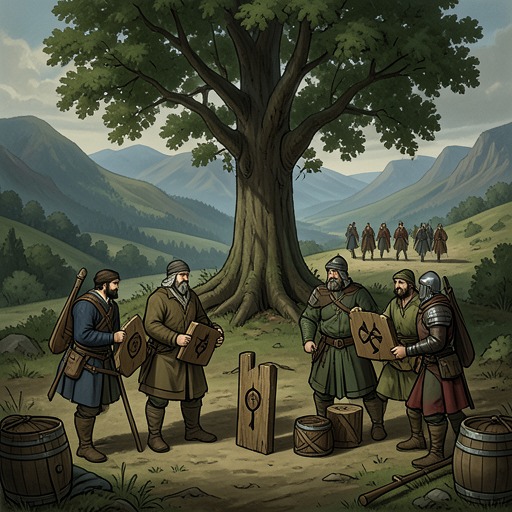
Rütli Meadow
William TellRütli Meadow is the political meeting place where the Three Cantons’ defense of their inherited liberties takes collective form. Its significance lies less in a detailed scenic portrait than in the transformation enacted there: deliberation over authority and obligation becomes a public oath binding the participants to stand together in danger and death.
Setting and Dramatic Function
The evidence identifies Rütli Meadow chiefly through the assembly and its purpose, rather than through a precise description of the terrain. The location is part of a play whose political action is shaped by an outdoor world of lakes, mountain routes, and exposed landscapes. Elsewhere, cloud shadows cross the scene as a rumbling and cracking noise sounds among the mountains; thunder and wind accompany the rising lake, and heavy rains later flood streams and sweep away bridges. These moments establish the physical pressures of the drama’s geography, though they do not provide a topographical description of the meadow itself.
Deliberation over Rights and Authority
At the gathering, the participants distinguish voluntary imperial protection from submission to local tyranny. They maintain that their communities freely sought the Empire’s protection and invoke Emperor Frederick’s charter as confirmation that this arrangement was granted freely. Stauffacher recognizes that even the freest people require a superior authority to judge disputes and hear appeals. The argument therefore does not reject every form of rule: it presents imperial allegiance and local freedom as compatible, while denying that tyrannical officials may claim unlimited power.
That distinction shapes the proposed response. The speakers describe the Empire as their feudal lord and resolve to do what necessity requires, but no more. Their plan is to drive out the tyrants and their agents and demolish their imposing strongholds. The meadow thus becomes a place where resistance is framed not as an abandonment of all political obligation, but as a defense of ancient rights against officials who have exceeded their proper authority.
Oath and Confederacy
The gathering culminates in a call to swear a confederacy. The participants promise to form a nation of brothers and never to separate in danger or death. That pledge turns shared grievances into an explicit mutual commitment: each community’s security is joined to the others’, and resistance becomes a coordinated undertaking rather than an isolated act.
The oath also gives the meeting its durable dramatic force. At Rütli Meadow, speech does practical political work: the participants do not merely describe their common identity but pledge themselves to enact it. The promise of solidarity supplies the human bond behind the plan to oppose tyranny and preserve their rights.
Political Significance
Rütli Meadow concentrates the play’s account of legitimate authority into a single collective scene. The speakers affirm imperial protection, acknowledge the need for a supreme judge, and at the same time draw a boundary against abuses by tyrants and their agents. Their oath converts that boundary into collective resolve. The meadow’s importance is therefore both spatial and political: it is the setting in which separate communities declare themselves answerable to one another, and where a defense of local liberty becomes the foundation of confederate action.