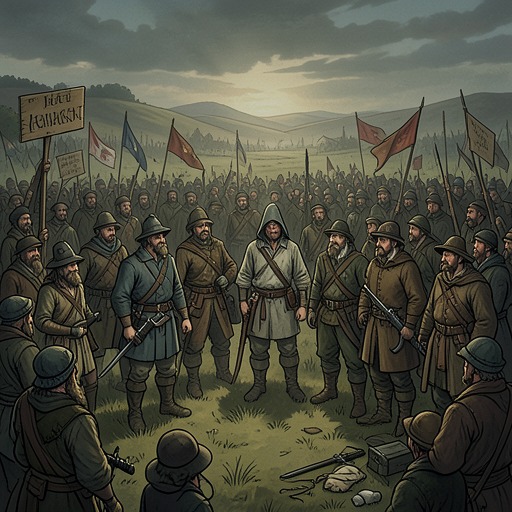
Serfdom in Rudenz's lands
William TellSerfdom in Rudenz's lands names a form of personal subjection that the play sets against its defense of freely held rights and bounded political authority. Its emancipation is part of the larger movement from dependence toward freedom; the available evidence establishes that outcome, but does not detail the serfs’ working conditions or the specific terms of their release.
Serfdom and Political Obligation
The play’s debate about authority offers a framework for understanding the serfs’ position. Speakers from Uri recall that their community freely sought the protection of the empire, and argue that its corresponding duty was to aid the emperor with arms in war. Stauffacher acknowledges that even the freest people may have a feudal lord and a supreme judge to whom disputes can be appealed. The contrast is not between all authority and none, but between obligations represented as freely accepted and limited, and coercive rule that violates inherited rights.
Furst gives that distinction a practical edge: the people will do what necessity requires, but nothing beyond it. He describes the aim as throwing off a hated thraldom and preserving ancient rights. These statements concern the cantons’ political resistance rather than directly describing life on Rudenz’s estates; they nevertheless place emancipation within the play’s broader rejection of subjection without consent.
Emancipation and the Wider Uprising
The emancipation of Rudenz’s serfs is associated with the transformation of authority in the play, rather than supplied here as a separate, detailed episode. The wider revolt moves from deliberation to collective action: Rosselmann calls for a ring to be formed and swords planted in the ground, while Furst states that the tyrants and their agents will be driven out and their strongholds razed. When the people attack a building, Furst observes that the floodgate has burst and cannot be restrained. The sequence presents liberation as part of a communal break with oppressive rule, not merely a private adjustment of relations on one estate.
Freedom Made Visible
The play also gives the overthrow of imposed obedience a public emblem. A crier announces that a cap will be set on a pole in Altdorf’s marketplace, turning a commanded gesture of submission into a public spectacle. After the revolt, girls bring the cap back on its pole. Furst rejects its destruction: once an instrument of despots, it can be preserved as a lasting symbol of freedom. This reversal clarifies the political atmosphere in which the emancipation of Rudenz’s serfs belongs: domination is not simply removed but publicly reinterpreted, while freedom is framed as the recovery of rights and the refusal of arbitrary demands.