Swiss Confederacy of the Three Cantons
William TellThe Swiss Confederacy of the Three Cantons is the political community formed by Uri, Schwyz, and Unterwalden, bound by an ancient agreement that its members renew when danger threatens their liberties. In the play, the Confederacy is more than an alliance against a common enemy: it articulates a claim to self-government grounded in inherited rights, mutual justice, and a carefully limited obligation to the Empire. Its movement from secret deliberation to coordinated action turns scattered grievances into a shared political cause.
Identity and Historical Bond
The Confederacy’s roots are presented as ancient rather than newly improvised. A note accompanying the text explains that the League, or Bond, of the Three Cantons was of very old origin and was renewed from time to time, especially when liberty came under threat. The reproduced Bond names the men of Uri, the community of Schwyz, and the men of the mountains of Unterwalden as its parties. This formulation gives the association a territorial and communal basis: it is not described simply as an agreement among rulers, but as a bond involving the people of the valleys and mountain communities.
The Bond supplies a practical principle for resolving internal division as well as resisting outside pressure. If one party refuses to accept justice in a dispute, the others are to assist the party willing to accept it. The agreement’s decrees are presented as enduring for the community’s common advantage. Mutual aid is therefore conditional on a shared standard of justice, not merely a promise that each canton will defend every act of another. That provision makes unity a civic obligation while preserving a means of judging conflicts within the alliance.
Rights, Empire, and Self-Government
The Confederates explain their political position by distinguishing freely chosen imperial protection from submission to local princes. They say that their forebears sought the Empire’s protection freely and that it was freely granted, a relation recorded in Emperor Frederick’s charter. Their argument does not reject every superior authority: Werner Stauffacher acknowledges that even the freest people may have a feudal lord and a supreme judge to whom disputes can be appealed. The crucial question is whether authority operates within an accepted legal and reciprocal framework.
The same distinction shapes their account of military duty. As freemen of the Empire, they are bound to assist it with their swords in war; guarding the Empire that guards them is described as the freeman’s proper obligation. This reciprocal account of allegiance sharply contrasts with the coercion they experience from the local tyrants. Walter Furst states that the Confederates will do what necessity requires, but no more: they will drive out the tyrants and their agents and raze their strongholds. The object is to recover and preserve ancient rights, not to exchange one arbitrary master for another.
Secret Deliberation and Collective Action
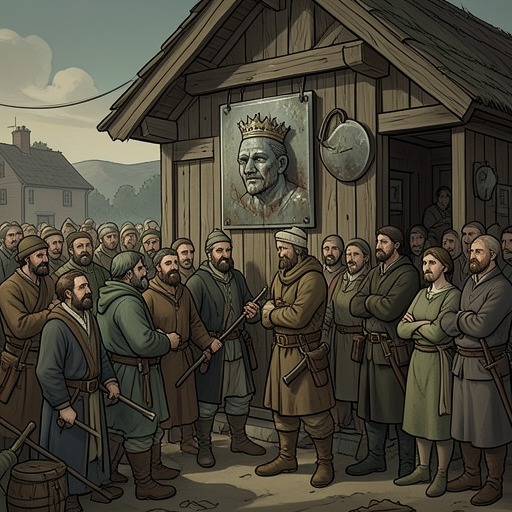
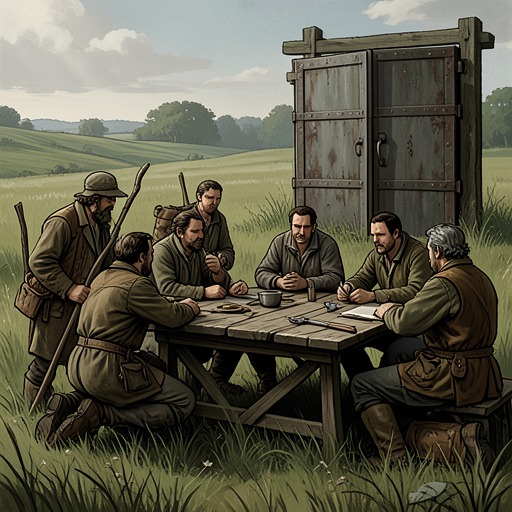
The Confederacy’s principles take shape in a clandestine nighttime Diet. Thirty-three men gather around a fire on their ancestral soil, and Walter Furst observes that they have been driven to meet in secret, as though they were murderers. The scene makes secrecy both a sign of political repression and a method of organizing against it. The men are not assembled as an official governing body with public authority; their covert meeting dramatizes the gap between the community’s claim to inherited rights and the dangerous conditions in which it must now act.
The gathering includes armed countrymen, among them Melchthal and Conrad Baumgarten, as well as Winkelried, Meyer von Sarnen, Burkhart am Buhel, Arnold von Sewa, Klaus von der Flue, and others. Their presence links deliberation to readiness for action, while the larger count of thirty-three emphasizes that the cause extends beyond a single household or leader. The discussion also shows that common purpose does not eliminate disagreement over timing. Winkelried proposes waiting until Christmas, when serfs customarily throng to the castles; Werner Stauffacher cautions against haste and asks whether they do not all serve the same cause. The meeting leaves the timing to circumstance, and the dawn light on the mountain tops brings the nighttime council to an end without making its deliberation seem complete.
From Pact to Resistance
The play carries the Confederacy’s resolve from council into assaults on the governors’ strongholds. When the people surge against a building, Walter Furst declares that the floodgate has burst and that they can no longer be restrained. Melchthal and Conrad Baumgarten enter and refer to the fortress still standing while Sarnen lies in ruin. The scene presents resistance as collective and spreading: the destruction of one stronghold does not by itself end the struggle, and news of action elsewhere becomes part of what the assembled people must confront.
The Confederacy is also addressed as a political body from beyond the three cantons. In a letter read aloud by Walter Furst, Queen Elizabeth sends greetings to the worthy men of Uri, Schwyz, and Unterwalden. She says that her people will abhor the perpetrators of the murder and relies on the cantons not to aid them. The appeal treats the three communities as a recognizable collective whose response matters beyond its own territory. It also places their rebellion within a wider political crisis, even as their own stated purpose remains the defense of their rights and the removal of tyrannical agents.
Unity, Leadership, and Meaning
The Confederacy’s strength lies in coordination rather than in the substitution of one solitary hero for a whole people. Werner Stauffacher asks where Wilhelm Tell is and whether the founder of their freedom will be absent from the festival. The question gives Tell exceptional symbolic importance, but it also makes clear that the freedom celebrated belongs to a community capable of acting together. The bond, the secret Diet, the armed gathering, and the later attacks on strongholds form different stages of that collective action.
At the same time, the Confederacy is not represented as rejecting all law or obligation. Its members invoke an imperial charter, accept the possibility of a supreme judge, and recognize a duty of military aid; their resistance is directed against arbitrary local domination. The distinction is central to the play’s political argument. Freedom means preserving communal rights and reciprocal justice, while collective force becomes legitimate, in the Confederates’ account, when the authorities who should protect them instead threaten those rights. The ancient pact thus serves as both a memory of self-government and a practical framework for acting together when that government is endangered.