Swiss Confederates
William TellThe Swiss Confederates are not merely a crowd gathered around a hero: they are a community that argues over the meaning of its inherited liberties, coordinates resistance, and gives political form to freedom in public. Their movement runs from secret meetings and armed action to a festival at which Wilhelm Tell is acclaimed and Bertha asks to enter their league as a protected citizen.
Identity and Political Inheritance
The Confederates define themselves through a combination of local self-rule and a freely chosen relationship with the empire. At the nocturnal Diet, their leaders recall that their ancestors had preserved freedom and had never bowed the knee to princes. Yet they do not describe themselves as owing allegiance to no one: they had freely sought imperial protection, and Rosselmann invokes Emperor Frederick’s charter as confirmation that protection was freely granted. Their account of liberty is therefore not simple isolation, but a claim that political obligation must rest on consent and on a recognized compact.
The discussion also acknowledges a tension within that claim. Stauffacher observes that even the freest people have some feudal lord, and argues for a supreme judge to whom disputes can be appealed. The Confederates’ case against the governors is not presented as a rejection of every authority; it is a distinction between legitimate, limited authority and oppressive rule. Their traditional duty, as described at the meeting, is to aid the emperor with their swords in war and to guard the empire that guards them. That obligation does not license the governors to strip away the community’s ancient rights.
Deliberation and Collective Action
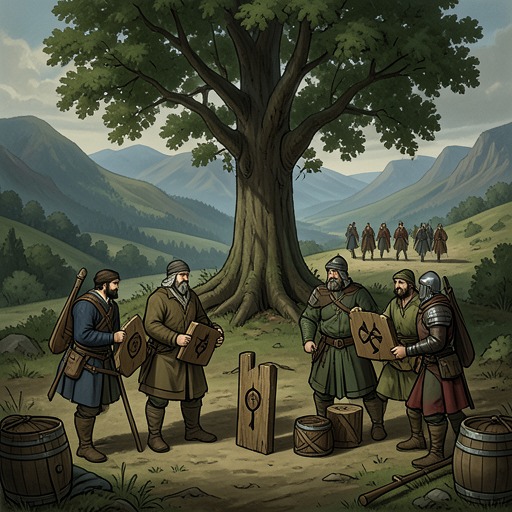
The Confederates’ resistance takes shape through a collective meeting rather than a solitary decision. Thirty-three countrymen gather around a fire, while armed representatives include Arnold of Melchthal, Conrad Baumgarten, Winkelried, Meyer von Sarnen, Burkhart am Buhel, Arnold von Sewa, and Klaus von der Flue. Their secret gathering carries a bitter contrast: on the soil their fathers left them, they must creep out by stealth to meet as if they were murderers. The circumstances make secrecy itself evidence of how far ordinary political life has been distorted.
Their deliberation concerns both the aim and the limits of resistance. Walter Furst frames the purpose as shaking off a hated thraldom and keeping ancient rights inviolate. He also insists that they will do what necessity requires, but nothing beyond it: the tyrants and their agents are to be driven out, and their towering strongholds razed. This formulation presents the proposed destruction of the fortresses as part of a bounded political program, not an unqualified license for violence.
The timing remains open to debate. Winkelried asks whether they should wait until Christmas, when serfs customarily throng the castle, while another voice warns that haste disturbs the peace and asks whether all stand for the same common cause. The group does not settle every practical question in advance. As dawn kindles the mountain-tops while their night Diet is still under way, the Confederates part with the expectation that circumstances will help determine what must be done. Their coordination depends on shared purpose, but also on patience about the moment for action.
From Opposition to Public Action
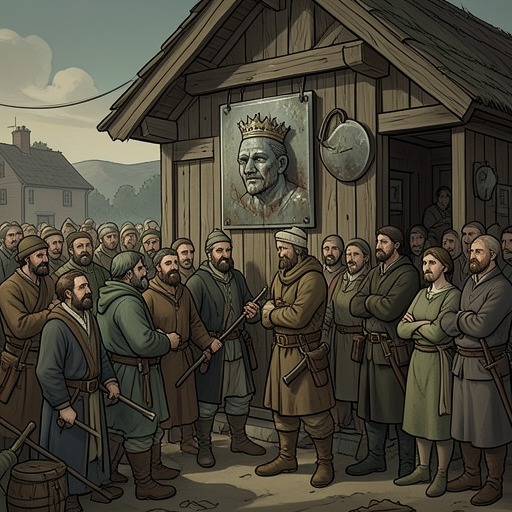
The Confederates’ action becomes visible when the crowd falls upon a building from every side. Furst declares that the floodgate has burst and that the people can no longer be restrained. The image conveys a movement passing from controlled, secret deliberation into force that exceeds the leaders’ ability to contain it. The assault is not detached from the preceding debate: it is the practical confrontation with the strongholds that the meeting had identified as instruments of tyranny.
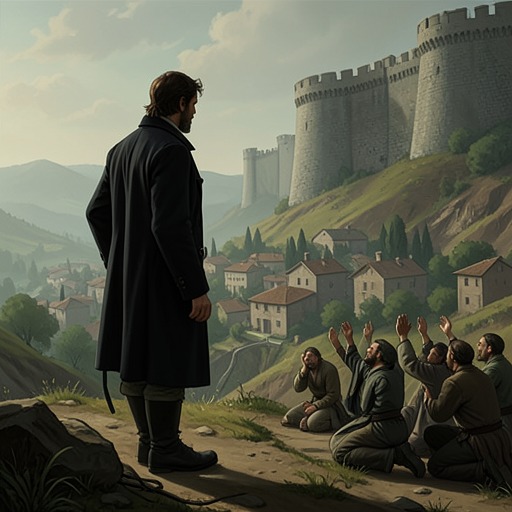
Arnold of Melchthal and Conrad Baumgarten then enter and ask whether the fortress still stands when Sarnen lies in ruins. Their arrival connects the attack at the building to the wider struggle against the governors’ fortified positions. The Confederates’ resistance is thus represented through coordinated pressure and reports of changing conditions, rather than through one action by one protagonist. A rumor of the latest atrocity had already spread through distant valleys and from door to door, giving the oppression a reach beyond the people directly present at the meeting. The collective cause answers a violence understood as affecting the country broadly.
Recognition, Belonging, and Aftermath
After the fighting, imperial politics briefly appear to offer the Confederates a new safeguard. They hear that the empire intends to assert its old prerogative of choice, and the prospect that the emperor will need valiant friends and shelter them from Austria’s vengeance prompts the peasants to embrace. An imperial messenger arrives with the sacrist, who presents the assembled leaders as the worthy chiefs of Switzerland. But the messenger’s appeal to the love and grace once received from Rudolph’s princely house meets visible dissatisfaction. The crowd’s response shows that dynastic recollection cannot simply erase its experience of oppression or settle what protection should mean now.
At the festival, the community’s recognition of Wilhelm Tell is emphatic. When he appears, those gathered receive him with loud cheers, and the crowd calls, "Long live brave Tell, our shield, our liberator." Stauffacher asks where Tell is and whether the founder of their freedom should alone be absent from the celebration. Their praise places individual courage within a collective account of liberation: Tell is honored, but the voices and gathering that make the honor public belong to the Confederates.
The festival also gives their political community a new test of inclusion. Bertha addresses the peasants and Confederates, asking to be received into their league because she is the first to find protection in the land of freedom. She entrusts her rights to their hands and asks whether they will protect her as a citizen. The peasants answer that they will do so with life and fortune. Their promise makes freedom more than the removal of a ruler: it entails a reciprocal commitment to protect a person’s rights and recognize her membership in the community. The Confederates’ arc therefore ends not simply with victory over strongholds, but with an expressed responsibility for the civic order that follows.