Swiss Uprising Against the Habsburg Bailiffs
William TellThe Swiss Uprising Against the Habsburg Bailiffs turns a concealed plan to recover local rights into a public overthrow of the bailiffs’ strongholds. Its decisive significance lies in the distinction the play draws between allegiance to the Holy Roman Empire and submission to officials who violate the communities’ inherited liberties: the rising seeks to expel the tyrants while preserving the cantons’ own laws and political life.
Legal Background and Political Aim
The revolt grows out of a layered account of authority. The communities say that they freely sought the protection of the empire, and Rosselmann points to Emperor Frederick’s charter as recording that protection as freely granted. Werner Stauffacher acknowledges that even the freest people may have a feudal lord, a supreme judge to whom disputes can be appealed. The play therefore does not frame the uprising as a simple refusal of all superior authority.
The communities’ customary self-rule is central to their claim. At home, they had governed themselves in peace according to their own laws and ancient usages. The emperor’s stated right was to adjudge the penalty of death, exercised through a powerful noble appointed as his delegate. Their argument sets that limited account of imperial authority against the conduct of the bailiffs: the officials’ local power is not treated as an unlimited right to rule. The uprising’s political aim is to shake off an abhorrent thraldom and keep the old rights inviolate, rather than to abandon every bond that binds the communities to the empire.
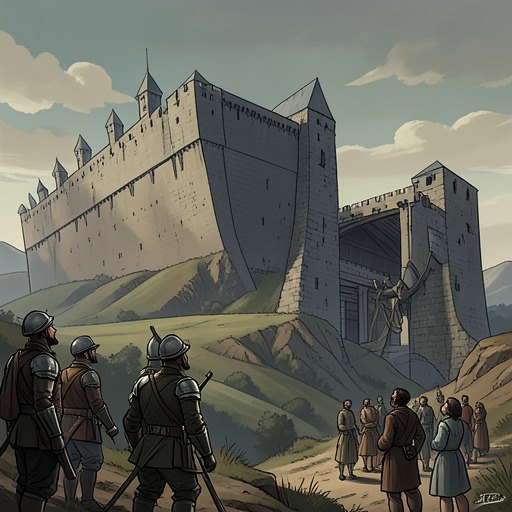
That distinction shapes the decision to act. Walter Furst insists that the communities will do what necessity requires, but nothing beyond it: the tyrants and their dependants are to be driven out, and their towering strongholds razed. The stated object is therefore both defensive and institutional. The revolt removes the machinery through which the bailiffs impose their power, while its speakers present the recovery of customary rights as the measure of success.
Coordinated Plan
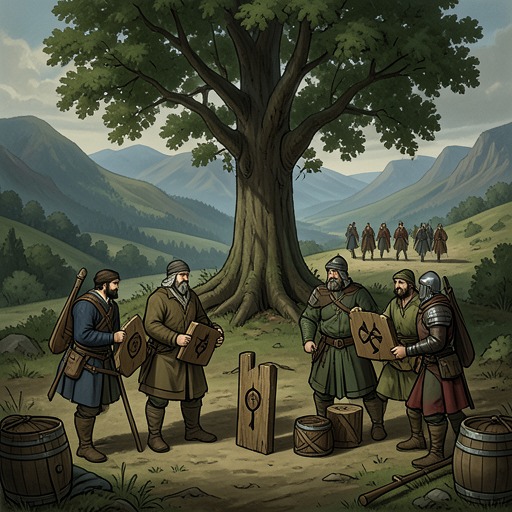
The rising is planned as a coordinated action rather than a succession of isolated local protests. Furst describes a signal to be passed from mountain to mountain once the castles have fallen. Each canton is then to raise its general levy, so that the communities can appear together in force. The sequence gives the dispersed mountain settlements a shared timetable: the fall of the castles triggers the signal, and the signal mobilizes the wider population.
The plan also includes an expectation about the enemy’s response. Furst believes that, faced with the assembled force, the tyrants will not risk a battle and will instead withdraw. The strategy thus combines the capture of fortified centres with the threat of a larger collective mobilization. The play reports a majority of twenty to twelve in the decision-making, giving the plan the form of an agreed course of action rather than a command issued by one leader.
The projected signal matters as much as the seizure of any single fort. Mountain to mountain, then from each canton’s centre outward, the network turns local actions into a common rising. The structure also expresses the political principle the conspirators defend: communities that have governed themselves locally can unite for common protection without surrendering their distinct local standing.
Seizure of the Strongholds
The later report of the victories identifies two separate operations. Ulrich von Rudenz, acting with courage, took the keep at Sarnen; Melchthal says that he had stormed Rossberg Castle the night before. The account distinguishes their roles and the timing of their successes, while establishing that the overthrow did not depend on one commander or one assault. When Walter Furst asks how the forts came into their power, Melchthal answers with these concrete results, and Furst’s question makes the change of control the scene’s central news.
Melchthal and Baumgarten enter as the victorious report is being received. Around them, the crowd falls upon the building from every side. Furst describes the movement as a floodgate giving way and says that the people cannot be restrained; the stage direction makes the collapse visible as collective action, not merely as a change announced by a speaker. The beams of the scaffold are heard falling. The image of the shattered structure gives physical form to the destruction of the authority the characters call tyranny.
The play does not make the transfer of every fortress depend on a single, uniform procedure. It names the capture of the keep at Sarnen and the earlier storming of Rossberg Castle, then shows the crowd pulling down the building before them. The report and the stage action together present military success and popular participation as connected but distinct parts of the uprising.
Public Aftermath and Meaning
The immediate aftermath is staged as a public celebration of liberty. Children run across the stage carrying fragments of wood and cheering that they are free. Furst declares that the victory is unstained by blood; this is his assessment of the outcome, presented at the moment of communal relief. Melchthal then addresses the assembled company as they sit among the beams of the shattered scaffold, describing their position on the wreck of tyranny. The broken structure becomes both the literal setting for the gathering and its political emblem.
The closing documentary frame broadens the event beyond the named captains and fortresses. The Bond identifies the men of Uri, the community of Schwyz, and the people of the mountains of Unterwalden. Its appearance places the liberation narrative alongside a written expression of communal association: the political subject is not only the victorious leaders, but the communities whose shared obligations and rights make collective resistance possible.
The event’s force comes from that double movement. The cantons act together against the bailiffs’ strongholds, yet justify their action through local law, inherited usage, and a carefully limited account of imperial allegiance. The signal across the mountains, the separate victories at Sarnen and Rossberg Castle, and the public dismantling of the scaffold carry the same argument through different forms: authority that sustains protection and lawful appeal may be acknowledged, but tyranny can be resisted, and freedom is made visible when the people gather around the ruins of its instruments.