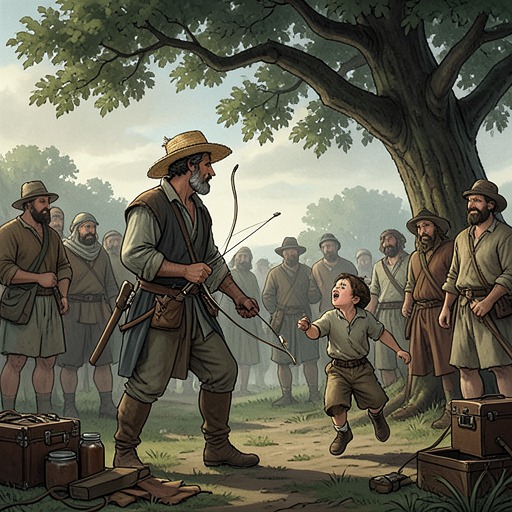
Tell assassinates Gessler at Küssnacht
William TellTell assassinates Gessler at Küssnacht in a carefully chosen defile, where a single road gives the governor no alternative passage. The act fulfills a vow formed during the ordeal in which Gessler forced Tell to aim at his own child, and it interrupts the governor as he is about to announce another law. Gessler recognizes the shot as Tell’s; Tell then appears above the rocks and declares the cottages free from the governor’s power. The scene makes the killing both a personal reckoning and a decisive attack on the authority that has threatened the community.
The Defile and the Ambush
Wilhelm Tell enters with his crossbow and assesses the terrain as a trap made by the road itself. Gessler must pass through the deep defile because no other road leads to Küssnacht. Tell identifies an alder tree as a place from which he can conceal himself and reach his target. The scene therefore presents the shot not as a spontaneous encounter but as an action enabled by careful attention to the route, the cliff, and the available cover.
That preparation gives the event a starkly bounded geography. Tell has selected a point where Gessler’s passage is predictable and where the governor cannot simply choose another road. The setting narrows the conflict to a single anticipated crossing: the ruler who has imposed his will on others is now made vulnerable by the limits of the landscape. The alder tree and the constricted route are practical elements of the plan, but they also make the encounter’s outcome feel concentrated and unavoidable.
The Vow and the Apple Ordeal
Tell’s decision is rooted in the earlier moment when Gessler forced a father to aim at his child. Tell recalls having drawn his bow with a trembling hand while Gessler watched with murderous pleasure. He had pleaded for mercy, but his appeal failed. The killing at Küssnacht thus answers an abuse of power that was intimate as well as political: the governor had made Tell’s love for his child part of the punishment.
In the agony of that ordeal, Tell made a fearful vow known only to God. If his bow sent another arrow on its way, he promised, its target would be Gessler’s heart. At Küssnacht, the planned shot fulfills that vow. The connection between the two scenes is exact: the same bow that Gessler made Tell use under coercion becomes the instrument with which Tell chooses his own target. The ordeal does not merely precede the assassination; it supplies the personal cause and the declared terms of the action.
Tell also frames the present act as protection for his children and his faithful wife from Gessler’s fury. His stated purpose binds retaliation to the prevention of further harm. That framing does not erase the fact that he has deliberately arranged an ambush and intends to kill the governor. Instead, the scene holds the motives together: Tell acts from a vow born in personal torment, while presenting the removal of Gessler as necessary to protect his family and others from continued oppression.
The Shot and Its Recognition
The assassination occurs as Gessler is about to publish a new law throughout the land. Before he can complete the announcement, an arrow pierces him. The interruption gives the shot a political consequence at the level of dramatic structure: an intended act of lawmaking is cut short by the sudden physical answer to the ruler’s authority. Gessler puts a hand to his heart and begins to sink; his appeal for mercy follows as he recognizes that he is dying.
Gessler identifies Tell as the archer. He then slides from his horse into the arms of his attendant, who lays him on a bench. The recognition is important: the attack is not left as an unexplained blow or attributed to an unknown hand. Gessler names the shooter, and Tell confirms it from above, telling him to seek no other hand. The exchange makes the responsibility for the killing explicit even as Tell refuses to approach the fallen governor.
Tell’s appearance above the rocks completes the scene’s carefully arranged positions. Gessler lies below, supported by another man, while the archer speaks from the height where he has been concealed. Tell declares that the cottages are free and that the innocent are safe from Gessler, who will no longer be their curse. He then disappears. His statement presents the shot as the end of the governor’s immediate capacity to threaten the community; it is not a report that every political consequence has already been settled.
From Private Vow to Public Reversal
The language of freedom gives the assassination a reach beyond Tell’s household. The vow began in the private anguish of a father forced to aim at his child, but the declaration after the shot names cottages and innocent people more broadly. The scene thus makes a personal act legible as resistance to a ruler whose coercion affects the community. Tell does not announce a new governing order; he declares Gessler’s threat ended and makes the act’s protective purpose public.
The play’s surrounding images of the cap sharpen this political reversal. Earlier, a crier announces that the cap is to be set on a lofty pole in Altdorf’s marketplace, where the people are expected to see it; the imposed gesture makes submission visible. Later, people gather as the cap is brought in on a pole, and Walter Fürst rejects destroying it, arguing instead that what served despots should be preserved as a lasting symbol of freedom. In another collective scene, Rosselmann calls for a ring to be formed and swords of power planted in the ground; at daybreak, people who have involuntarily removed their caps contemplate the light in silence. These public images contrast coerced observance with a community assembling and interpreting the signs of its own liberation.
Within that wider pattern, Tell’s shot is a forceful reversal, not a substitute for the collective scenes. The same work that has displayed the governor’s power through a public emblem also shows that power being challenged by an individual act whose consequences are addressed to the many. Gessler’s unfinished law, his recognition of Tell, and Tell’s declaration about the cottages give the killing its immediate stakes; the cap’s later preservation gives the overthrow of despotism a visible emblem. The assassination’s significance lies in this movement from a vow formed under coercion to an openly named claim that the community is no longer subject to Gessler’s threat.