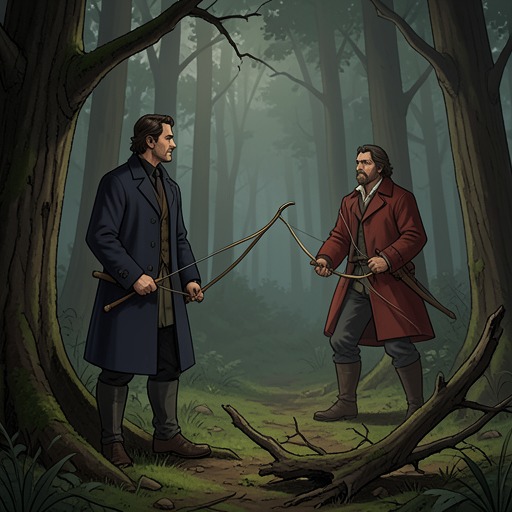
Tell escapes from Gessler’s ship
William TellTell escapes from Gessler’s ship in a storm-driven episode that turns temporary dependence into freedom. Recounted by Wilhelm Tell himself, the escape depends on a sharp reversal: the captive whom his captors need to save them from the storm is unbound, takes the helm, and uses the vessel’s passage beside a rocky shelf to get away with his weapons.
Background and Narrative Frame
The episode is presented as Wilhelm Tell’s account of an earlier ordeal, not as an action unfolding before the audience in real time. He tells it to the Fisherman, describing the voyage with the viceroy, Rudolph der Harras, and their attendants aboard. Tell’s narration makes the escape both an event and a piece of testimony: the audience learns how he came to be free from the person who carried out the escape.
At the outset, Tell is in bonds. His bow and quiver lie astern beside the helm, physically separated from him but still within sight. That arrangement matters to the action: he is a prisoner without control of the boat, yet his weapons remain aboard. When the vessel reaches the corner near Little Axen, the scene’s balance changes abruptly. A hurricane sweeps down from the Gotthard gorge, turning the captors’ journey into a shared emergency.
The Storm and the Bargain
The storm is described through its effects on those aboard. The rowers lose heart, and everyone on the vessel fears drowning. The boatmen are so frightened that they cannot decide confidently which course to take. The immediate danger therefore creates a practical problem that the captors cannot solve by force alone: they need someone who can steer.
One of the attendants identifies Tell as a strong, fearless man with unusual skill at the helm and proposes using his ability in the emergency. Gessler then addresses Tell directly, offering that he might consent to free him if Tell brings the party through the tempest safely. The wording makes the offer conditional rather than a settled grant of freedom. Tell agrees to try, asking for God’s assistance, and the captors release him from his bonds so that he can take the helm.
The bargain briefly gives Tell a new position aboard the vessel. He is no longer physically restrained, and responsibility for steering rests with him; the others depend on his judgment in a crisis that has frightened the crew. But his account also makes clear that release from his bonds is not the same as secure freedom. He keeps glancing toward his shooting gear, which lies near the helm, as he steers. His attention to the bow and quiver links the immediate task of survival to the possibility of escape.
The Escape
Tell directs the men to row with all their strength until the vessel reaches a shelving crag, telling them that the danger will be past there. They pull hard, and the boat approaches the point. Tell prays for God’s help, then strains to bring the vessel’s stern close to the rocky wall. The manoeuvre places the boat alongside a flattened shelf, making the rock a possible route out of the vessel and away from its occupants.
Once the stern is near the wall, Tell snatches up his weapons and leaps onto the shelf. He then thrusts the vessel away from the rock with his feet, sending the small boat back into the violent waters. The sequence is precise: he first brings the boat within reach, then secures his shooting gear, transfers himself to the shelf, and separates the vessel from the landing place. His escape is not achieved by waiting for the storm to subside or for Gessler to honour the conditional offer; it comes through taking advantage of the opening created by the steering manoeuvre.
The final image leaves the boat to drift wherever the storm takes it. Tell is on the rocky shelf, delivered from the storm and from the man who had held him captive. The escape thus answers two threats at once. The hurricane endangers everyone aboard, while captivity places Tell under Gessler’s power; the same emergency that makes Tell useful to his captors gives him the chance to break away from them.
Consequences and Significance
The episode’s decisive reversal rests on a practical skill rather than a change of allegiance or a negotiated release. Gessler’s party needs Tell because the boatmen are powerless with fear and Tell is known to steer well. Once freed to perform that task, Tell uses the helm to bring the vessel to the rock and then leaves the boat behind. The captors’ reliance on his ability creates the circumstances of their loss of control over him.
The bow and quiver, introduced as objects lying beside the helm, recur at the crucial moment when Tell seizes his weapons before leaping. Their presence gives the escape a concrete material condition: he gets away not empty-handed, but with the gear he had watched while steering. The rocky shelf likewise changes function within the episode, first serving as the point Tell tells the rowers to reach, then becoming his route out of the boat.
Because the escape is told retrospectively by Tell, its suspense is carried by the sequence of choices he recalls: agree to steer, watch the weapons, direct the crew toward the crag, bring the stern close, leap, and push away. The ending does not describe what becomes of the viceroy or the rest of the party, and the account leaves the boat in the storm. Its focus is Tell’s own deliverance: an offer made under pressure briefly frees his hands, but his decisive escape depends on his actions at the rock.