Tell's Apple Shot
William TellTell's Apple Shot is the ordeal in which Hermann Gessler forces Wilhelm Tell to shoot an apple from Walter Tell’s head, making a father’s precision answer to a threat against his child. The shot succeeds, but the scene does not end with the target’s fall: Tell reveals that he kept another arrow and tells the governor what it was for. The episode thus converts a display staged under authority into an exposure of the violence behind that authority—and leaves the cap that signifies it available for a later, transformed meaning.
The Challenge and Its Stakes
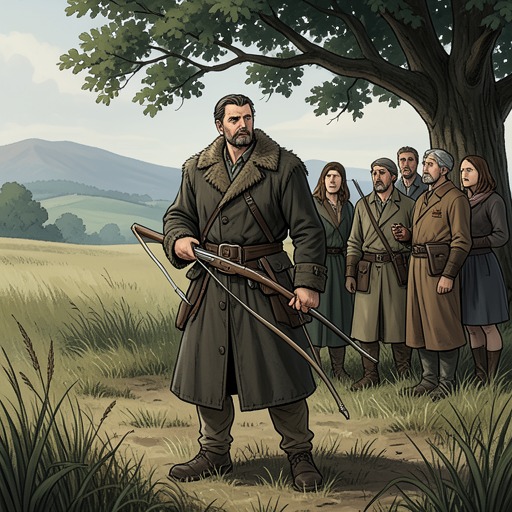
Hermann Gessler frames the ordeal as proof of a skill Tell is said to possess: if Tell can bring down an apple from a tree at a hundred yards, he must demonstrate that ability before him. The condition makes the demand more than an ordinary test of marksmanship. Tell must aim at an apple set on his own child’s head, and if he misses, he will pay with his own life. Skill is demanded under a threat that makes its exercise dangerous to both father and son.
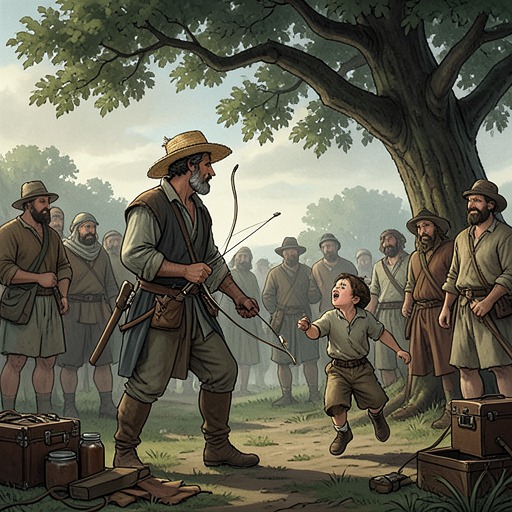
Tell protests the demand as monstrous and refuses at first to accept the prospect of shooting from his child’s head. His protest is not presented as indifference to the risk or a display of easy confidence. He says that both boys are equally dear to him; the scene makes the threatened child part of a larger paternal bond rather than a mere target in Gessler’s demonstration. The crowd gives signs of horror, registering publicly the cruelty of the terms. Gessler, by contrast, presses Tell to the task and invokes the danger of carrying deadly weapons, turning the presence of arms into another justification for coercion.
The episode’s stakes are therefore divided between the visible test and the hidden consequence. On the surface, the question is whether Tell can hit the apple. Beneath it is the governor’s power to make a father’s hand perform an act that could kill his child, while threatening the father if he refuses or fails. The shot’s apparent measure of skill is inseparable from a measure of how far imposed power can reach into private life.
The Shot Before the Crowd
The shot is staged amid competing attention. As Bertha casts herself between Ulrich von Rudenz and Hermann Gessler, the crowd’s eyes turn toward them; during that interruption, Tell fires. Werner Stauffacher exclaims that the apple is down. The brief announcement confirms the result, while the stage direction fixes the timing: the decisive act occurs as attention is directed elsewhere. The scene does not describe the arrow’s flight in detail; it makes the completed shot and the crowd’s redirected gaze carry the dramatic turn.
That turn is precise but not a simple release. Tell has met Gessler’s demand, and the apple has fallen, yet the successful shot cannot undo the threat that made it necessary. Its public success proves Tell’s ability under extreme pressure, but it also leaves the governor in control of what follows. The focus shifts from the target to the relation between the two men: after drawing another arrow from his belt, Tell fixes his eyes sternly on Gessler and says he will declare the truth because Gessler has promised not to take his life.
The Second Arrow and the Governor’s Word
Tell’s disclosure changes the meaning of the first shot. If his hand had struck his beloved child, he says, he would not then have missed. The extra arrow, drawn from his belt after the apple has been hit, makes the successful performance carry a further, dangerous meaning: Tell had prepared for the possibility that Gessler’s demand would cause his child’s death. He does not conceal the severity of that intention when the governor’s promise gives him an opening to speak without reserve.
Gessler answers by affirming that he promised Tell his life and will keep his knightly word. Yet the assurance is immediately qualified: he says that he knows the malice of Tell’s thoughts. The exchange places a spoken promise beside an openly acknowledged threat. Gessler’s word limits what he says he will do, but it does not restore trust or erase the peril his own challenge created. Tell’s disclosure, in turn, makes the successful shot more than an obedient completion of the test: the archer has survived it without surrendering his judgment of the man who imposed it.
From Coercive Sign to Public Emblem
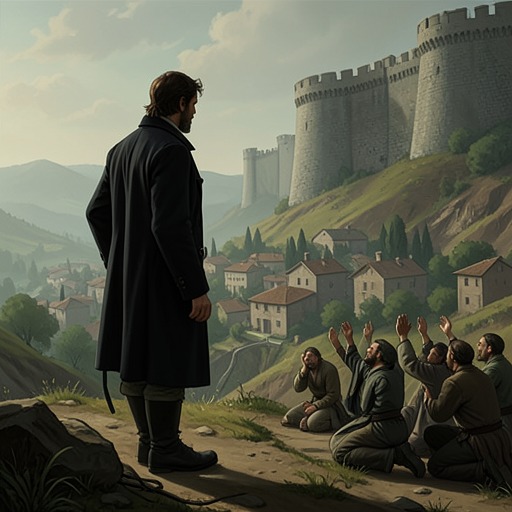
The cap associated with Gessler’s authority establishes a public frame around the ordeal. Earlier, a crier speaks in the emperor’s name and announces that the cap will be set upon a lofty pole in Altdorf’s marketplace. The cap is not merely a private possession in this account: its elevation in a public place makes it an object around which authority and collective attention are organized. The apple shot belongs to this same political landscape of commands made visible before the people, though its immediate action turns on the threatened father and child.
The cap returns later in a changed public setting. Girls bring it on a pole as the stage fills with people. Walter Furst refuses the proposal to burn it: once an instrument of despots, he says, it should instead be preserved as a lasting symbol of freedom. This later decision gives the cap a distinct afterlife. The object associated with enforced submission is neither erased nor left with only its earlier meaning; a gathered community publicly claims it for remembrance of liberty. Read beside Tell’s ordeal, that reversal clarifies the episode’s enduring tension: authority can compel a visible gesture, but the meaning attached to its symbols—and to an act performed under threat—can be contested and changed.