Tell’s crossbow
William TellTell’s crossbow is the weapon through which Wilhelm Tell’s celebrated skill is made visible and then subjected to Hermann Gessler’s authority. First identified in a stage direction as Tell enters carrying it, the crossbow becomes the instrument of a forced test involving an apple, a hundred-yard shot, and the life of Tell’s son.
Appearance and Identification
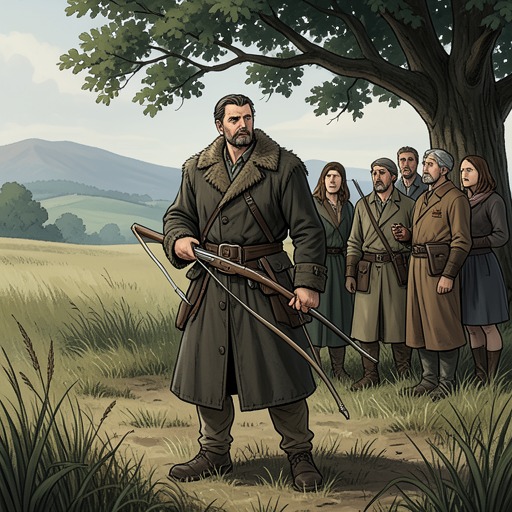
The crossbow is explicitly present when Tell enters the scene: the stage direction identifies him as carrying one. This entrance establishes the weapon as part of his practical identity before the confrontation over the apple makes its use a matter of life and death. The evidence does not describe its construction or appearance beyond identifying it as a crossbow.
Gessler’s Test
Hermann Gessler invokes Tell’s ability to bring down an apple from a tree at a hundred yards and commands him to demonstrate that skill. The order turns the weapon from a familiar sign of Tell’s competence into the means of a test imposed by the governor. Tell has just said that both boys are equally dear to him, making clear that the ordeal concerns more than marksmanship: his attachment to the children is placed under pressure by Gessler’s demand.
The Apple and Its Consequence
After the ordeal, Walter Tell runs in carrying the apple and reassures his father that he knew Tell would not harm him. The returned apple and the boy’s survival give the test its visible resolution. In this sequence, the crossbow is associated both with Tell’s capacity to make a precise shot and with the danger created when Gessler turns that capacity into an instrument of coercion.