Tell's Escape from Gessler's Ship
William TellTell's Escape from Gessler's Ship is Wilhelm Tell's escape from captivity during a storm on Lake Lucerne. With the vessel in danger and Hermann Gessler offering only the possibility of release in exchange for safe passage, Tell takes control of the immediate crisis, reaches a rocky shelf, and escapes with his weapons. The episode turns a conditional bargain into an act of self-liberation: the storm threatens everyone aboard, but Tell uses the shoreline to break free of both the vessel and the viceroy's power over him.
Storm and Captivity
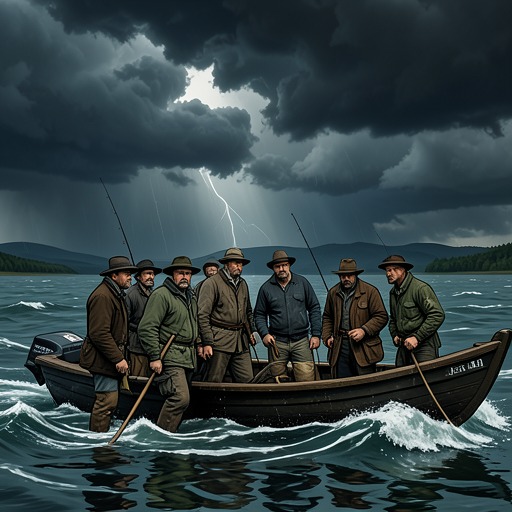
Tell recounts that he was aboard with Hermann Gessler, Rudolph der Harras, and their suite when the storm made the vessel's passage perilous. His bow and quiver lay astern beside the helm, leaving his weapons within reach but not in his hands. The danger is presented as more than an inconvenience: the rowers lose heart, and those aboard expect to drown. The storm's thunder and roaring wind, and the lake's rising waters, establish the physical force that has trapped captor and captive together.
The peril changes the balance among them. An attendant points out to Hermann Gessler that Tell might be useful in the emergency. The viceroy then addresses Tell with an offer: if he will undertake to bring them safely through the tempest, he might consent to free him from his bonds. The wording makes release conditional and uncertain, while the danger is immediate. Tell is being asked to save the party that holds him prisoner, not promised freedom outright.
The Escape
Tell does not describe simply waiting for the vessel to carry him to safety. He orders the men to exert themselves until they reach a shelving crag, explaining that the danger will be past there. He then brings the vessel's stern close to the rocky wall. The sequence matters: his command first makes the approach possible; steering the stern near the rock creates the opening for his leap.
At the crag, Tell snatches up his weapons, swings himself onto a flattened shelf, and thrusts the vessel away with his feet. The boat is left to drift in the storm, while he remains on the rock with his bow and quiver. His escape therefore depends on two precise opportunities—the vessel's proximity to shore and the shelf's usable surface—as well as his ability to act before the offer of freedom can be resolved. He does not wait for Hermann Gessler to release him: he breaks the physical connection between himself and the ship.
Outcome and Significance
Tell's account ends with a double deliverance: he is free of the storm's immediate reach and of the man who had held him in bonds. The storm is not a backdrop that the escape leaves unchanged; it makes the vessel's need for Tell urgent, drives the crew toward the crag, and supplies the dangerous waters into which he sends the boat. The same crisis that briefly makes him valuable to his captors gives him the chance to escape them.
The episode also marks the difference between promised freedom and freedom taken. Hermann Gessler's offer remains a possibility contingent on service, whereas Tell's leap makes the break real through his own action. The weapons beside the helm become part of that turning point: Tell retrieves them before leaving the vessel, so his escape restores not only his liberty but his possession of the means he carries. In the play, the episode is delivered as Tell's retrospective account, and its compressed action—command, approach, leap, separation—makes the escape a vivid reversal of the captors' control.