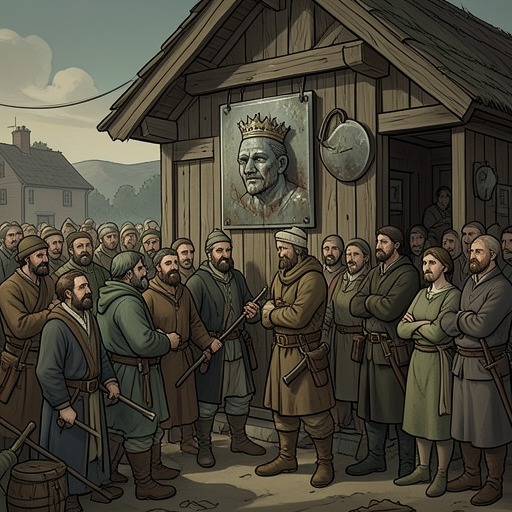
The Forest Cantons’ Conflict with Austria
William TellThe Forest Cantons’ Conflict with Austria is presented not simply as a contest between rulers and rebels, but as a dispute over the source and limits of political authority. The communities distinguish freely chosen protection by the empire from the coercion of local tyrants: they claim the right to govern themselves under their own laws, while resisting officials who turn delegated power into domination. Their eventual declaration that no tyrant remains in Switzerland gives this argument a victorious outcome.
Historical Claims and Political Identity
Werner Stauffacher sets the cantons’ cause against the condition of neighboring peoples, who, he says, have yielded to conquest, and of communities within the wider region bound to hereditary service. Against those examples, he describes the genuine Swiss as having preserved their freedom and never bowed the knee to princes. This contrast makes the conflict a defense of a particular political inheritance, not a general rejection of every form of authority: the Swiss claim that they have kept their liberty while other peoples have lost theirs.
That claim rests on a distinction between submission and voluntary agreement. Stauffacher says the communities freely sought the empire’s protection; Rosselmann answers that protection was freely granted and recorded in Emperor Frederick’s charter. The appeal to the charter gives the cantons’ position a documentary and legal basis within the play. Their argument is that imperial protection did not amount to surrendering their local rights to any noble who might claim power in the emperor’s name.
Overlapping Authority and the Limits of Rule
The political order described in the assembly is layered. The communities had ruled themselves in peace according to their own laws and ancient usages, while the emperor’s stated right was to adjudge the penalty of death. For that purpose, he appointed a powerful noble as delegate. The arrangement therefore recognizes a supreme authority and a judicial function above local government, but does not, in the speakers’ account, erase customary self-rule. The conflict sharpens when delegated office is treated as permission to govern the land without restraint.
Werner, Baron of Attinghausen, says the king’s displeasure rests on the land and weighs on every true-hearted person. His warning situates resistance amid a broader political crisis: the pressure is not described as a private quarrel alone, but as a danger to the country and its people. He condemns those who obscure the people’s understanding and turn them against their country’s good for selfish ends. The speech thus connects political domination with the manipulation of public judgment, while implying that the community’s welfare—not the private interest of rulers or their supporters—should guide action.
From Protest to Collective Resistance
Ulrich von Rudenz voices the opposing calculation, declaring it vain to strive against the king and suggesting that the world belongs to him. His position marks the force of the hierarchy the assembly is challenging: resistance can appear futile when royal power is treated as limitless. In response, the gathering asserts that a despot’s power has a limit, particularly when the oppressed seek justice in vain and can no longer bear their burden. The argument makes resistance a response to failed remedies rather than an appetite for conflict.
Walter Furst gives that reasoning a practical form. The objective is to shake off an abhorrent thraldom and keep the communities’ ancient rights inviolate. He urges the group to do what necessity requires, but nothing beyond it: the tyrants and their agents are to be driven out, their towering strongholds razed, and, if possible, no blood shed. This combination of force and restraint defines the proposed resistance. Its targets are the coercive rulers and the structures that sustain their authority; its stated purpose is the recovery of rights, not indiscriminate violence.
Outcome and Significance
The conflict’s resolution is reported in a later exchange. Walter Furst asks Arnold of Melchthal whether he brings liberty and whether the country has been freed of its foe. Arnold replies that the enemies have been swept from the soil and declares that, at that moment, no tyrant remains in Switzerland. The wording presents liberation as a collective removal of foreign oppression, answering the assembly’s earlier demand to expel the tyrants and their followers. It also shifts the account from a proposed course of action to an accomplished political change.
The Bond, identified in the text with the men of Uri, the community of Schwyz, and the mountain communities of Unterwalden, gives the cantons’ alliance a documentary and communal form. Alongside the references to the charter, local laws, and ancient usages, it underscores that the conflict concerns competing accounts of legitimate order. The Forest Cantons do not reject protection or judgment as such; they oppose the conversion of those powers into unchecked rule. Their resistance therefore rests on a claim that freedom and collective obligation can coexist, provided authority remains bounded and the communities retain their customary self-government.