The Moral Distinction Between Self-Defense and Murder
William TellThe Moral Distinction Between Self-Defense and Murder is articulated most sharply when Wilhelm Tell rejects Duke John’s attempt to equate their acts of violence. Tell presents his own deed as compelled by the need to defend his children and home; he condemns Duke John’s act as a crime of ambition and refuses to claim fellowship with him. Elsewhere, the drama gives resistance a political boundary: the community seeks to preserve its ancient rights and oppose tyranny, while acknowledging duties to an empire understood as a source of protection. Together, these arguments distinguish protection from predation and resistance from unrestricted vengeance.
Reciprocal Authority and the Limits of Allegiance
The political argument begins with a claim of longstanding freedom. The speakers say they have never bowed to princes, yet they distinguish that independence from having no superior authority at all: they freely sought the empire’s protection, and that protection was freely granted. Rosselmann invokes Emperor Frederick’s charter as confirmation. The account therefore grounds their political status not in a rejection of every bond, but in a freely accepted relationship whose terms matter.
Stauffacher makes the qualification explicit: even the freest people may have a feudal lord, a supreme judge to whom disputes can be appealed. The lines resist the idea that autonomy means the absence of law or a final arbiter. They also point toward a distinction between legitimate authority and arbitrary domination: an authority that protects and judges is not interchangeable with princes who impose tyranny.
The corresponding military obligation is described as service to the empire in war. The speakers present this as the freeman’s duty: to guard the empire that guards him. Protection and service thus form a reciprocal pair rather than an unlimited demand for obedience. This framework gives the later resistance a measure: the community is not portrayed as repudiating every political obligation, but as defending rights against rulers and their agents when the protective relationship has been violated.
Resistance as a Bounded Collective Act
When the speakers consider what course remains, Furst frames their purpose as casting off an abhorrent thraldom and keeping their ancient rights inviolate. His formulation identifies both the cause and the limit of action: resistance answers subjection and aims at preservation of inherited rights, not an open-ended pursuit of power. He then says they will do what necessity requires, but nothing further, drive out the tyrants and their followers, and raze their strongholds. The emphasis on doing no more than necessity demands anticipates Tell’s later insistence that circumstances and purpose determine the moral character of violence.
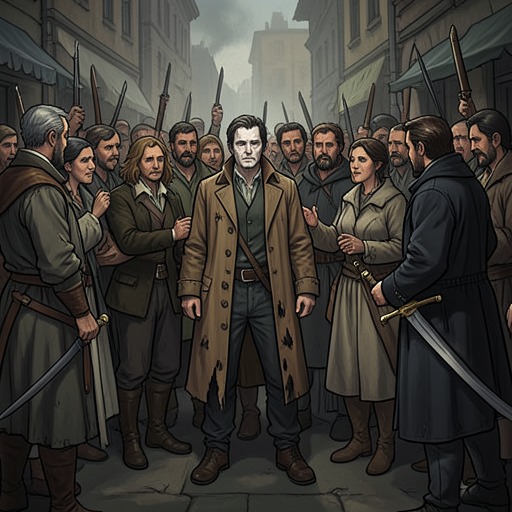
That resolve becomes physical when the assembled people fall upon a building from every side. Furst observes that the floodgate has burst and that the crowd can no longer be restrained. The image marks a change from deliberation to collective action: a carefully stated limit confronts a force that has become difficult to contain. The scene therefore holds two facts together. The uprising is presented as a response to tyranny and a defense of rights, but the gathering’s momentum is not wholly controlled by the language of restraint that preceded it.
Tell’s Distinction Between Defense and Ambition
The clearest personal statement of the distinction occurs when Duke John compares his act with Tell’s and calls attention to revenge upon a foe. Tell rejects the comparison. He asks whether Duke John acted to shield children, protect the home, or avert a final danger from those he loved. These are not abstract justifications: Tell makes the threatened household and the duty of a father the specific circumstances that, in his account, compelled his own deed.
Tell contrasts that necessity with what he calls Duke John’s crime of ambition. He raises his hands to heaven as unpolluted, curses the act and its author, and says that he has avenged a violated principle of human nature. His language asserts more than a difference in outcomes. For Tell, the object and motive of violence matter: protecting those placed in his care is morally unlike acting from ambition, even when both acts involve killing an enemy. The claim is his defense of his own deed, not a general permission to call any personal retaliation self-defense.
His refusal is categorical. Tell declares that he has no part with Duke John and identifies him as a murderer, while claiming that he has shielded what was dearest to him. Duke John answers that Tell has cast him into comfortless despair. The exchange makes moral judgment itself consequential: Tell will not let shared violence create solidarity, and Duke John experiences that rejection as abandonment. The drama leaves the distinction morally forceful but grounded in the particular circumstances Tell names, rather than setting out a complete legal test for every act of violence.
Ethical and Political Significance
Across the political deliberations and Tell’s confrontation, protection is the recurring standard. The empire’s claim to service rests on its guarding those who serve it; the community’s resistance is directed toward recovering rights under tyranny; Tell defends his act by invoking the immediate safety of his family. In each case, obligation is presented as bound to a protective purpose, not as obedience without limit.
The contrast also prevents the drama from treating every act against an enemy as morally equivalent. Collective resistance is framed as necessary but expressly bounded, even as the attacking crowd becomes difficult to restrain. Tell, by contrast, insists on the intimate cause of his own act and refuses Duke John’s appeal to a common category of revenge. The concept’s force lies in that tension: violence may be represented as defense against domination, but its justification depends on the threat, the purpose, and the limits claimed for it.