Wilhelm Tell
William TellWilhelm Tell is presented as both a formidable archer and a father whose resistance to authority is inseparable from the defense of his child. The play moves between the crossbow and the domestic hearth: Tell enters armed, confronts the governor with a conditional promise of lethal retaliation, and eventually returns to a family that has been waiting for him.
Identity and First Appearance
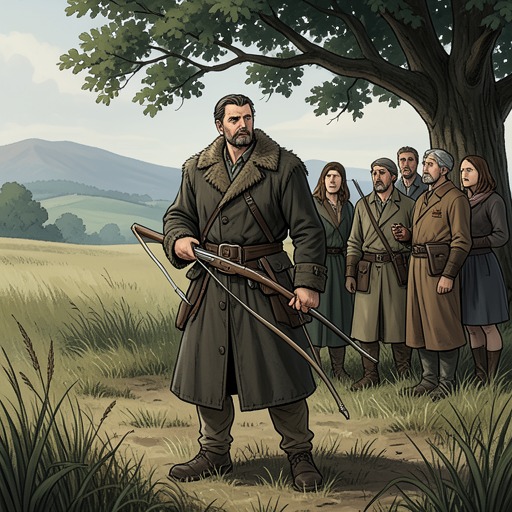
Ruodi identifies Tell as “Tell, brave Tell, of Buerglen” just before Tell enters carrying a crossbow. The brief entrance establishes his reputation before he speaks: he is recognized by name, associated with Bürglen, and marked by the weapon that will define his public presence. The crossbow is not merely a detail of costume; later, a boy notices that it is missing when Tell comes home, making its absence conspicuous against this first image.
The Governor Confrontation
When the governor interprets Tell’s action as evidence of a disaffected spirit, Tell answers with an apology and a distinction: the action arose from inadvertence, he says, not disrespect. His response acknowledges the offense as the governor sees it without accepting that it expressed intentional rebellion. The exchange makes Tell’s position more exact than simple submission or open challenge: he explains the act, but does not concede the governor’s right to define his character by it.
That restraint sharpens into a threat when Tell draws an arrow from his belt and fixes his eyes sternly on the governor. He describes what he would have done if his hand had struck his child: the second arrow would have been aimed at the governor, and he would not have missed. The threat is conditional, but its terms are unequivocal. Tell makes the child’s life the point at which obedience ends and retaliation begins; the archer’s skill, already signaled by his entrance with a crossbow, becomes an explicit warning.
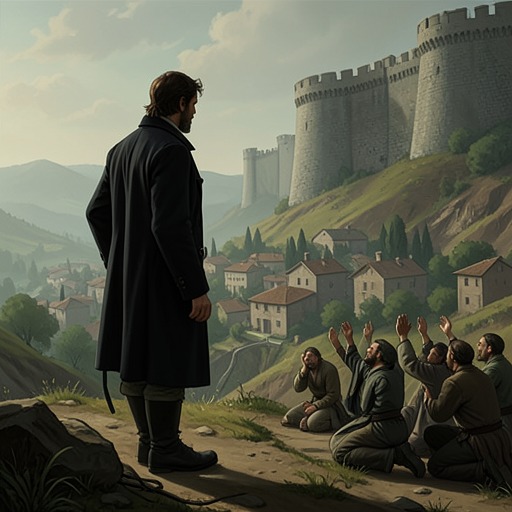
Later, Tell appears above the rocks and says, “Thou knowest the archer, seek no other hand.” He then declares, “Our cottages are free, and innocence”. The placement above the others and the direct identification of himself as the archer link individual action to a wider claim about the cottages. In this moment, Tell does not conceal his identity or leave the deed to an unnamed hand; he presents himself openly, while associating the result with freedom and innocence.
Family and Homecoming
At the cottage, Hedwig tells the boys that their father will come that day. The scene is set inside Tell’s home, with a fire burning on the hearth and the open door revealing the outside. That domestic setting gives the anticipated return a concrete focus: the household is not an abstraction but a place whose ordinary welcome has continued in his absence. The boys respond to the arrival with cries of recognition, and Tell answers that he is with them again and stands once more at his own hearth.
The homecoming also returns the play to the crossbow, now through its absence. One of the boys asks where it has been left, saying that he cannot see it. The question recalls Tell’s armed entrance and the arrow he drew before the governor, but the scene offers no explanation for the missing weapon. Instead, it places the familiar emblem of danger outside the visible domestic reunion: Tell is present with his family, while the instrument associated with his public confrontation is not at hand.
Dramatic Role
These scenes define Tell through contrasts rather than through a continuous account of his private thoughts. In public, he is recognized as an archer, answers an accusation of disloyalty, and makes his capacity for violence unmistakable. At home, he is welcomed as a father whose return restores the family’s immediate joy. The movement from governor to rocks to hearth connects personal protection with the freedom of the cottages, while keeping the consequences of his actions attached to a particular family and a particular home.