“We are not members, we are commodities”
Women Talking“We are not members, we are commodities” is Salome Friesen’s forceful account of women’s position in Molotschna Colony: they sustain the community but are excluded from meaningful control over its rules and their own futures. The expression interrupts a discussion of membership and gives the women’s deliberations a political vocabulary for connecting the assaults, male authority, domestic labor, and the choice of whether to leave.
The Statement and Its Occasion
Greta Loewen is asked whether her beloved horses Ruth and Cheryl are members of Molotschna Colony. Greta answers that they are not, then begins to qualify her reply. Salome cuts in, redirecting the conversation from the status of the horses to the standing of the women themselves. Her declaration does not read like a technical claim about formal membership; it exposes the distance between living within the colony and having a voice in how it is governed.
Salome expands that claim into a description of a hierarchy in which women are expected to serve quietly and obey. She points to boys as young as fourteen being able to give women orders, affect their fates, participate in decisions about excommunication, interpret the Bible, lead worship, and punish them. In her argument, exclusion is not an abstract insult: it is enacted through the ordinary distribution of authority, from religious interpretation to decisions that shape women’s lives.
The passage also carries a translation caveat. A note by August Epp says that the word patriarchy was supplied by the translator in place of Salome’s curse, whose origin is uncertain. The note makes the statement’s form significant: Salome is speaking with anger in her own idiom, while the record renders part of that speech through an explanatory term. The expression about membership and commodities remains legible as a direct challenge to the structure the surrounding speech describes.
Commodification and the Work of the Colony
Salome’s next claim extends the metaphor across generations. She argues that women are used up by the demands placed on them and that attention then turns to their daughters. The point is not simply that women perform service; it is that the community treats their work, bodies, and future roles as resources to be allocated by others. The phrase “commodities” condenses this account of instrumental treatment into a single political charge.
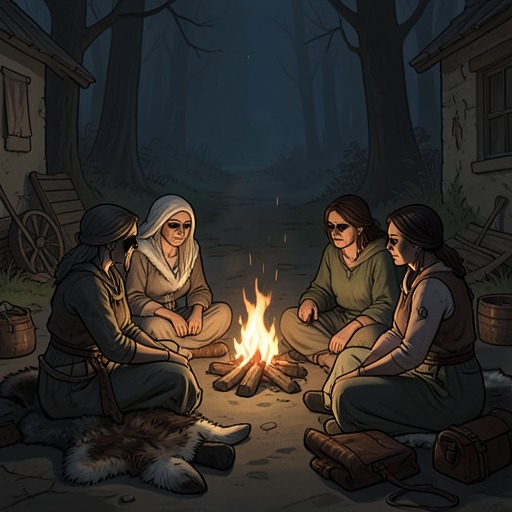
The women’s meeting makes the material basis of that charge visible. Salome proposes bringing spelt bread while Mejal Loewen fetches soup from the summer kitchen, so the discussion can continue over lunch and instant coffee. Later, as the day ends, the cows still need milking and the women are still accounting for the colony’s practical needs. Mariche Loewen offers to feed dogs whose usual caretaker is away so they will not threaten children. These are not incidental interruptions to the political discussion: food, animal care, and child safety are among the tasks that keep the community functioning while its women debate whether they can remain in it.
Agata Friesen addresses the pressure to leave the hayloft and resume milking and supper preparations by saying that women outside the meeting can take care of those duties for now. Her point is that the group’s future requires time to settle its remaining concerns. Ona Friesen objects to treating the future of relationships with beloved boys and men as a last-minute matter. Between these exchanges, domestic labor appears both as a persistent obligation and as something women can temporarily redistribute to make collective deliberation possible.
Assault, Forgiveness, and Unequal Authority
The declaration arises in meetings hastily organized by Agata Friesen and Greta Loewen after years of assaults against women and girls in Molotschna Colony. Many residents had understood the attacks as supernatural punishment for sin; the attackers were eventually identified as eight local men, many related to the women they had assaulted. The women are then given very little time to respond to a decision imposed by the elders and Peters: they are expected to forgive the men if they return, while refusal would mean leaving for an outside world the women have been kept from knowing.
Ona challenges the logic of that demand by connecting forgiveness to the colony’s refusal to provide counseling after the assaults. If the women were unconscious and are denied help in understanding what happened, she asks, the demand that they forgive raises a problem the authorities have not addressed. Her intervention makes knowledge part of the dispute over authority: the women are asked to perform a religious obligation even as their access to explanation and support is restricted.
That conflict also reaches the interpretation of scripture. Salome identifies male interpretation of the Bible, and the way it is handed down to women, as more than a gap in knowledge. Ona states that women’s inability to read or write puts them at a serious disadvantage in negotiating over biblical meaning. The declaration’s challenge to membership thus belongs to a wider challenge over who can speak authoritatively, whose account of the assaults is recognized, and who is allowed to interpret the faith invoked to regulate women’s choices.
From Naming Exclusion to Collective Choice
The women’s ballot lays out three alternatives: Do Nothing, Stay and Fight, or Leave. In considering the second option, Ona asks August Epp to record a heading for Staying and Fighting and a subheading for its pros. The written list turns the women’s disagreement into a process they can examine together, while the declaration gives that process a shared account of what is at stake: remaining in the colony cannot be separated from the question of whether women count as participants in it.
The practical preparations described later give the argument material consequences. August reports obtaining the Co-op Safe, Dynamite, and a World Map. As the women assess a possible attempt to misdirect or stop them, Agata reasons that the Koop brothers may be waiting to alert the men or prevent their departure; a supposed fire to the north could be a way to push the women south, toward the city. Mariche rejects that claim and says they will head north, away from the men. These details show the discussion moving from naming exclusion to coordinating around risks, supplies, and direction.
The expression is therefore more than a rebuke to a single question about membership. It exposes the contradiction of a community dependent on women’s care and work while reserving decision-making, religious interpretation, and the power to define women’s futures for men. In the meetings, naming that contradiction helps make a collective choice possible: the women can assess not only what they owe the colony, but whether its terms allow them to belong as people rather than as resources.