Aaron
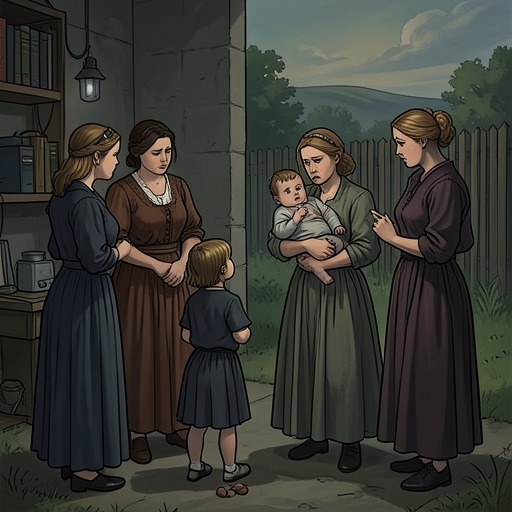
Women TalkingAaron is Salome’s son, an able and affectionate presence among the boys taught by August Epp. His talent for walking the narrow top beam of the yearling paddock fence earns him a handmade trophy; when the women plan to leave Molotschna Colony, his age places him on the wrong side of the boundary between children permitted to go and boys expected to remain with the men.
Identity and Place in the Colony
August describes Aaron as good-natured, graceful, and one of his exceptional students. Aaron is also approaching a decisive change in his life: he will soon leave school for good to help the older men in the fields. His circumstances are shaped by an age threshold. Boys fifteen and older have been counted as full members of the church and are already with the men, while boys twelve and under may accompany the women. Aaron is only just over twelve, but that small difference separates him from the younger boys who can leave with his mother.
Skill, School, and Recognition
Aaron’s distinctive skill is fence walking. He can balance along the three-inch-wide top beam of the fence around the yearling paddock, walking its entire length. August and the boys make a trophy for him from scraps of machinery, wood, and twine. Cornelius, the colony’s skilled pyrographer, inscribes Aaron’s name and title in cursive on its base. The handmade award turns an individual accomplishment into a shared school celebration, fashioned by the boys and their teacher.
Peters confiscates the trophy and warns Aaron, and then the class, about the consequences of vanity and pride. The warning is vague, but includes a threat involving flesh-eating worms. The episode places Aaron’s playful distinction within a school culture where even a child’s public recognition can be treated as a moral danger. August’s account also links the confiscation to his own distress: afterward, he goes into the field behind the school to pray, overwhelmed by thoughts of the classroom and his anger. Aaron does not cause that crisis, but the incident shows how much August’s work and care for his students matter to him.
The Departure and Its Cost
When the women consider leaving, Aaron’s mother, Salome, faces the prospect of going without him. The proposed plan would leave him with the men because he is older than twelve, though only barely. Salome’s anger gives way to tears, and Agata puts an arm around her, recognizing the sadness of leaving Aaron behind. She presents the separation as a temporary spur for Salome and the other grieving mothers to rebuild a better colony for everyone.
Salome challenges the age rule by asking why boys aged thirteen and fourteen should be left to the men, especially if the accused men are released on bail and return to the colony. She fears those boys could be vulnerable in the absence of women and girls. The discussion makes Aaron’s position part of a wider question: whether age alone should determine which children the women can protect by taking them along. Mejal supports Salome’s challenge, and August is asked for his judgment as the boys’ teacher.
Relationships and Significance
August answers that boys of thirteen and fourteen can cause harm, but are still children who can be taught. He describes them as energetic, impulsive, and capable of both tenderness and empathy, and argues that direction, firm love, and patience can help them learn their responsibilities. His view resists treating adolescent boys as either harmless or beyond change. Though the discussion addresses an age group rather than naming Aaron as a particular risk, it frames the educational and moral stakes surrounding boys like him.
Aaron’s place in the story is defined by the tension between the women’s effort to protect children and the departure plan’s age-based limits. He is not simply a reason for Salome’s grief: his school life, his impending move into field work, and his place among the boys force the women to consider who is included in their safety and who is left behind. The evidence does not resolve whether Aaron later joins his mother; it establishes the painful uncertainty of that separation.