Age-Fifteen Baptism and the Threshold of Adulthood
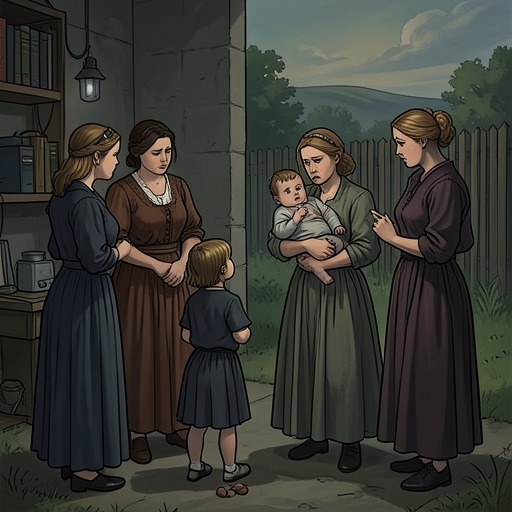
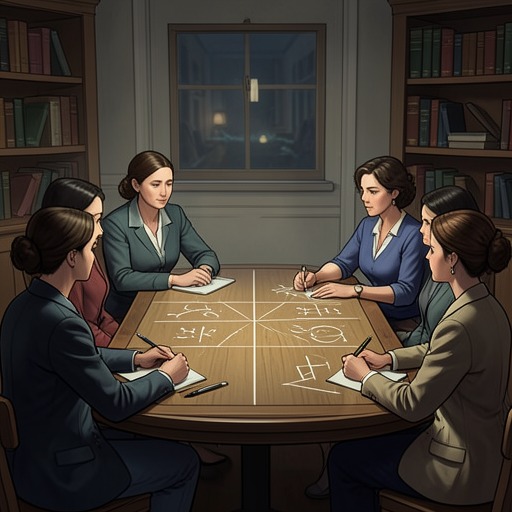
Women TalkingAge-Fifteen Baptism and the Threshold of Adulthood is the rule that places baptism and full church membership at fifteen, a dividing line with immediate consequences for where boys belong and who is responsible for their care. In the women’s debate over leaving the Molotschna Colony, the boundary becomes more than a marker of religious status: it determines which children are already with the men and whether the women will take responsibility for boys still considered children.
The Age Boundary and Its Consequences
Fifteen is the age of baptism and full-fledged membership in the church. Boys who have been baptized are treated as men; at the time of the debate, they are in the city with the older men. Boys under fifteen remain in the colony. The distinction assigns boys to different groups not simply by their age, but by a religious threshold that changes their social status and expected place in the community.
The women’s discussion exposes the unevenness of the boundary. Boys twelve and under may accompany the women, while fifteen-year-olds are already with the men. That leaves thirteen- and fourteen-year-olds in a precarious middle category: no longer among the youngest children, but not yet counted among the baptized men. The women ask why those boys should be left to the men’s care and instruction if the women depart.
The Thirteen- and Fourteen-Year-Olds
Salome Friesen raises the concern that the boys in this intermediate age group could themselves be endangered. If the accused men were released on bail and returned to the colony after the women and girls had left, she asks, might the boys become targets? Mejal Loewen joins the challenge, questioning why the boys should be excluded from the women’s departure and whether fear of boys their age is a sufficient reason to leave them behind.
August Epp answers that boys of thirteen and fourteen can pose a threat, as can anyone, but he does not treat that possibility as proof that they should be abandoned or defined by danger. He describes them as children who may cause harm but can also learn. In his view, their immaturity and capacity for reckless conduct coexist with tenderness and empathy; firm love, patience, and direction might help them relearn their roles. His answer reframes the question from whether the boys are dangerous to whether the community will undertake the work of teaching them.
Faith, Authority, and the Meaning of Protection
The proposed response is argued through religious commitments as well as maternal responsibility. Agata Friesen contends that remaining in the colony would risk drawing the women into violence and conflict with their commitment to Mennonite pacifism. Leaving, she argues, would better allow them to protect themselves and their children while teaching the children values of peace, love, and forgiveness. The debate therefore challenges any simple division between religious obedience and departure: the women consider leaving as a way of living out their faith.
The age rule also sits within a dispute over who has authority to interpret that faith. Salome Friesen points out that the women cannot read the Bible and therefore depend on men’s claims about what it requires, including the claim that wives must submit to their husbands. Her argument does not establish a new scriptural interpretation, but it questions the authority of interpretations that the women cannot independently verify. In that context, the women’s decision about boys under fifteen is also a decision about who may define children’s needs and obligations.
The Proposal and Its Limits
Agata proposes that all boys under fifteen accompany the women. She reasons that those boys, along with Cornelius and Grant, remain in the colony and need special care; the women’s duty to protect their children, she insists, applies to sons as well as daughters. When Ona Friesen describes influencing their sons as revolutionary, Agata calls the responsibility instinctive: the women are their mothers, and the boys are their children. She presents maternal care, collective judgment, and religious conviction as compatible grounds for action.
The proposal is not an unconditional order that every boy must leave. Agata says boys who refuse may stay in the colony with the Do Nothing women and their fathers, who are expected to return. Nor does the proposal guarantee that every child will be able to accompany the group. Cornelius ultimately remains behind because his mother belongs to the Do Nothing camp and he has no choice but to stay with her. His case makes the limits of the women’s protective plan concrete: a proposed rule can include boys under fifteen in principle while circumstances still separate an individual child from the departing group.
Significance
The fifteen-year threshold initially sorts boys into a male community and a younger group left in the colony; the women’s debate tests whether that inherited distinction can answer the immediate question of safety. By proposing to take all boys below fifteen, Agata recasts the boundary as a responsibility rather than merely a classification. The discussion neither abolishes the baptismal threshold nor shows that the plan succeeds for every child. Instead, it reveals how the women negotiate the gap between religious status, practical vulnerability, and their claimed duty to care for children.