Autje Loewen
Women TalkingAutje Loewen is Mariche Loewen’s daughter and one of the younger women present at the meetings in the hayloft. She is also Greta Loewen’s granddaughter: Mariche is Greta’s eldest daughter. Autje’s place in the gathering is therefore familial as well as generational. She takes part alongside her mother and other adults while bringing the concerns and irreverence of the younger women into a debate about whether to stay in Molotschna Colony or leave. Often seen with Neitje Friesen, she is part of a younger circle whose presence interrupts the proceedings but also helps push their questions forward.
A young participant in the meetings
Autje is present in meetings recorded by August Epp, who has been asked by Ona Friesen to translate and write down what the women say. The women speak Plautdietsch, a language August renders into English for the minutes; because they are illiterate, the written record is made by someone outside their speaking group. Autje’s participation thus takes place within a discussion whose record she cannot read for herself. She is not simply an observer of the adults’ deliberations: she contributes questions and proposals, and Salome Friesen argues that Autje and Neitje should remain in the meeting precisely because they have raised important questions about boys and men.
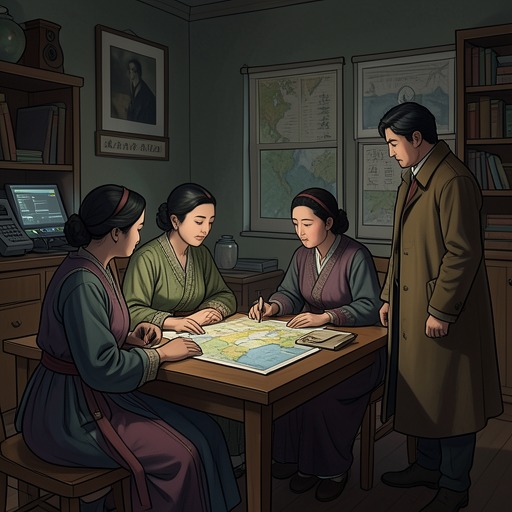
The women’s arrangement of the meeting makes room for practical needs as well as deliberation. They gather in the hayloft rather than in a kitchen, where children would be underfoot, and the makeshift table is plywood laid across hay bales, with milking buckets for chairs. Autje and Neitje sometimes sit on the window ledge or on saddles taken from Earnest Thiessen’s tack room. The setting is a working farm space, but it becomes a place where younger women can enter a collective argument over their lives.
Play, risk, and defiance
Autje’s play repeatedly unsettles the meeting’s formal purpose. During a discussion, she swings from a rafter, kicking at hay bales and loosening straw. Mejal Loewen looks up and warns her about the creaking rafter and the possibility of the roof giving way. The episode draws attention away from the adults’ exchange, but it also establishes Autje’s ease with the loft and her willingness to turn its structures into part of her play.
On another afternoon, as Greta and Agata Friesen say that the women must decide whether to stay or leave, Autje and Neitje return with a stunt prepared in secret. They have placed a flatbed wagon stacked with bales beneath the window. Autje performs despair, runs to the window, and throws herself out headfirst; the alarmed women hurry over and find her sitting calmly on the bales. Ona laughs at the performance, while the others try not to show approval. The apparent crisis resolves into a staged joke, reversing the meeting’s moment of tension. Autje’s theatricality does not settle the women’s decision, but it gives the gathering a brief release from its urgent seriousness.
Questions about boys and education
Autje’s contributions are not limited to jokes. When the women consider which boys might accompany them if they leave, the distinction between age groups becomes a question of safety, responsibility, and who is entitled to protection. Boys aged fifteen and older are already in the city with the men; boys twelve and younger may join the women. Salome questions why boys of thirteen and fourteen should be left behind, particularly if the accused men return and the girls and women are no longer there. Mejal supports raising the question rather than treating the boys’ age as a reason to exclude them automatically.
August answers that boys of thirteen and fourteen can pose risks, but also emphasizes that they are children who can be taught. He imagines firm love, patience, and direction helping them relearn their roles. In a later discussion about what he would do if the women left and there were no children for him to teach, Neitje suggests that older boys might continue attending classes. Autje slyly adds that several could benefit from remedial teaching. Neitje then points to the older boys’ immature conduct toward girls. Autje’s proposal gives the discussion a practical, wry turn: the boys who remain would still need education, and their membership in the church would not mean that their learning was complete.
Family, departure, and the record left behind
Autje’s participation is shaped by the women’s differing circumstances. Ona is pregnant, and the elders have decided that her unborn child will be raised by another colony family. When Ona proposes writing the pros and cons of the women’s options on large cheese-packaging paper, she explains that the women cannot read the list but may preserve it as an artifact for others to find. Autje and Neitje exchange puzzled glances at the proposal. Their reaction registers the distance between Ona’s idea of a future reader and the young women’s immediate uncertainty about what she means; the paper is at once a practical record and an unfamiliar claim that the meeting’s words might matter beyond the present.
That tension between immediate decisions and possible futures returns when Agata speaks of rebuilding a better colony after the women leave. Greta asks whether Cornelius, who uses a wheelchair, is ready to go. Melvin explains that he will stay because his mother belongs to the Do Nothing group and he has no choice. Autje and Neitje frown and moan at the news. The young people of Molotschna are fond of Cornelius for his jokes, comedy, and creativity, and Agata reassures them that he and his mother might yet change their minds and join the women elsewhere. Mariche rejects that hope, warning that once the men return no women will be permitted to leave. Autje’s reaction gives the prospect of departure a personal cost: even a necessary collective choice threatens to divide the young people from someone they value.
The surviving scenes show Autje moving between mischief and serious participation rather than assigning her a single role as comic relief. Her pranks briefly remake the emotional atmosphere of the hayloft; her contribution to the discussion of education recognizes that the boys who remain will still require care and instruction; and her response to Cornelius’s absence makes visible the friendships placed at risk by the decision. When August finally runs back for his notebooks and minutes, intending that they be given to Ona, Salome points out that Ona cannot read them. The written record therefore preserves the meetings through a literate intermediary, while Autje’s actions and comments survive as part of a conversation whose participants cannot themselves consult its pages.