Butterflies
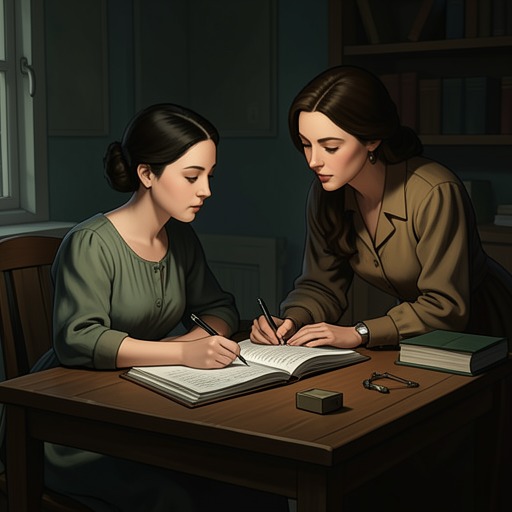
Women TalkingButterflies enter the women’s story as more than a detail of the natural world: their long migrations give Ona Friesen and August Epp a way to consider journeys whose destinations may lie beyond the travelers’ own lives. Their conversation about the Comma butterfly then turns that image into a small inquiry about interpretation. Ona imagines a name shaped by the creature’s movement; August supplies the ordinary factual explanation. The exchange holds both the attraction of metaphor and the value of correction.
Migration and Delayed Arrival
Ona introduces the scale of butterfly migration by observing that the journey can take so long that the butterflies arriving at the intended destination may be the travelers’ grandchildren. The detail makes migration an intergenerational passage rather than a single creature’s completed trip. Arrival remains possible, but the distance in time separates the destination from the individual that first set out toward it.
Butterflies appear alongside dragonflies in this observation. Both are associated with a migration period long enough to complicate the usual idea of a journey as one traveler’s movement from departure to arrival. Ona’s example gives the journey a duration that exceeds an individual life: the intended destination is reached through continuation across generations. The emphasis falls not on a map or a described landscape, but on the difference between setting out and finally arriving.
That distinction gives the image particular resonance in a narrative concerned with women weighing departure and an unfamiliar future. The butterfly observation does not prescribe a decision or promise a safe destination. Instead, it makes room for a more difficult measure of movement: a journey can matter even when the traveler cannot personally witness its completion. Its destination may belong to those who come after.
The Comma Butterfly
August Epp introduces a butterfly called the Comma. Before he can explain the name, Ona offers her own account: she imagines the butterfly flitting among leaves, stems, and petals, pausing briefly as it goes, so that its journey itself seems like a comma—continuous movement interrupted only by short rests. Her interpretation treats punctuation as a figure for travel: a pause is not necessarily an ending, but part of a passage that continues.
August clarifies that this is not the reason for the name. The Comma is named for a comma-shaped mark on the underside of its wing. The correction is modest but definite: the name comes from a visible feature of the butterfly, not from the imagined rhythm of its flight. The exchange therefore keeps two kinds of attention in view, one grounded in the animal’s markings and the other in the meanings its movement can suggest.
A Pause That Becomes an Idea
Ona’s proposed explanation is factually mistaken, but August’s correction does not simply close down the association she has made. He reflects that texts and journeys contain periods as well as pauses and stoppages. The discussion moves from a particular mark beneath a wing to punctuation more broadly, where a sign can suggest a break in a larger sequence.
The contrast gives the conversation its shape. Ona supplies an imaginative explanation that follows the butterfly’s movement; August distinguishes that interpretation from the factual origin of the name, then considers how pauses operate in writing and travel. The factual answer and the interpretive possibility remain distinct. The Comma does not bear its name because it pauses on its journey, yet the pause continues to offer a way of thinking about journeys and texts.
Significance
The butterfly conversation brings natural history into a shared act of thinking. Ona notices the scale of migration and invents a lyrical account of the Comma’s name; August contributes the correction and extends the discussion to periods within texts and journeys. Their exchange does not require the metaphor to be literally true in order to be meaningful. Instead, it distinguishes what can be verified about a butterfly from what its movement allows the speakers to imagine.
Across these details, butterflies hold together continuation and interruption. Migration stretches arrival across generations, while the Comma’s name begins with a mark on a wing and leads the conversation toward pauses within ongoing journeys. The image is neither a promise that every journey will reach its destination nor a claim that a pause has no cost. It offers a precise, limited figure for movement: a journey can contain stoppage without being reducible to its end, and what reaches the destination may be the continuation of an earlier traveler’s passage.