Facts as gifts, currency and Eucharist
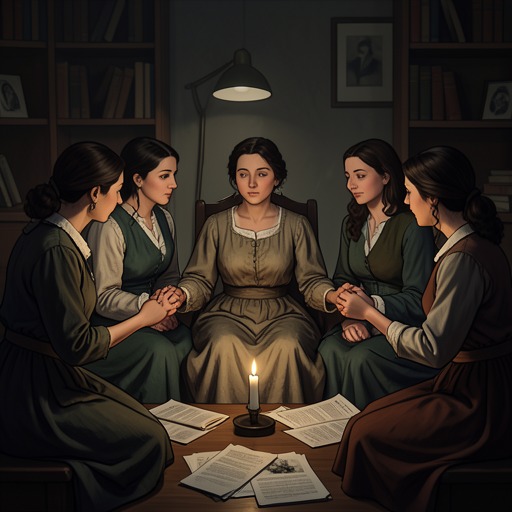
Women TalkingFacts as gifts, currency and Eucharist is August Epp’s image for knowledge in Molotschna Colony, where facts are both coveted and kept from women who cannot read. The image joins Ona Friesen’s appetite for precision with the making of the meeting minutes: a record that preserves the women’s speech, yet also exposes the limits and mediation involved in preserving it.
Facts in a Restricted World
August describes facts as taking on the quality of dreams for people in Molotschna, because the world in which facts exist is treated as a world the community does not belong to, or cannot belong to. Knowledge that is excluded therefore acquires unusual force. He figures facts as gifts and as samizdat, currency passed through restricted channels, and finally as Eucharist: forbidden yet sustaining. These are not interchangeable images. A gift suggests something offered; currency suggests something circulated and valued; the Eucharist makes knowledge a source of shared nourishment.
Ona embodies the attraction of exact knowledge. August remembers her love of facts and of precision, including the detail that dragonflies have six legs but cannot walk. In his account, such information can seem wondrous precisely because it is factual and because access to facts is constrained. He places this ordinary observation beside a scientific account of cells from male fetuses later found in the hearts of women who had given birth to sons. The passage presents that account as something August invokes, joining verifiable-seeming knowledge to the wonder and unease that facts can provoke; it does not turn the claim into an event in the women’s story.
Translation and the Making of a Record
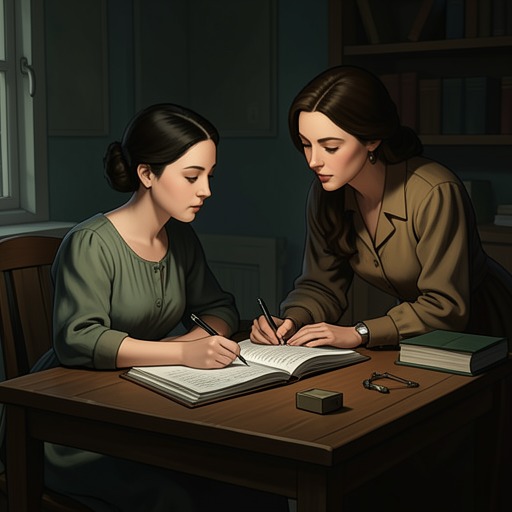
The minutes give the metaphor a practical setting. August is appointed to record the women’s meetings because the women are illiterate. Ona asks him to create a document about them, and he explains that their speech in Plautdietsch, the language spoken by members of Molotschna Colony, must first be translated quickly in his mind into English before he can write it down. He describes Plautdietsch as an unwritten, moribund language. The minutes are therefore not a transparent written transcript: they depend on August’s translation and on his position as the literate recorder.
The difference between speech and document remains visible in the women’s handling of the record. Ona gives August brown packaging paper taken from the summer kitchen and proposes that he write the options’ pros and cons on a large sheet. The women will not be able to read what he writes, she acknowledges, but the sheet can remain in the hayloft as an artifact for others to discover. Written knowledge is at once inaccessible to its immediate speakers and deliberately preserved for an unknown future reader.
The Record as Gift and Artifact
That tension returns when August rushes to gather his notebooks and the minutes and asks Salome Friesen to give them to Ona. Salome points out that Ona cannot read them and questions what use she could make of them. The exchange makes the record’s value more complex than its practical readability: August still wants it placed in Ona’s hands, while Salome draws attention to the gap between preserving her words and giving her direct access to what has been written about them.
Across these moments, facts move through distinct forms: spoken Plautdietsch, August’s mental translation, written English, and the physical paper kept for discovery. The expression’s religious and economic metaphors give that movement weight. Knowledge is precious not because it is beyond verification, but because it is denied, translated, carried, and saved. The minutes become one such material trace, holding the possibility that the women’s words may reach beyond the meeting even when the women themselves cannot read the page.