For the Beauty of the Earth
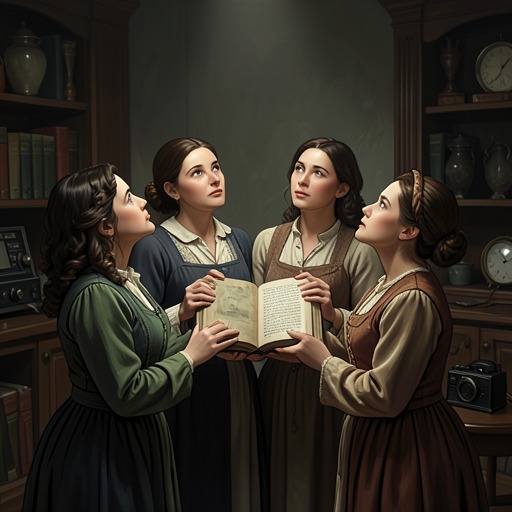
Women TalkingFor the Beauty of the Earth is the hymn the women sing together in Earnest Thiessen’s hayloft, where its praise of the natural world and human bonds meets the immediate possibility of separation. Agata Friesen begins the song; the women join her in voices that differ by age and feeling. August Epp understands the occasion as perhaps the last time he will hear Ona Friesen sing. The hymn therefore becomes more than a shared devotional act: its words about family and fellowship sound within a gathering whose members are preparing for loss and change.
The song in the hayloft
The women sing in Earnest Thiessen’s hayloft, a place set between earth and sky in August Epp’s account. That position gives the scene a quiet symbolic openness: the singers remain in a familiar, enclosed meeting place, while the song looks outward to the earth and skies it praises. August describes this as perhaps his last opportunity to hear Ona Friesen sing, so the hymn is marked by an ending even as the group performs it together.
The singing follows an intimate gesture of connection. Agata Friesen takes August’s hand after letting go of Greta Loewen’s; August puts down his pen and takes Greta’s hand, careful not to press her swollen knuckles. The joined hands make the song part of a shared act of attention, rather than a performance set apart from the women’s circumstances. The hymn’s communal form is echoed by the people physically linking themselves as they sing.
Different voices, one hymn
Agata begins, and everyone joins in, but the group does not respond uniformly. The two older women sing with gusto. The two youngest, by contrast, mumble with mortification, while those between them sing with resignation, though artfully. These distinctions preserve the women’s different ages and responses inside a single collective act. Their voices converge without erasing their differences.
That mixture matters to the scene’s sense of fellowship. The hymn is not presented as proof that the women feel alike, or that singing dissolves their unease. Some participate exuberantly, some self-consciously, and some with a controlled reluctance. Yet they sing the same words in the same place. The communal force of the moment lies in that combination: a shared song made from unlike voices, at a time when their lives are moving toward separation.
Earth, kinship, and the words of the hymn
The opening verse names the beauty of the earth and skies, then turns from landscape to praise: “For the beauty of the earth,” “For the beauty of the skies,” and “For the Love which from our birth.” The movement from the world around the singers to love that accompanies human life gives the hymn its widening shape. Its language holds natural beauty and human attachment together rather than treating them as separate subjects.
Later, the words make that human attachment concrete: “For the joy of human love,” followed by “Brother, sister, parent, child,” and “Friends on earth, and friends above.” This naming of family and friendship has particular weight in the surrounding discussions. Salome Friesen is grieving the prospect of leaving her son Aaron behind for the time being; Agata comforts her, and Mejal Loewen crosses the plywood table to embrace her. Ona Friesen, meanwhile, is pregnant, and the colony’s elders have determined that her unborn child will be raised by another family. The hymn does not resolve these separations. Instead, its celebration of parent and child makes the distance between its ideal of human love and the women’s circumstances unmistakable.
A song at the threshold of departure
The moment is both collective and precarious. August’s expectation that he may not hear Ona sing again places the hymn at the threshold of departure, while the singers’ joined hands and shared verses give the gathering a present-tense form of companionship. Its meaning comes from that contrast: the women can affirm love and fellowship together, even as the surrounding decisions threaten to divide families and end their life in the colony as they know it.
For the Beauty of the Earth thus gathers several strands of the scene without concealing their tensions. The earth and skies provide the hymn’s wide frame; its words turn that frame toward human love; and the singers’ varied voices and linked hands make the abstract language communal. Because the song is sung in what may be the last such moment with Ona, its praise carries the weight of farewell. The hymn offers no promise that the women will remain together, but it gives their temporary togetherness a clear and memorable expression.