Forgiveness Entrusted to God Alone
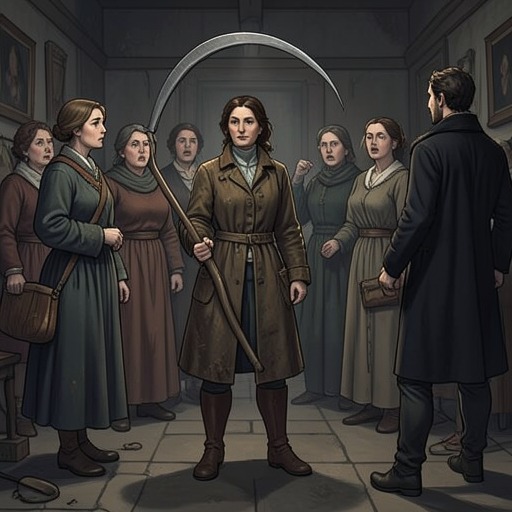
Women TalkingForgiveness Entrusted to God Alone names a disputed idea developed during the women’s meetings in Molotschna Colony: forgiveness for certain profound harms may be entrusted to God rather than demanded from the person harmed. Ona Friesen raises the possibility especially in relation to violence against a child, which a parent may find impossible to forgive. The proposal challenges the colony’s expectation that women forgive on command, while the debate around it tests whether compassion, religious commitment, and refusal of further harm can coexist.
Origin in the debate over forgiveness
The proposal arises as the women consider whether staying behind to fight would expose them to further conflict and to religious penalties. Mariche Loewen argues that resistance would fail, violate their vow of pacifism, and deepen their vulnerability; she also warns that the women would still be expected to forgive the men if they wanted God’s forgiveness. Ona questions whether forgiveness imposed under those conditions could be genuine. She distinguishes spoken compliance from forgiveness felt inwardly and suggests that violence against a child may be so difficult for a parent to forgive that God, in divine wisdom, could assume that responsibility alone.
Salome Friesen presses the emotional consequence of Ona’s suggestion: whether a parent might be permitted to retain a very small amount of hatred in order to survive. Mejal Loewen objects that even a small seed of hatred may grow, while Salome maintains that a limited measure of hatred can be necessary to life. The exchange does not settle the question. Instead, it exposes a tension between protecting the injured person’s capacity to endure and fearing that hatred will expand into a force of its own.
Compulsion, ignorance, and authority
Ona later returns to forgiveness through the question of counseling. The elders and the bishop of Molotschna have decided that women do not require counseling after the attacks because they were unconscious when they occurred. Ona asks what the women are then required, or even able, to forgive if they cannot understand what happened to them. She extends the difficulty beyond the attacks: ignorance cannot make a person free merely because that person does not know the world or recognize confinement. In this argument, the demand to forgive is inseparable from who is allowed to name harm and determine what the women know about it.
Mariche describes Ona’s proposal as a new system of forgiveness in which men could not force women to forgive, expel them for refusing, or threaten them with God’s refusal to forgive. She recalls that Ona has placed harm to children in a category reserved for God and challenges the authority involved in creating such a category. Ona quietly denies that she believes in authority at all, arguing that authority makes people cruel. Their disagreement shows that the proposal is not accepted as an uncontested doctrine: even among the women, its meaning and the right to define it remain under debate.
That dispute takes place within unequal access to religious knowledge. Salome argues that the women cannot know whether leaving disobeys the Bible because they have not been taught to read it, and that their obligation to submit to husbands is presented to them through their husbands’ claims about scripture. She identifies the male interpretation of the Bible, handed down to women, as a deeper problem than gaps in knowledge alone. Ona agrees that the inability to read or write places women at a disadvantage when negotiating biblical interpretation. The proposed freedom from coerced forgiveness therefore belongs to a larger contest over who interprets religious duty and whose account of harm carries authority.
Forgiveness at a distance
Ona insists that forgiveness is meaningful only when heartfelt. The women’s responsibility, as she describes it, is to protect their God-given souls; they may need to reach forgiveness themselves whether or not Peters or anyone else expects it, whether or not the men ask, and even if the men maintain their innocence until death. Ona says that understanding how the crimes could have occurred might make forgiveness possible and that, from a distance, she can almost pity and love the men. Her account makes distance important: forgiveness need not mean remaining physically close to those who caused harm.
Agata Friesen takes up that distinction and turns it toward the decision to leave. From a distance, she argues, forgiveness, compassion, and love may become possible alongside adherence to Mennonite faith. She calls that distance a new perspective and presents leaving as a duty rather than a renunciation of belief. Ona describes the choice as moving on rather than fighting; Mariche remains troubled by the argument and tells her to return to the discussion. The proposal thus helps the women imagine separation not as proof that they have rejected forgiveness, but as a condition in which it might become voluntary rather than coerced.
Faith, nonviolence, and the children
Agata grounds the decision in pacifism. She reasons that staying would place the women in direct conflict with violence, whether they became perpetrators or targets, and could turn the colony into a battlefield. Leaving, by contrast, could help them uphold pacifism, love, and forgiveness without making a show of compliance that they do not feel. She also argues that departure would protect the women and their children and teach the children to value those commitments beyond their fathers’ expectations. Forgiveness entrusted to God is therefore linked to a practical choice about safety, not only to a private spiritual state.
The argument reaches beyond the parents’ immediate decision. Agata describes the women’s collective resolve to influence their sons as both maternal instinct and considered judgment, joining their instincts with intellect and their understanding of the soul. The women also consider what will happen to boys who do not leave, with Agata saying that the Do Nothing women and the boys’ fathers can care for them. These plans place the forgiveness debate within a broader effort to protect children and shape what they learn about faith and peace.
The concept remains deliberately unresolved between two risks: that compelled forgiveness will reproduce the power that harmed the women, and that retained hatred may become destructive. Its force lies in refusing to treat forgiveness as a duty that authorities can extract as the price of belonging. By separating the possibility of inward compassion from enforced proximity and submission, Ona’s proposal allows the women to consider leaving as consistent with faith, nonviolence, and care for their children.