Freedom to Think
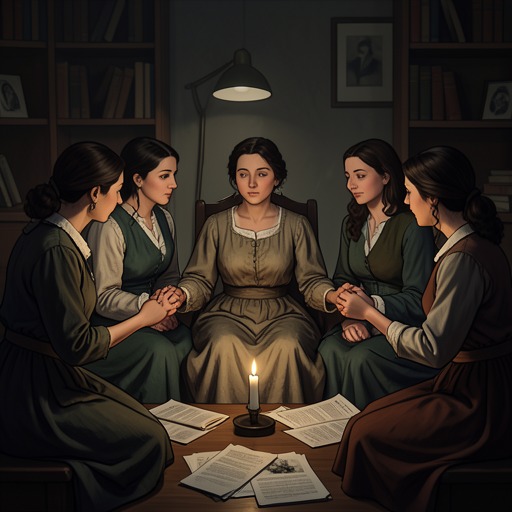
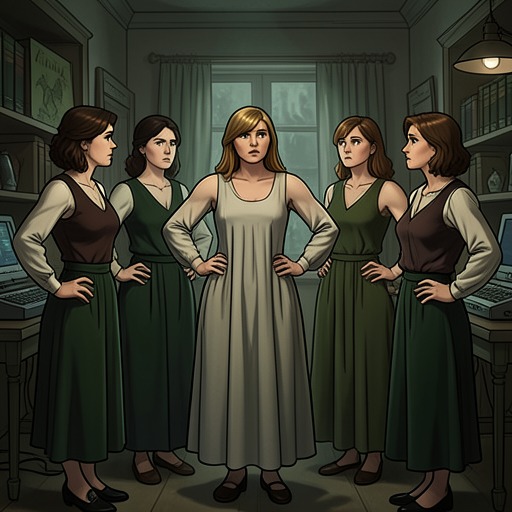
Women TalkingFreedom to Think is the women’s demand for independent judgment in a community where their access to literacy, religious interpretation, and authority over their own lives is restricted. It becomes more than an abstract ideal: in the women’s meeting, it gives them a way to question the explanations imposed on them, debate what faith requires, and plan a departure whose destination they cannot know.
A Demand Within the Women’s Three-Part Aim
Mariche Loewen gives the demand its clearest formulation while crying and struggling to speak: the women want their children to be safe, to remain steadfast in their faith, and to think. The three aims belong together. Thinking is not presented as a rejection of faith or family responsibility; it is a condition for deciding how to serve both. Agata Friesen responds with approval, and the older women celebrate the formulation, while Salome Friesen and Mejal Loewen smile.
The urgency of that claim is sharpened by the conditions surrounding the meeting. The attacks on women in Molotschna Colony had initially been attributed to supernatural causes, but the perpetrators were discovered to be men from the colony, including relatives of their victims. Peters and the elders then imposed a two-day period for the women to organize a response: if they did not forgive the accused men, they would have to leave. Under that ultimatum, the ability to assess what had happened and what the proposed forgiveness meant becomes inseparable from the ability to choose.
Who May Interpret and Know
Ona Friesen questions the elders’ reasoning that counseling is unnecessary because the women were unconscious during the attacks. She asks what they can be required to forgive if they are told the event did not happen to their conscious selves or that they cannot understand it. She extends the problem beyond the attacks: if women do not know the world, does that make them free from its influence, or does it prevent them from recognizing their confinement? Her argument exposes ignorance not as protection but as a condition that can conceal the limits placed on a person’s freedom.
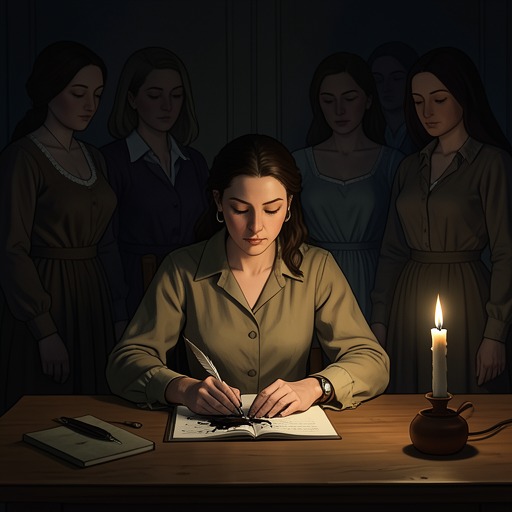
The women’s restricted literacy also shapes who can claim religious authority. Salome Friesen points out that women cannot read the Bible for themselves and that their supposed duty to submit to their husbands rests on what their husbands tell them the Bible says. She identifies the male interpretation of scripture, passed down to the women, as more than a gap in their knowledge. Ona agrees that being unable to read or write puts women at a disadvantage whenever biblical interpretation is disputed. The issue is therefore not only what the text contains, but who is permitted to read, explain, and apply it.
That restriction has consequences beyond religious debate. Salome describes a colony where men and even fourteen-year-old boys can direct women’s lives, interpret scripture, and participate in decisions about excommunication, while women remain silent. Her account presents dependence on male interpretation as part of a broader social arrangement that treats women as subordinate rather than as members with an equal voice. Freedom to Think challenges that arrangement by insisting that women’s own reasoning and experience count.
Reasoning Through Faith and Departure
The women do not reach their decision by setting faith aside. Agata argues that pacifism is central to the Mennonite faith and that remaining in Molotschna would expose the women to a direct collision with violence, whether inflicted on them or committed by them. Ona and Agata then connect religious duty to the protection of women and children and to sincere, rather than coerced, forgiveness. In their account, leaving offers a better chance of practicing pacifism, love, and forgiveness, while teaching children to hold those values even when their fathers expect otherwise.
The argument makes independent thought consequential: it allows the women to distinguish the faith they profess from the terms imposed by male authority. Their decision is not simply a choice between staying and leaving. It is an effort to decide which course best accords with their understanding of faith, safety, and responsibility. Salome Friesen says there are no disadvantages to leaving, while the women’s discussion acknowledges that they do not know where they will hide or what they will encounter. Ona answers that thinking includes considering what is unknown; the absence of certainty is not a reason to surrender the effort to judge.
From Thought to Collective Action
The women’s reasoning becomes practical when Agata asks whether they agree to leave after dark, so they can pass the Chortiza Colony and Hiakjeke Colony without being seen. The women nod. Their agreement does not resolve every uncertainty: Greta Loewen asks where they will hide with their teams, livestock, children, and other dependents, and Agata says they cannot know the answers in advance. Instead of treating uncertainty as a disqualification, the group continues organizing around what it can determine.
That work includes deciding what to take and preparing transport. Ona identifies animals and teams as provisions for the journey, and the women’s plans include Ruth and Cheryl. The narrator reports wrapping a map around a large block of cheese and covering it in brown paper, placing the Co-op Safe beneath the back seat of Greta Loewen’s buggy, and packing onions, soap, and pieces of wood for muddy wheels or kindling. The World Map and the practical supplies turn deliberation into movement: freedom to think is expressed not only in arguments about scripture but in the collective work of preparing to leave.
The concept remains tied to an unresolved future. The women cannot yet know where the journey will take them or whom they will meet, but they claim the right to think about those possibilities rather than accept another person’s account of what they must believe. In the meeting, that right becomes a form of collective agency: the women interpret their circumstances, reason from their faith and experience, and act on a decision they have made together.