Hiakjeke Colony
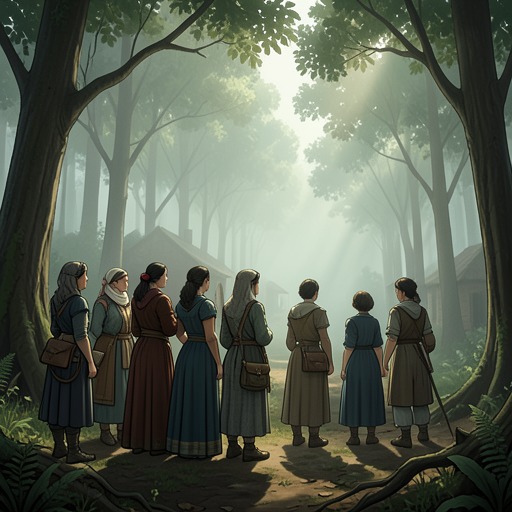
Women TalkingHiakjeke Colony is a neighboring settlement mentioned in connection with marriage prospects and the route the women plan to take when leaving Molotschna. It remains offstage, but its position matters: the women expect to pass near it, and the possibility of being seen there helps determine their timing and direction.
Position and Name
A translator’s note identifies Hiakjeke as a colony north of Chortiza Colony. The name is explained as meaning “Here, look,” supposedly an answer to the question of where the speakers are. In the women’s discussion of the surrounding settlements, Salome Friesen places Hiakjeke east of Molotschna, with Chortiza Colony to the west. These references give the colony a place in the region’s geography without depicting its people or daily life.
Marriage and the Future of the Boys
Agata Friesen raises Hiakjeke as one possible source of marriage partners for boys who remain behind. Young men in Molotschna often marry at sixteen, she observes, and boys who stay may eventually marry girls from Chortiza Colony or communities beyond it, including Hiakjeke. That prospect is part of the women’s concern that departure could divide families and shape the boys’ futures: those who remain may become rooted through marriage and be less willing to leave later.
The Departure Route
As the women settle on leaving after dark, they want to avoid being seen while passing Chortiza Colony and Hiakjeke. Salome Friesen treats the neighboring men’s possible interest in the women as a reason for caution, not as a welcome connection. She points out that the city lies south, Chortiza Colony west, and Hiakjeke east, then proposes going north instead. Hiakjeke thus helps turn the escape plan into a question of route and visibility: the women are not simply choosing a destination but trying to move without drawing attention from nearby communities.